🏦 Wells Fargo's AI assistant hits 1 billion customer interactions
Wells Fargo's AI assistant, Fargo, has handled more than 1 billion customer interactions in under three years, answering account and banking questions without a phone call or branch visit. Adoption has climbed every quarter since launch, with no signs of plateauing.
🧪 DBS Bank cuts software testing time by 20x
DBS Bank, Singapore's largest bank, now runs 430 AI use cases in production, including software testing that used to take 20 person-days and now takes one. The bank credits AI and data initiatives with more than a billion dollars in economic value last year.
🛒 Morrisons deploys AI to catch missed scans in 200 stores
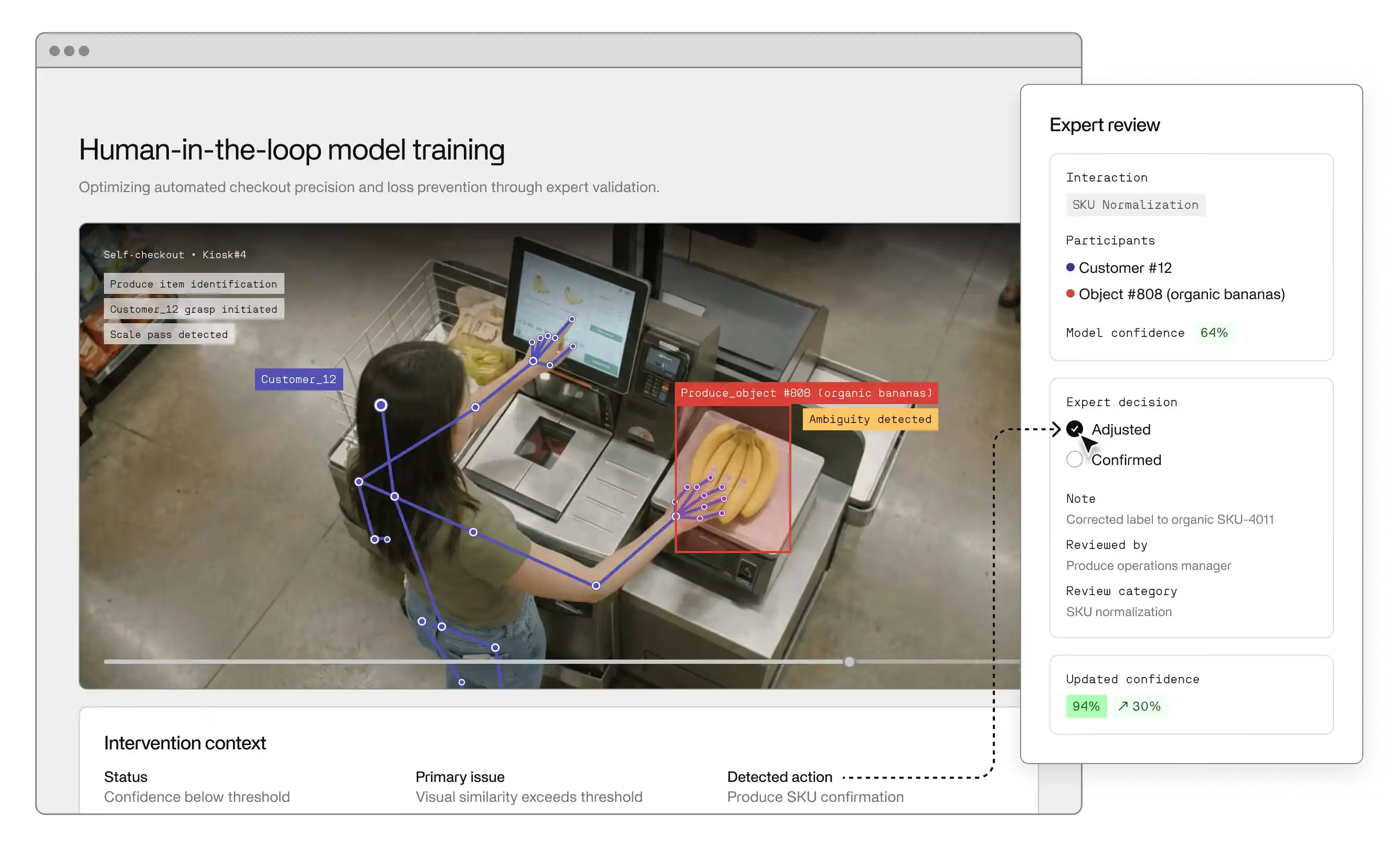
Morrisons, a major UK supermarket chain, has rolled out Everseen's computer vision platform across 200 UK stores to catch missed scans at self-checkout in real time. The system flags discrepancies as they happen instead of relying on staff spot-checks after the fact. A successful trial preceded the chain-wide rollout.
Learn more: Morrisons' setup is a live example of what Invisible's Computer vision solution does at scale, converting motion into structured, real-time insight for retail, safety, and infrastructure use cases.
🎨 Michaels' AI shopping assistant logs 75,000 conversations
Michaels, the craft retail chain, has logged nearly 75,000 conversations through its "Ask Mike" AI shopping assistant since launch. More than 60% of those conversations involve product discovery: shoppers hunting for a specific item or a fix for a craft project. That is a volume of questions no human staff could handle around the clock.
🩺 Oxford PT recovers $250,000 in revenue with AI
Oxford PT, an 11-location physical therapy practice group, says an AI documentation and billing platform helped it recover more than $250,000 in revenue and cut its claim denial rate to 0.5%. The system flags billing errors before a claim goes out, instead of after it bounces back. Both figures come from the company's own reporting.
🎯 Suraj Srinivasan: AI's payoff goes to adopters, not inventors
Companies that adopt AI are capturing as much economic value as the labs that build it, according to an analysis of 1.8 million patents by Harvard Business School's Suraj Srinivasan. The finding cuts against the assumption that AI's biggest financial rewards flow upstream to model builders. Adoption, not invention, is where the returns increasingly land.
💰 Lukas Althoff: AI could raise lifetime earnings for lower-skilled workers
AI exposure could raise lifetime earnings by 15 to 45% for lower-skilled workers, according to research from Stanford economist Lukas Althoff. The gains concentrate among workers who use AI tools directly in jobs that used to cap out at a lower ceiling. The data suggests AI narrows income gaps tied to skill level.
📈 Aleh Tsyvinski: markets are pricing who wins from AI
Financial markets are already rewarding AI-exposed companies with measurable excess returns, about 0.64% a week beyond what the broader market would predict, according to Yale economist Aleh Tsyvinski's analysis of 380 trillion AI tokens. The premium holds even after controlling for sector and company size, across industries far beyond the usual tech favorites.
🤝 Andrew Shipilov: big companies buy into AI through startups
Eighty percent of large corporations now say startup collaboration is critical to their AI strategy, up from 67% in 2023, according to INSEAD research led by Andrew Shipilov and Nathan Furr. Companies with a dedicated open-innovation function post a 73% success rate on AI initiatives, versus 51% without one.
📥 Qwen passes 3 billion downloads, more than Google and Meta
Alibaba's Qwen open model family has passed 3 billion downloads, more than Google's and Meta's open models combined, per a Hugging Face report on global open-weight adoption. Qwen now spans more than 460 openly released models and over 300,000 community-built derivatives, most from developers outside Alibaba itself.
⚡ OpenAI's Ultrafast mode runs GPT-5.6 Sol 14x faster
OpenAI's new Ultrafast mode runs its GPT-5.6 Sol model at 750 output tokens per second, about 14 times faster than standard processing. The speed boost runs on Cerebras chips instead of OpenAI's usual infrastructure. It is currently limited to a small group of preview customers, with no public pricing yet.
💸 Gemini 3.7 Flash: 50% cheaper for coding and agents
Google has cut prices on Gemini 3.7 Flash by roughly 50%, positioning it as the default choice for coding and agent workloads. Input tokens now run about $0.75 per million, down from $1.50. The cut is introductory, so enterprises locking in workflows around it should confirm current pricing before committing at scale.
🤖 Grok 4.6 matches GPT-5.6 Sol at a lower cost
xAI's Grok 4.6 scored 61 on the Artificial Analysis Intelligence Index, matching OpenAI's GPT-5.6 Sol on that composite benchmark. Grok 4.6's input pricing runs at $2 per million tokens against GPT-5.6 Sol's $5, and its output pricing undercuts it by an even wider margin. For enterprise buyers running high-volume workloads, that gap compounds fast.
🎭 An AI-generated sorority star fools an entire rush week
An AI-generated TikTok character named Janie fooled an entire college sorority rush week, gaining 1,300 followers and nearly 100,000 views on her debut video before anyone realized she wasn't real. Her creator, a16z partner Olivia Moore, built her for $100 in credits and about 30 minutes of daily upkeep, then self-reported all of the results.
👯 Tech CEOs are cloning themselves with AI
A growing number of tech executives, including Uber's Dara Khosrowshahi and Meta's Mark Zuckerberg, have built AI clones of themselves to stand in for routine interactions with employees and customers. The goal is freeing up the real executive's time for higher-stakes decisions. Employees who have interacted with the clones describe the experience as strange, even when the answers check out.
🧓 Older consumers are AI customer service's most loyal users
About 90% of consumers over 60 keep using an AI customer service system once it works reliably, more loyalty than any other age group, per Parloa's 2026 Consumer Patience Index. Younger consumers trust AI accuracy more but stick around less. As Parloa CMO Latané Conant put it, "nobody is against automation if it works."
🚕 A prankster orders 50 Waymos onto one San Francisco street
A San Francisco prankster ordered 50 Waymo robotaxis to converge on a single street, grinding traffic to a halt and forcing Waymo to pause rides in the area overnight. The stunt exposed a gap: there is no cybersecurity standard for robotaxi fleets, unlike the mandatory safeguards built into airbags and seatbelts.




.avif)