
This guide is for VPs of Supply Chain, Operations, Merchandising, and Finance who need to decide if, where, and how to use AI demand forecasting to improve forecast accuracy, inventory, and profitability. Learn more about Invisible's demand forecasting solution here.
--
Getting demand wrong can lead to costly stockouts or excess inventory that strains working capital. Traditional forecasting methods built on historical sales data and simple algorithms struggle with volatile demand patterns, promotions, and the complexity of omnichannel operations. These gaps weaken forecast accuracy and disrupt supply chain management.
AI demand forecasting uses machine learning models and richer data sources to capture real demand signals, improve accuracy, and support smarter demand planning. Companies adopting these tools report fewer stockouts, leaner inventory levels, and smoother operations.
This guide shows how AI-powered forecasting works, where it delivers value, and what data and workflows are required to make it successful.
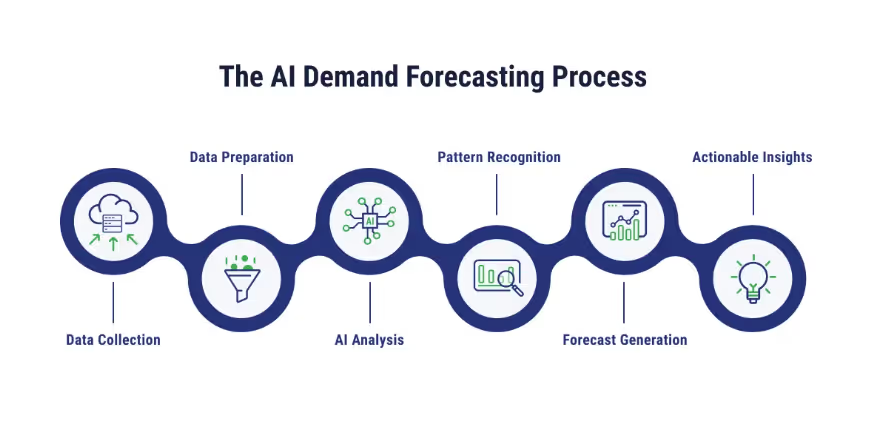
Traditional forecasting methods such as moving averages, exponential smoothing, and ARIMA assume that demand stays predictable over time. These tools work when markets are stable, but they fall short during volatility or promotion-driven spikes. Research shows this clearly, as classical models struggle with nonlinear shifts and external shocks.
These tools also ignore external inputs such as weather or macro trends. When forecasts rely solely on historical data, they miss new patterns and create mismatches between inventory and real demand. This often leads to stockouts or excess stock in fast-moving environments.
Excess inventory ties up cash, increases storage costs, and inflates working capital requirements. Stockouts result in lost sales and lower customer satisfaction. According to a recent report, global retail inventory distortion, the combined cost of overstocking and stockouts, amounts to about $1.73 trillion annually, roughly 6.5% of global retail sales.
Forecast inaccuracies also distort financial performance. Companies with high supply chain management risk tend to carry more inventory and accounts receivable, raising net working capital by about 6% per year. This reduces liquidity and limits operational flexibility.
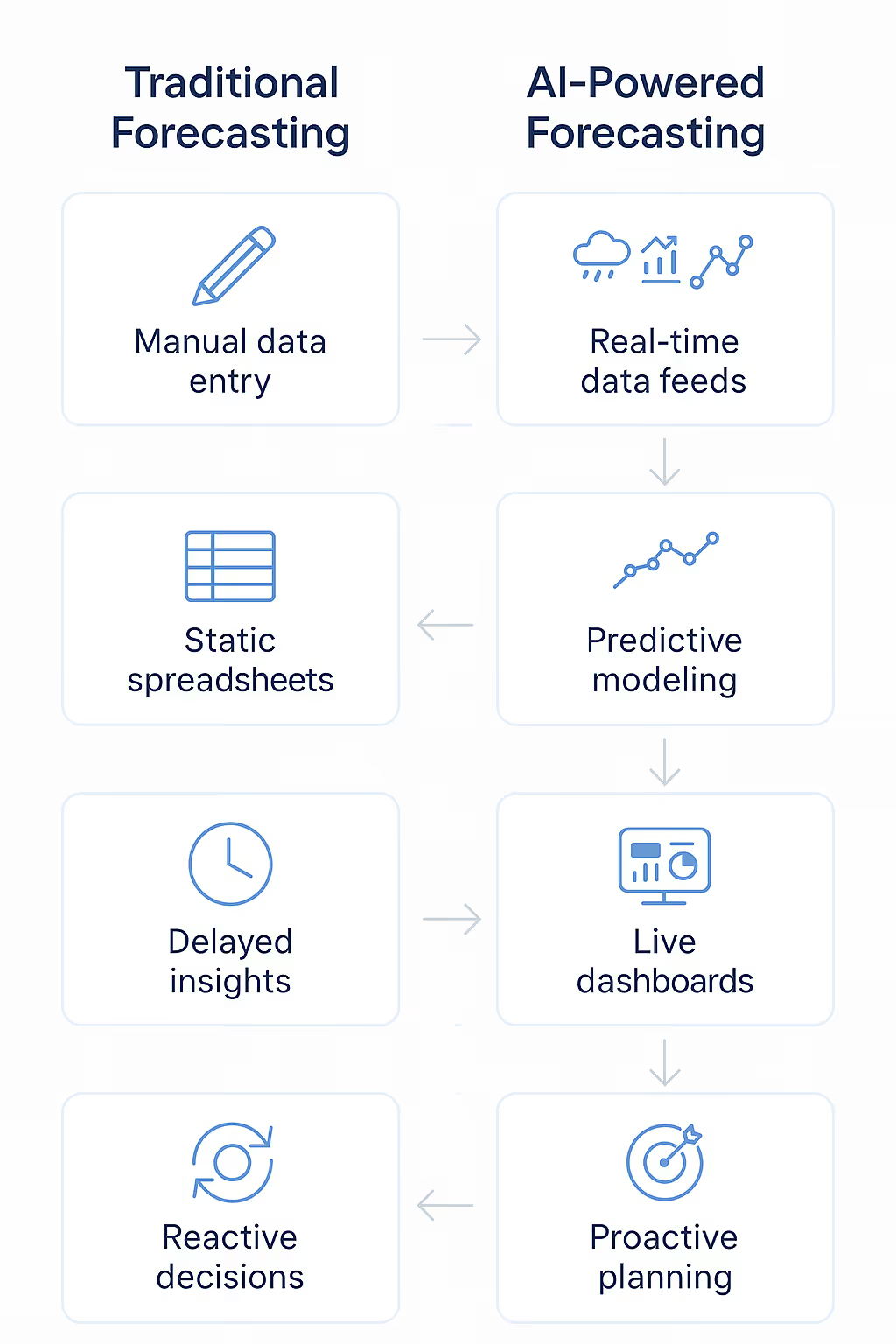
The table below compares traditional forecasting methods with AI-driven approaches, showing differences in data, accuracy, and business impact.
AI-powered demand forecasting provides an alternative. It combines historical sales data, real-time data, and external factors such as market trends, weather patterns, social media signals, promotions, and pricing changes. These AI models deliver more accurate demand predictions.
Machine learning algorithms and predictive analytics help planners anticipate disruptions, optimize inventory levels, and align production schedules with actual customer demand.
A review shows that AI models such as LSTM, XGBoost, and Random Forest can reduce forecast error from 28.76% to 16.43%, a drop of about 42.87%. That improvement translates directly into fewer stockouts, lower overstock levels, and stronger operational performance for supply chain and finance teams.
Artificial intelligence and machine learning power modern demand forecasting. These systems analyze data to uncover complex patterns that traditional statistical methods often overlook. The insights they provide help businesses make more accurate and informed decisions.
AI demand forecasting goes beyond simply collecting data. AI models combine historical sales, real-time data, and external factors such as promotions, pricing, and market trends to detect patterns that traditional linear models miss. This works because machine learning algorithms can identify non-linear relationships and interactions among multiple variables.
However, some constraints can still cause AI forecasting performance to drop.
AI-based forecasting cannot fix poor data quality, incomplete data collection, or broken workflows. It is also not a one-size-fits-all solution across products, regions, or channels. Even the most advanced machine learning models require clean data sets, clear assumptions, and human oversight. Overestimating AI capabilities can lead to unrealistic expectations and wasted resources.
Forecasting remains difficult when demand is volatile, highly seasonal, or influenced by external shocks. Although AI may predict demand better than traditional methods, its performance still depends on proper implementation and integration.
These challenges highlight why businesses need to select the right AI solution. Here are some types of AI tools and solutions available, and how they handle complex demand patterns.
AI solutions come in multiple forms, each suited to different demand patterns:
Understanding the tools is just the first step. Companies also need a strategy for integrating AI into their workflows and deciding how much automation versus human oversight is appropriate.
Organizations must decide how AI integrates with human workflows. Some use AI predictions as a baseline while planners review exceptions. Others combine AI with existing tools to improve accuracy for volatile or promotion-driven demand. The goal is to augment human decision-making, reduce forecast error, and streamline operations without replacing expertise.
Also, watch out for vendors that label basic statistical models as AI or push organizations to replace all forecasting tools. Successful AI adoption involves augmenting workflows, integrating AI solutions into demand planning, and using AI tools to streamline operational efficiency rather than replace domain expertise.
Leaders need to understand what improvements AI solutions can deliver before investing. Forecast accuracy depends on historical data quality, real-time and external data, and how AI models are embedded in the forecasting process.
High-signal SKUs (Stock Keeping Units) with consistent demand patterns often see faster benefits. Low-volume or erratic items may remain difficult to predict with high confidence.
AI-driven forecasting can reduce forecast error compared with traditional methods. However, as discussed earlier, results vary by data quality, SKU mix, and how external factors are modeled.
Greater accuracy translates into fewer stockouts, lower excess inventory, and improved customer satisfaction. Optimized demand predictions reduce working capital, minimize overstocking, and cut emergency replenishments, boosting operational efficiency.
The Eurocell Group shows how AI-driven demand planning can make a real difference. By forecasting over 43,000 SKUs more accurately, the company improved product availability by 6.7% and freed £1.86 million in working capital. This also helped streamline replenishment decisions and tighten inventory management.
The image below highlights how AI improves forecast accuracy and business outcomes compared with traditional methods.
Before adopting AI, it’s important to know how to measure success. Forecast accuracy alone isn’t enough. KPIs help connect predictions to real business outcomes like inventory efficiency and operational performance.
The following list mentions a few KPIs to track.
Understanding these metrics helps organizations evaluate whether AI forecasts are actually improving operations. They also guide adjustments to models, workflows, or data sources to maximize benefits.
Accurate forecasts matter most when they are put into action. Companies that unify data and embed AI predictions into planning workflows can make smarter inventory, production, and replenishment decisions.
Extending AI coverage to all SKUs, including low-volume or promoted items, helps reduce stockouts, lower excess inventory, and improve service levels. True impact comes when forecast improvements lead to operational efficiency and better decision-making across the supply chain.
AI forecasting does not improve all items at the same rate, and that shapes how teams apply it. Stable SKUs with clear demand patterns often show quick gains because models can learn from consistent data. Low-volume or unpredictable items remain harder to model, which is why planners still rely on manual checks or safety stocks. These limits do not negate the value of AI but show that automation works best when paired with informed human oversight.
Data quality and model design also influence how much improvement teams can expect. Forecasts depend on clean historical records, reliable external signals, and timely operational data. When these elements are aligned, AI supports better buying decisions and reduces excess inventory. When they are not, accuracy gains flatten, and operational benefits weaken, reminding teams that forecasting depends as much on inputs as on algorithms.
Teams also need to avoid celebrating accuracy improvements without checking the downstream effects. Better forecasts only matter if they lead to optimized buys, lower overstocking, and stronger OTIF performance. This final step often reveals whether the model is creating real operational value or simply producing cleaner numbers on a dashboard.
AI-powered demand forecasting depends on stable, well-structured data. The easiest way to build this foundation is to strengthen each layer step by step, so the model learns from clean inputs and produces reliable predictions.
Everything starts with a clean sales history. AI models learn patterns from 18 to 24 months of consistent product and location data. When IDs change or records are incomplete, the model cannot form a reliable baseline.
Fixing this layer creates the foundation for everything that follows. Without it, even advanced machine learning models struggle to detect meaningful demand patterns.
Once historical data is stable, the next priority is linking pricing and promotion data to actual transactions. Pricing changes, promotions, and discount events need to be connected directly to transactions. These signals help the model distinguish normal fluctuations from campaign-driven spikes. Missing this context can distort demand predictions and reduce forecast accuracy.
Inventory management data from ERP (Enterprise Resource Planning), WMS (Warehouse Management System), or OMS (Order Management System) systems is another critical area. Stock levels, lead times, shipments, and inventory movements provide context, so forecasts translate into actionable decisions. Forecasting without this context makes it hard to optimize inventory levels or set reorder points.
Once internal data is consistent, external factors provide additional insights. Weather patterns, holidays, local events, macroeconomic indicators, social media trends, and competitor pricing all influence customer demand. These external data sources help the AI model anticipate market shifts that historical sales alone cannot reveal.
Real-time data pipelines and master data governance make AI forecasting sustainable. Pipelines clean and normalize data from multiple sources. Master data governance ensures consistent SKU and location IDs, standardized calendars, and unified hierarchies. Without this, even the best AI algorithms produce unreliable outputs.
When the core structure is ready, a small pilot helps validate data flows. Focusing on a specific SKU set, region, or channel reduces risk and shows where improvements appear first. If forecast accuracy improves, the same design scales smoothly to more categories and data sources.
A clear data foundation opens the door for meaningful AI gains, but the next step is choosing where to apply these capabilities first. Not every SKU or category is equally suited for early AI adoption, so the logical move is to identify the use cases that deliver value quickly and avoid those that slow progress.
Selecting the right starting points is essential before scaling any forecasting solutions. Some categories respond quickly because their signals are stable and their data foundation is strong. Others slow progress and make it harder for AI technologies to produce accurate demand forecasting. Beginning where models have the clearest view of future demand helps teams build trust and demonstrate early value.
Products with steady sales patterns and rich histories provide AI models with the data they need to perform well. These models analyze vast amounts of data and capture seasonality, pricing shifts, and recurring trends. Strong signals improve forecast accuracy early and support better decisions in inventory management and replenishment.
E-commerce and omni-channel products move quickly under changing market conditions. AI-powered forecasting solutions detect drivers like promotions, traffic spikes, and social signals more effectively than linear tools. This functionality helps teams reduce stockouts, prevent overstocking, and stabilize production schedules across channels.
Some items produce outsized value even with modest accuracy improvements. Seasonal goods, repeat-purchase items, and predictable components fall into this group. More reliable demand prediction helps teams align production schedules, avoid excess inventory, and improve customer satisfaction more consistently.
Items with low volume or irregular demand often lack the signal needed for machine learning models to perform well. When data is sparse or erratic, predictions vary too widely to guide decisions. These SKUs often rely more on human judgment, scenario planning, or safety stock until better data emerges.
Any SKU category without defined workflows or decision rights is not ready for AI adoption. If teams are unclear on who reviews or acts on forecast outputs, the predictions never impact real operations. AI forecasting delivers value only when insights feed directly into purchase orders, replenishment rules, or inventory adjustments.
A strong use case still needs reliable inputs and structured decision-making. A readiness check ensures that both the data and the surrounding workflows can support AI forecasting tools.
A readiness checklist confirms that each category has clean historical data, stable product identifiers, and linked pricing and promotion details. These elements help AI technologies detect patterns tied to seasonality, new products, or shifts in market conditions.
The checklist also verifies whether forecasts can feed directly into planning tasks like reorder points or production decisions. This connection ensures the system’s predictions turn into practical, operational improvements.
Each forecasting category needs a person responsible for using AI outputs. A business owner reviews unusual predictions, compares model results with domain knowledge, and ensures insights influence ordering and inventory decisions. This role prevents forecasts from sitting unused and helps teams trust the system as data and functionality expand.
Once AI forecasts are integrated into planning and operations, the next step is choosing where to apply them first. Focusing on high-impact SKUs and channels ensures quick, measurable value and lays the foundation for scaling AI forecasting effectively.
Once your data and systems are ready, the next step is deciding which AI demand forecasting use cases to tackle first. Focusing on the right products and scenarios ensures early wins and sets the stage for broader adoption.
Before embedding AI-driven forecasts, it’s important to start with the right use cases. Focusing on high-volume or high-impact SKUs ensures early wins and builds confidence. Forecasts should integrate into demand planning cycles, replenishment rules, and inventory management across stores and distribution centers. Proper integration ensures forecasts are actionable rather than just theoretical outputs.
AI outputs provide value when linked to Sales and Operations Planning (S&OP) and Integrated Business Planning (IBP). This alignment connects demand predictions to revenue, margin, and operational targets. Teams can then make informed decisions, balancing supply, inventory, and financial objectives.
Decide which tasks should be automated and which require human judgment. For high-impact SKUs, an “AI suggests, planner approves” approach works best. AI provides recommendations such as reorder quantities, replenishment timing, promotional adjustments, or expected demand shifts.
Planners then review these suggestions, checking them against local events, market conditions, or business rules. Approving means either confirming the AI recommendation or adjusting it based on operational realities. This step ensures decisions are both accurate and practical.
Low-risk or routine SKUs can follow automated rules without review, saving planner hours while maintaining efficiency. The goal is to let AI handle repetitive calculations while humans guide high-stakes decisions.
Turning AI outputs into actionable insights is essential. Explainable drivers such as pricing, promotions, weather patterns, channel mix, and market trends help planners understand changes. Connecting AI systems to existing ERP, planning dashboards, and forecasting tools ensures predictions are acted upon rather than ignored.
Poor integration or opaque AI models can undermine confidence. For example, if an AI system predicts that a popular SKU will need 2,000 units next week, the planner may ignore the recommendation if they cannot see how the forecast was calculated. They may not know whether it considered promotions, seasonality, or recent sales trends. This can lead to stockouts or overstocking.
Clear explanations, dashboards, or confidence scores help planners understand why the AI is making a suggestion. When planners can see the drivers behind the forecast, they are more likely to act on it, balancing AI recommendations with operational judgment.
Even with clean data, advanced AI models, and well-designed workflows, AI-powered demand forecasting can fail if key risks are not managed. Understanding these failure modes upfront helps planners and leaders prevent costly mistakes, maintain forecast accuracy, and protect inventory levels and customer satisfaction.
Before implementing safeguards, it’s important to recognize that each risk requires targeted strategies. Applying a one-size-fits-all approach to mitigation will limit the benefits of AI-driven forecasting. Carefully designed techniques ensure forecasts remain actionable and support informed decisions.
To reduce these risks, companies can take several steps:
Taking these precautions ensures AI-driven forecasting becomes a reliable tool rather than a fragile system. It also helps companies maintain accuracy, optimize inventory, and support informed decision-making.
Once risks are addressed, the next step is structured execution. A clear rollout plan helps teams focus on high-priority SKUs, track progress with key metrics, and embed AI-driven forecasts into daily workflows. Following a phased approach ensures measurable results while reducing operational risk.
Start by selecting one or two categories or regions with clear demand forecasting challenges, such as frequent stockouts, overstocking, or poor OTIF performance. Extract and clean historical sales data, inventory positions, promotions, and pricing information for the chosen scope. This ensures AI models have reliable inputs for accurate predictions.
Train an initial AI-powered model and compare its forecasts offline against existing forecasting tools. This baseline helps evaluate improvements in forecast accuracy, inventory levels, and operational efficiency.
With a baseline in place, the focus shifts to refining models and integrating AI forecasts into planning discussions.
Run AI-driven forecasts alongside legacy forecasting methods to highlight areas of improvement. Incorporate real-time data and external factors such as weather patterns, local events, competitor activity, social media signals, and market trends.
Use AI forecasts as a second opinion in demand planning meetings. Document instances where predictions improve decision-making or reveal gaps in current forecasting processes. This phase strengthens trust in AI systems and shows the benefits of AI-driven forecasting for supply chain management, demand planning, and operational efficiency.
After integration, operationalizing AI forecasts ensures predictions drive action and measurable business impact.
Embed AI forecasts into planning dashboards, ERP systems, and replenishment workflows. Define automation rules that specify which SKUs can be auto-replenished and which require human approval.
Measure impact on key metrics, including stockouts, excess inventory, inventory turns, OTIF performance, and margin. Confirm alignment between supply chain, finance, and merchandising teams to ensure forecasts inform strategic decisions.
Decide whether to scale AI solutions to additional SKUs or regions, refine models, or pause to address data or process gaps. This phase ensures AI-driven forecasting delivers tangible improvements in inventory management, customer satisfaction, and operational efficiency.
With a structured rollout, organizations can embed forecasts into daily workflows. This drives sustained gains and improves decision-making across the supply chain and finance.
AI-driven demand forecasting can transform inventory management, production planning, and the alignment of supply chain, finance, and merchandising teams. Success begins with readiness. Organizations should ask:
With these foundations in place, companies can implement AI in phases, track measurable improvements, and embed forecasts into daily workflows. Platforms like Invisible provide the tools and infrastructure to make AI-driven forecasting practical, scalable, and actionable across the organization.
Typical inputs include historical sales, product attributes, pricing and promotions, inventory levels, and lead times. Channel data, such as online versus in-store sales, is also important. External factors like weather, local events, and macroeconomic indicators further improve forecast accuracy.
Retail, consumer goods, manufacturing, logistics, and e-commerce are common adopters. However, any B2B or B2C organization that relies on demand predictions for inventory, staffing, or capacity planning can benefit.
Common use cases include inventory optimization, workforce scheduling, route and distribution planning, capacity planning in manufacturing, and pricing or promotion planning.
Accuracy depends on data quality and model design, but AI approaches typically reduce forecast error compared with manual or rule-based methods, especially in complex, seasonal, or promotion-heavy environments.
AI models can be retrained frequently and ingest high-frequency data. This allows forecasting to respond much faster to shifts in demand patterns than traditional periodic planning cycles.
Companies track outcomes such as reduced stockouts and overstock, lower waste and markdowns, and improved service levels. Better labor utilization and higher revenue or margin from more aligned supply and demand are also common indicators.