What good AI in citizen services looks like at scale isn't a vision statement. It's a specific operational architecture. The agencies that have genuinely scaled AI for government and public institutions aren't distinguished by their vendor selection or their AI strategy documentation. They're distinguished by the decisions they made before any system went live: which processes to automate, where human judgment stays in the loop, how citizen data is governed, and what happens when AI systems produce outputs that require review. That architecture is what separates durable deployments from expensive pilots.
Scaled AI in government services isn't a single system. It's a stack of decisions executed consistently across the full service delivery operation. The agencies running high-performing AI programs share a recognizable profile, and it has less to do with the sophistication of their AI systems than with the operational discipline surrounding them.
They start with transactional volume, not complexity. Document processing is where artificial intelligence delivers consistent, measurable ROI in government operations: permit applications, benefit eligibility checks, license renewals, and routine correspondence. The throughput is high, decision rules are typically clear, and the cost of automation is straightforward to calculate against manual processing time. Agencies that try to solve complex judgment problems with AI before automating their high-volume, well-defined processes are working in the wrong order.
They build feedback loops into the architecture. Generative AI systems handling citizen queries or generating eligibility guidance don't improve autonomously. High-performing government AI programs have structured mechanisms for capturing output errors, flagging edge cases, and routing corrections back into the model — which requires qualified human reviewers with domain knowledge, not a QA checklist.
They govern data before they deploy models. Machine learning models trained on inconsistent or incomplete government data produce inconsistent and incomplete outputs. In a citizen services context, that translates directly to incorrect eligibility determinations, benefit delays, and guidance that generates more follow-up contacts than it resolves. Data quality is a precondition for AI performance, and agencies that skip it pay for it downstream.
Four use case categories consistently deliver at scale in public sector AI. Understanding what AI can actually automate in government operations is the prerequisite to knowing where to deploy resources, but these categories have the clearest evidence of impact.
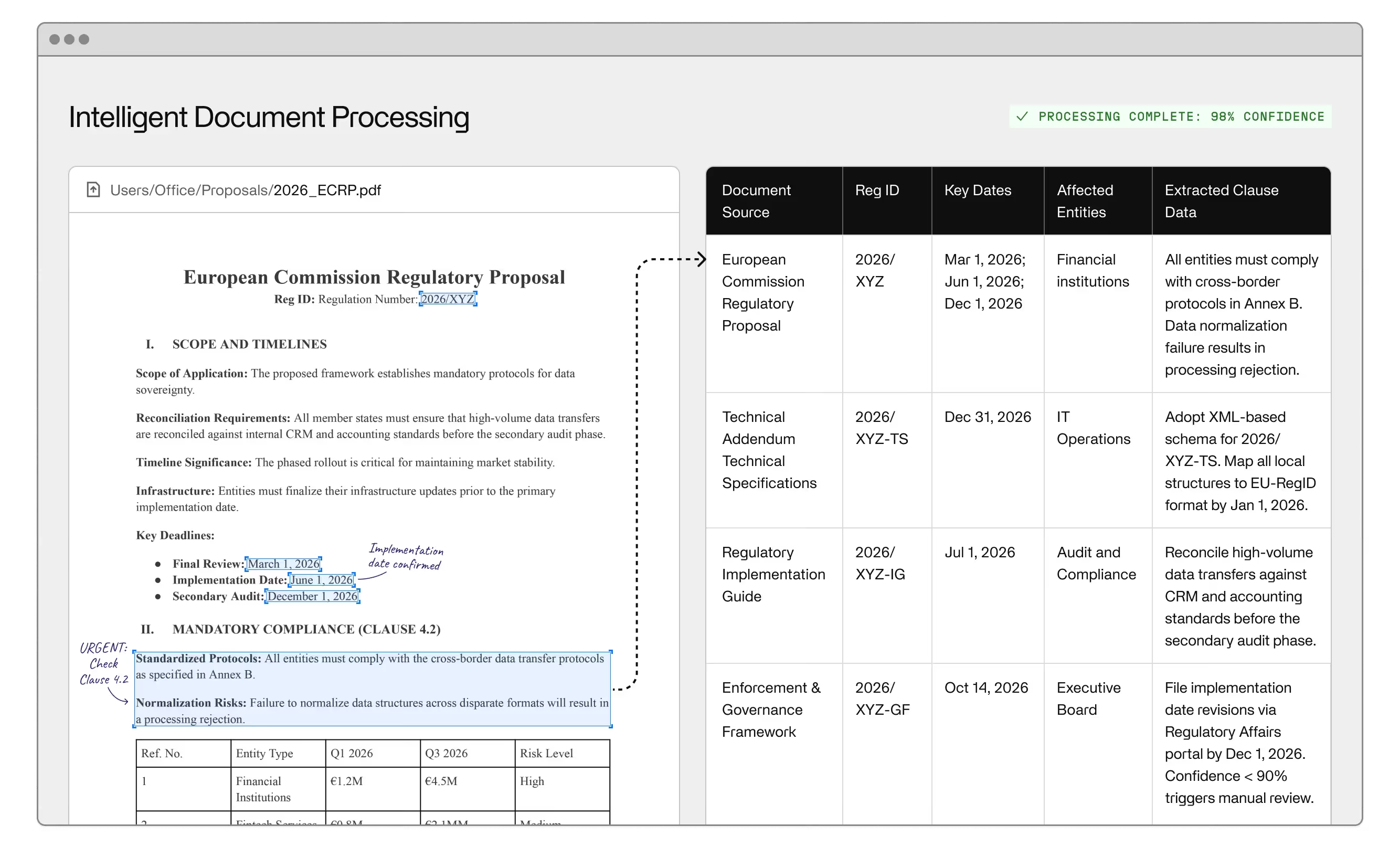
Document processing and application handling. Government agencies process enormous volumes of structured forms. Natural language processing (NLP) and robotic process automation (RPA) handle the two sides of this problem: NLP classifies and extracts information from varied document formats; RPA routes the processed document through the appropriate workflow. Well-implemented document processing automation reduces processing time from weeks to days, with accuracy rates that match or exceed manual review for standard form types. The key constraint is exception handling: real government workflows contain edge cases that rule-based RPA alone breaks on, and AI systems that can't route those exceptions intelligently create backlogs of a different kind.
Chatbots and virtual assistants for citizen inquiries. The most visible application of generative AI in government services is the chatbot or virtual assistant handling inbound citizen questions — service hours, application status, eligibility guidance, procedural explanation. When implemented well, these systems deflect significant call center volume and extend service access beyond business hours. When implemented poorly, they erode trust and drive repeat contacts. The difference is almost always training data quality, escalation design, and whether AI outputs are reviewed and corrected on an ongoing basis rather than only at go-live.
Fraud detection in benefits programs. Machine learning-based fraud detection is one of the most established applications of AI in government operations. State government agencies running automated fraud detection in benefits programs — unemployment insurance, Medicaid, supplemental nutrition — report recovery rates that outperform rule-based systems by meaningful margins. Predictive analytics models trained on claims patterns flag anomalous activity for human review before payment is processed, shifting the fraud response from recovery to prevention. The performance advantage compounds over time as the model learns from each reviewed case.
Predictive resource allocation. Generative AI and predictive analytics are increasingly applied to data-driven decision-making in human resources planning and public service delivery. Predicting when service centers will experience volume spikes, modeling where field inspection resources should be concentrated, or anticipating permit application surges by season — these are tractable problems for AI algorithms trained on historical operational data. The data science infrastructure required is substantial, but agencies that invest in it report meaningful reductions in backlogs and overtime costs.
Every government AI deployment that has scaled without incident shares one characteristic: the governance infrastructure was designed before the technology went live, not retrofitted after problems emerged.
For AI in government specifically, this means three things. Data privacy protections must be embedded at the architecture level, applied as a design constraint rather than added as policy after citizen data is already flowing through AI systems. Cybersecurity review must be part of the AI procurement process, because AI systems that introduce new data flows or third-party API connections change an agency's threat surface in ways that require explicit assessment, and running that review post-deployment inverts the risk calculus entirely. And accountability structures must be defined by policymakers before authorization: specifically, who is responsible when an AI system produces an incorrect output, and how citizens can contest AI-generated decisions.
Regulatory compliance is also a live constraint. Law enforcement agencies face significant scrutiny over AI algorithms used in decision-making, and predictive policing systems have faced legal challenge in multiple jurisdictions. Agencies deploying AI in national security or public safety contexts need legal review baked into the deployment architecture, not treated as a go-live checklist. Several states have enacted AI-specific legislation governing how artificial intelligence can be used in benefits determination and law enforcement. Policymakers who engage with that regulatory environment at the design stage make better decisions than those who discover it at the procurement stage.
Trustworthy AI in government isn't a product feature. It's the output of institutional design: governance frameworks that define scope and limits before procurement, accountability structures that outlast leadership changes, and audit mechanisms that demonstrate consistent performance across the full citizen population served. AI research on bias and disparate impact in public-sector AI systems is well established, and the evidence that AI trained on historical government data can replicate and amplify existing inequities is not a theoretical concern. Agencies building toward trustworthy AI need to evaluate AI systems against their full population of citizens, not just the majority demographic.
Generative AI has shifted the capability ceiling in public sector service delivery in ways that earlier generations of AI simply couldn't: rule-based automation, first-generation machine learning, and static chatbots all hit hard limits on open-ended citizen questions. ChatGPT and the large language models that followed demonstrated that AI systems could generate contextually appropriate, fluent responses to open-ended questions. In a citizen services context, that means moving from FAQ-lookup chatbots to AI that can explain complex eligibility rules in plain language, draft correspondence, or guide a citizen through a multi-step process in real time.
The risk scales with the capability. Generative AI systems hallucinate — they produce confident, coherent outputs that are factually wrong. In a government context, a hallucinated eligibility determination isn't a bad user experience; it's a compliance failure and a potential legal liability. Agencies deploying generative AI in high-stakes citizen services apply human-in-the-loop review to consequential outputs, define clear thresholds for when AI responses require human verification, and monitor output accuracy continuously rather than at periodic audits.
Agentic AI, where AI systems execute sequences of actions autonomously rather than generate a single response, is the next development affecting government services. Document processing workflows that currently require multiple handoffs between AI and human reviewers can, in principle, be collapsed into single agentic AI flows. That capability comes with governance requirements commensurate with the autonomy: agentic AI operating on benefits records or case files needs human review checkpoints built into the workflow from the start, before automation rates make them feel optional. The policy frameworks governing agentic AI in government are still being written, and agencies that deploy before those frameworks are defined create liabilities that are difficult to unwind.
Procurement documents for AI in government services are almost uniformly optimistic about deployment timelines and integration complexity. The work that consumes the deployment calendar is consistently underestimated: data cleaning, legacy system integration, change management, and staff training. Agencies that have been through government AI projects that stall between pilot and production recognize this pattern: timeline risk accumulates in exactly the places the SOW doesn't cover.
Successful AI adoption in government typically runs through structured phases with defined success metrics at each stage, rather than building toward a single go-live event. It also requires AI literacy across the agency, not just within the technical team. The staff reviewing AI outputs, escalating edge cases, and managing citizen complaints need to understand what the system can and cannot do — without that literacy, review processes become rubber-stamping and oversight collapses without anyone noticing.
The agencies that get AI in government right are rarely the ones with the most sophisticated AI strategy on paper. They're the ones that started with an honest assessment of their data quality, a realistic view of their integration complexity, and the organizational discipline to treat deployment as an ongoing operation rather than a project with a go-live date. When you're ready to move from that assessment to selecting a partner, knowing what to require from a government AI vendor is the logical next question.
Invisible designs and operates AI programs for government agencies and their partners — from back-office document processing automation built for government-scale exceptions to human-in-the-loop operations for generative AI systems in production. Get started.
Document processing, chatbots for routine inquiries, and fraud detection in benefits programs consistently deliver the strongest ROI. These use cases share high transactional volume, clear decision rules, and measurable outcomes, which makes performance straightforward to evaluate. Generative AI is extending what's possible in citizen query resolution, but requires more rigorous governance infrastructure than automation of well-defined, structured tasks.
The most common failure modes are poor data quality before deployment, inadequate governance infrastructure, and insufficient human review capacity. Machine learning models trained on inconsistent government data produce unreliable outputs at scale. Deployments that go live without defined accountability structures and citizen recourse pathways generate public trust problems far harder to recover from than a delayed launch date.
Generative AI lets agencies move from FAQ-lookup chatbots to AI systems that handle open-ended citizen questions in natural language, draft correspondence, and guide citizens through complex processes. The trade-off is that generative AI systems hallucinate, producing confident, fluent, and incorrect outputs. Responsible deployment requires continuous output monitoring and human review for high-stakes responses, not just at go-live.
Agencies need data privacy protections embedded at the architecture level, cybersecurity review of any new data flows the AI system introduces, and defined accountability structures: specifically, who is responsible when AI produces an incorrect output and how citizens can contest AI-generated decisions. These should be established by policymakers before procurement, not negotiated with vendors during deployment.
The accountability framework needs to be defined before deployment, not after. That means establishing who is responsible for AI-generated decisions, what the audit trail looks like, and how citizens can contest AI determinations. It also means distinguishing between high-risk applications (law enforcement, predictive policing, benefits determination) and lower-stakes uses, and applying governance requirements proportionate to that risk.
Document processing automation can reach reliable production in 90 to 120 days when data is clean and integration scope is contained. A citizen-facing generative AI system with appropriate governance, data privacy review, and human-in-the-loop oversight typically takes six to twelve months to reach production scale. Agencies that plan for the longer timeline make better staffing and budget decisions than those that take vendor projections at face value.