The gap between a successful government AI pilot and a working public sector AI deployment is where most digital transformation in government initiatives fail. The pilot works. The demo goes well. Leadership approves the next phase. Then nothing ships, or what ships doesn't hold up past the first operational quarter.
This pattern has specific, structural causes. The difference between an agency running AI in production and one still running its third pilot is a clear-eyed understanding of the specific operational gaps that cause the failure — not abstract strategy problems.
Government digital transformation projects stall for structural reasons, not technical ones. The AI works in the pilot. It fails in production because the conditions required for it to operate at scale were never built into the original digital transformation project.
Most pilots are scoped to prove a concept in a controlled environment: a single workflow, curated data, limited scope. That design is exactly what makes them succeed as pilots and exactly what makes them useless as a foundation for production. When production requirements arrive, legacy systems weren't connected, data sharing agreements didn't exist, and cybersecurity review hadn't been built into the timeline. The pilot collapses under requirements it was never designed to meet.
Digital transformation for government has a long history of this pattern. The barriers that actually block government AI deployments are well documented. The AI layer is new. The structural failure mode is the same one that stops enterprise AI projects from reaching production across every sector.
Most government operations run on infrastructure built across decades, with no shared data standard and no unified integration layer. That matters more than most pilots account for. An AI system that cannot read from a 1990s benefits database is not a production system — it is a prototype running next to one. Modernization of the data layer connecting outdated infrastructure to new capabilities is a prerequisite for production, not a follow-on project. Government agencies that defer this step build pilots that work cleanly in isolation and fail immediately on contact with live infrastructure.
The change management problem is the one most teams underestimate. Sustained organizational will is required throughout, not just executive sponsorship at the pilot stage. Procurement timelines can run past a year on their own. Government procurement timelines can run past a year. The teams whose workflows are being automated determine whether the system gets used, and so do the people relying on the digital services they power. If they were briefed after the fact rather than involved in shaping the service design, adoption fails regardless of how well the technical system performs.
Data sharing compounds both of those. Citizen experience in government depends on complete, accurate data. Government data is typically fragmented across agencies under legal frameworks never designed for AI use cases. Mapping which government processes AI handles well reveals where those data gaps matter most. Cross-agency access requires negotiated agreements, and those take time you won't have if you need them at launch.
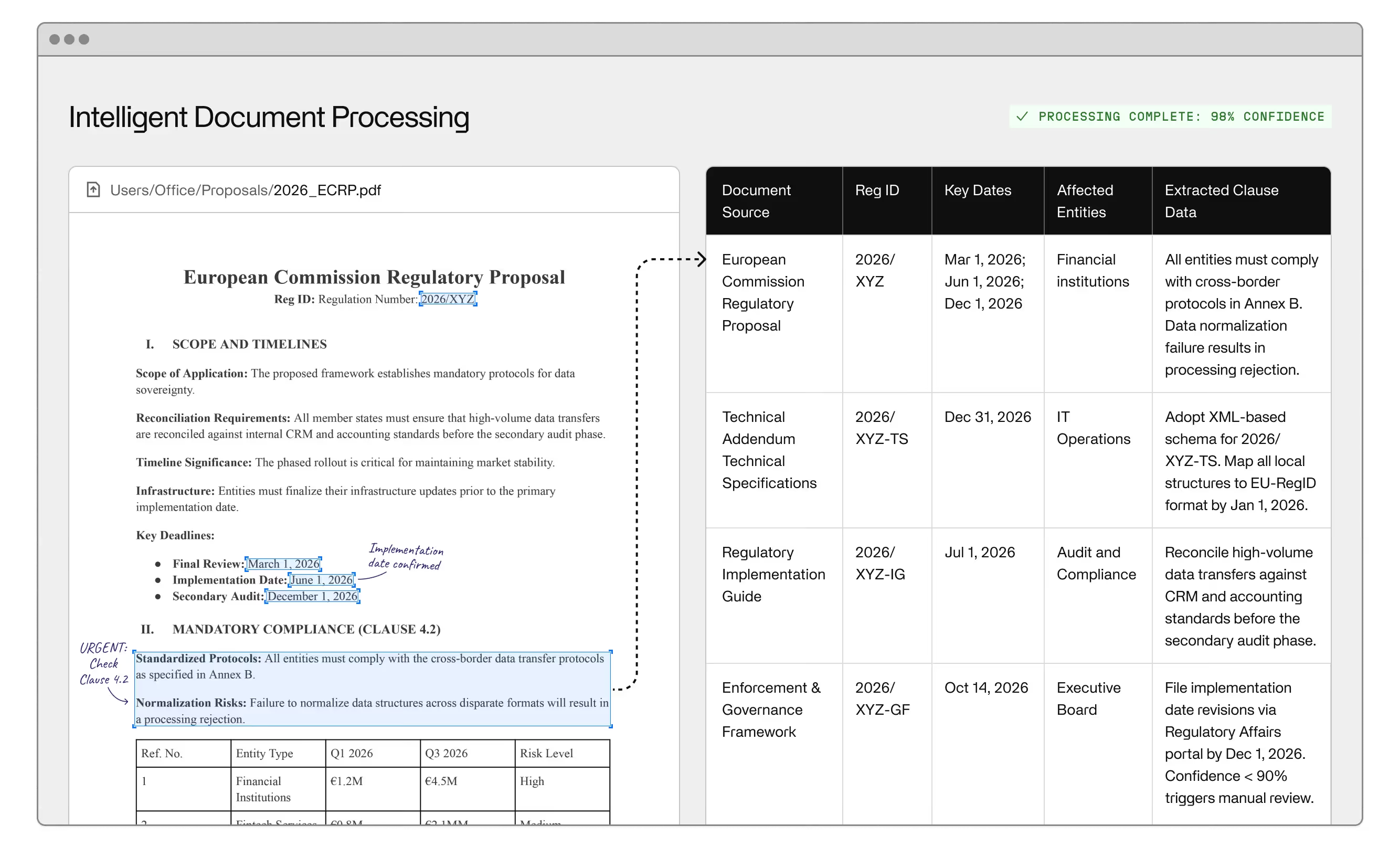
Then there are the compliance requirements that arrive late because they weren't scoped into the pilot. Government operates under the most demanding auditability and transparency requirements of any sector, and AI introduces new surface area for both. Any AI system informing decisions in a government context must log what it did, explain why, and flag low-confidence outputs for human review. Cybersecurity review takes longer than most project timelines budget for, and systems not built with regulatory compliance baked in have to be rearchitected before they can survive it.
Getting to production requires a different foundation than what most pilots establish.
Data infrastructure has to come first. Before any AI deployment operates in production, you need a governed, unified data layer that resolves the interoperability problem. Cloud computing infrastructure, whether government-specific or in a compliant private deployment, provides the scalability and access controls that production volumes require. Data analytics pipelines that worked cleanly on curated pilot data will perform differently on live data. Machine learning models trained in isolation behave differently once connected to production systems. Those gaps need to be measured and designed around before launch.
Process automation produces the fastest operational impact when it targets high-volume, narrow workflows rather than attempting comprehensive modernization at once. Government agencies that reach production successfully tend to start with one process: document extraction, case routing, or benefits determination, then build outward from a working system. Digital services that deliver measurable improvements in a single workflow are more valuable than a broad digital government strategy that has yet to ship anything. A second round of process automation on a working system is faster and lower-risk than an inaugural deployment on a complex one.
Service design determines how much of the technical capability actually gets used. The user experience for case workers and the citizen experience for the public are shaped more by how the process is designed around the AI output than by which model is running under it. What does a case worker do with a low-confidence result, and who in the organization has authority to act on it? How does the system route an exception? Agencies that answer those questions at design time reach production faster and produce better outcomes. That holds for digital services citizens interact with directly as much as for internal workflow tools.
Transparency and auditability are specifications, not obstacles. Government CIOs and CFOs who treat them as late-stage constraints spend more time in remediation than they saved in speed. Digital technologies designed for transparency from the start produce systems that survive oversight and get extended. Decisions are logged and inputs are traceable. High-stakes outputs go to human review before anything irreversible happens. Systems that treat regulatory compliance as a final gate get redesigned or cancelled.
The digital transformation for government that reaches production follows a recognizable pattern. Success is defined in operational terms before technology selection — cases processed per day, manual review hours eliminated, accuracy rate on document classification. Data science and data infrastructure are treated as foundational investments. Cybersecurity review is built into the development timeline rather than deferred to a final checkpoint.
Emerging technologies including artificial intelligence, machine learning, and internet of things integration are increasingly embedded in government operations at scale. Digital identity programs and open data initiatives represent genuine modernization opportunities, as do broader customer experience improvements. They are also complex, long-horizon programs with coordination requirements that go beyond what any single deployment can carry. Government agencies that build institutional capability through narrower, higher-confidence deployments first are better positioned to take on those broader programs when the organizational readiness exists.
The question your agency faces is not whether AI works in government. It does. The question is whether the data infrastructure and governance model are in place to move past the pilot. If they are, organizational readiness is usually the last gap — and the most actionable one to close.
See how Invisible supports public sector AI deployments end-to-end, or book a demo to start a conversation.
Government AI pilots are designed to prove a concept in controlled conditions: curated data, isolated workflows, limited scope. That design makes them succeed as pilots and fail in production. Production exposes what the pilot didn't test: system integration gaps, real data quality, security review timelines, and the organizational adoption challenges that follow.
Disconnected infrastructure is the most common technical barrier — most government systems were built without integration layers, and AI can't operate in production without data access. The most common organizational barrier is change management: procurement timelines run long, and the teams whose workflows change determine whether a deployed system gets used.
They make late-stage compliance expensive. Any AI system informing government decisions must log inputs, explain outputs, and flag exceptions for human review. Building compliance in from the start costs less and takes less time than retrofitting it after a security review identifies the absence. Agencies that treat it as a design constraint reach production faster than those that treat it as a final gate.
Document extraction, case classification, and benefits routing are the strongest early targets. They have high volume, clear success criteria, and exceptions humans can review without specialized model knowledge. Starting with a narrow, measurable process produces operational impact faster and builds the institutional capability to take on more complex process automation in subsequent deployments.
Start with the data layer, not the application layer. Modernization that focuses on connecting legacy infrastructure to a governed data layer gives AI deployments something to operate on. Wholesale system replacement is slower, riskier, and rarely necessary. The goal is data connectivity and access across the systems that matter most to the target workflow, not a comprehensive infrastructure rebuild before anything ships.
In operational terms, not technical ones. Cases processed per day, manual review hours eliminated, and accuracy rate on document classification are the metrics that matter. Deployments that survive budget cycles are those with specific, measurable operational improvements that CIOs and CFOs can report. A system that is technically functioning but hasn't changed throughput or reduced manual work has not succeeded.