
A comprehensive guide for enterprise leaders to understand how AI-powered contact centers integrate voice, text, and screen data to drive measurable improvements in customer experience, operational efficiency, and governance. Learn more about Invisible's contact centre solutions here.
_
Contact centers feel the strain on every interaction. Customers expect instant clarity, problems span multiple systems, and those systems rarely agree with one another. Agents get pulled into messy workarounds, and at underperforming organizations, 58% end up jumping across screens just to finish a single task.
Traditional bots and simple AI are built for the easy cases. Once the conversation touches fragmented systems, non-linear workflows, or compliance rules, they fall apart.
Agentic AI changes the equation. These systems use real-time context, workflow orchestration, guardrails, and CRM data to guide actions. The result is faster resolutions, lower effort for agents, and a more reliable, scalable customer experience.
This article will explain how agentic AI transforms contact centers end-to-end, what problems it solves, how it works in practice, and the measurable outcomes enterprises can expect.
If you want to see where a system falls apart, try running it in a call center. The workflows are messy, and the “edge cases” show up all day long. Agents bounce between CRMs in the middle of a conversation just to finish one task. And they’re expected to do it in seconds, not minutes.
Consider a customer reporting a fraudulent charge. The agent must verify identity, check multiple accounts, apply the correct fraud policy, and decide whether to freeze or replace the card.
When the customer mentions a second joint account with different rules, a standalone LLM can choose the wrong policy or freeze the wrong card without access to live systems and rules.
Agentic AI is built for this pressure. It handles imperfect data, branching workflows, compliance constraints, and shifting customer intent, all while moving the interaction forward. If an AI system can operate here, it can operate anywhere else in the enterprise.
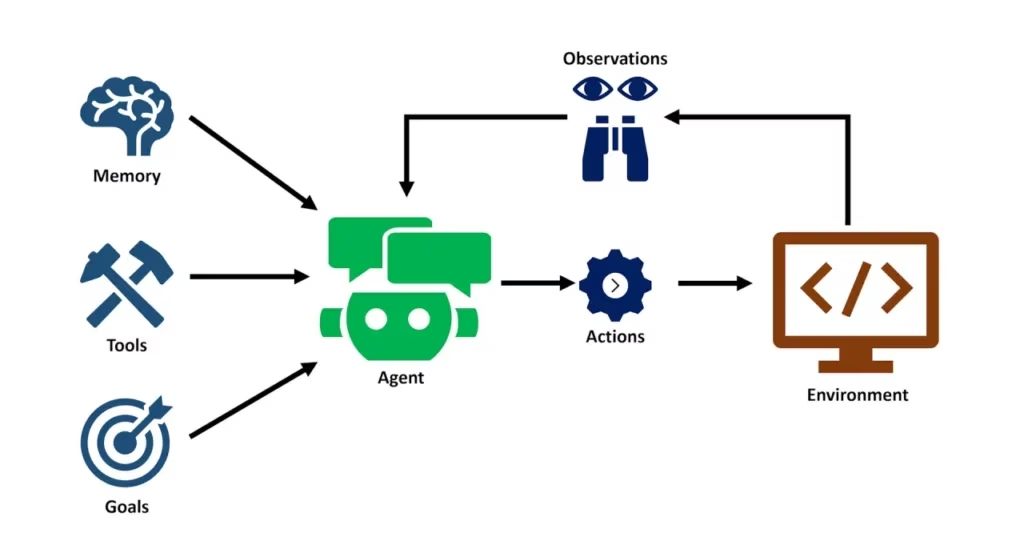
An AI call center agent understands the request, retrieves the right data, and performs governed workflow steps in real time. It adapts as the interaction changes and supports agents by handling routine tasks.
IVRs and menu-driven chatbots can’t do this. They follow a fixed script and only work when the customer fits the path they were designed for. When a request falls outside the script, they fail. AI agents don’t rely on rigid menus. They understand intent, track state, and make decisions in real time.
Beyond intent detection and workflow execution, AI agents also handle the operational load that slows human teams down. With generative AI capabilities, agentic AI agents generate summaries, fill forms, tag conversations, and surface relevant policies automatically.
It’s also important to be clear about what this is not. AI doesn’t replace an entire call center overnight. Real impact comes from staged automation, reliable handoffs between AI and humans, and the effort required to connect AI to real processes, policies, and data.
AI reduces manual load and improves consistency, but it still relies on guardrails and human oversight to keep decisions accurate, compliant, and safe.
AI only drives value when tied to measurable operational goals. When aligned with core contact center metrics, AI agents can deliver meaningful improvements across performance, service, and cost. Here are a few of them:
AI agents deliver these results by operating inside the contact center’s systems and making precise, context-aware decisions in real time. Key capabilities include:
A real AI-powered contact center doesn’t run on chatbots. It runs on a system coordinated, deliberate, and built to handle the full weight of real customer interactions.
Here’s the stack that makes reliable automation possible.
This layer captures every interaction signal and delivers it to the AI in real time. Voice, chat, and email flow through a unified platform that streams audio in real time, exposes IVR and routing controls, and sends clean event signals downstream.
Clean signals allow lower average handle time, smoother triage, and better handoffs to human agents when needed.
Modern LLMs and natural language processing power transcription, intent detection, sentiment, and compliance checks.
AI models generate grounded responses, detect entities in customer data, and produce human-like outputs using generative AI. Machine learning pipelines catch patterns such as repeated policy misuse, rising complaint themes, and identity-risk signals that influence decision-making, while guardrails help reduce hallucinations.
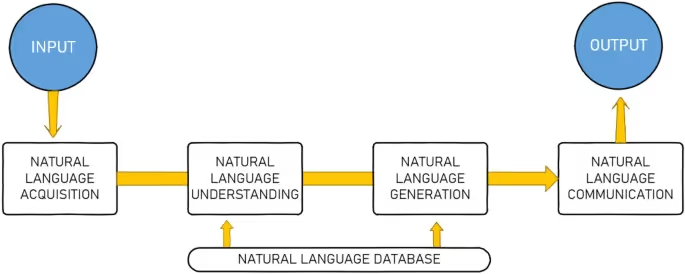
A well-structured knowledge base, policies, product details, FAQs, and documentation are indexed for fast retrieval. Embedding search and retrieval-augmented generation ensures answers stay tied to current content, not stale model weights.
This keeps service aligned with policies, improves customer experience, and raises customer satisfaction and customer satisfaction score (CSAT).
An orchestration layer coordinates multiple AI systems, tools, and models. It runs action-selection algorithms that determine the next operation, retrieval, mutation, validation, or escalation based on context, constraints, and policy.
This approach eliminates hardcoded branches and produces workflows that adapt dynamically as interaction states evolve.
This layer executes verified actions against authoritative systems. Secure connectors let the AI read and write data under strict data privacy and human oversight guardrails.
This is essential for updating tickets, finishing forms, triggering follow-up tasks, and meeting enterprise customer expectations.
An operational, full-fledged contact center has several dedicated AI agents, rather than a single one. Every role has a specialized role in the workflow, and this makes the entire system more resilient, more context-specific, and more optimizable.
When these roles work together, the contact center moves beyond simple chatbots. The result is a coordinated network of small AI tools and AI systems that manage complex workflows.
AI agents operate on a continuous stream of voice, text, and screen signals, merging them into a unified interaction state.
This gives the system full situational awareness, not just of what the customer says, but what the agent sees and which systems are in play.
Live phone calls are processed with streaming ASR, conversational AI, and NLP models. Speech is transcribed instantly, allowing the AI to extract intent, detect sentiment, and support orchestration of next steps.
Chat, email, and messaging channels appear as structured text streams. Generative AI, LLMs, and traditional AI systems track context across each thread, identify repetitive tasks, and surface relevant knowledge.
The AI agents also use previous customer interactions to maintain consistent answers and reduce unnecessary escalations.
Screen-understanding models interpret what the agent has open, CRM tabs, policy pages, order records, or editable fields. Reading the interface lets the AI understand which task the agent is performing and enables it to streamline form entry, autofill fields, or correct errors.
That multimodal view gives the AI the context to act with precision. With that context, it can:
Real impact comes from systems that fit the way support agents already work, simplify decisions, and reduce friction instead of creating new UX burdens.
Support teams perform most tasks inside a CRM, agent desktop, or unified inbox. Effective conversational AI and agentic AI capabilities need to appear directly in those surfaces.
No extra login, no new dashboards, no parallel system. The AI becomes part of the normal automation workflows and orchestration layer.
Examples include:
When the AI blends into the existing interface, adoption rises, and customer experience improves without additional cognitive load.
Frontline agents need clear, predictable interaction patterns. The system should make it obvious when the AI is acting and when the human should step in.
Consider a delivery-status call. The AI fetches the tracking data, spots a delay, and drafts the update. The agent sees the source, the reason, and the message in one view, with a quick approve-or-fix option.
If the AI pulls a status for the wrong package, for example, the customer’s previous order instead of today’s, the agent can correct it instantly without breaking the flow.
A reliable implementation roadmap for AI agents moves in four controlled phases, observe, assist, automate defined flows, and continuously optimize. Each phase reduces risk, builds operational confidence, and ensures AI strengthens, not disrupts existing contact-center operations.
Begin with AI that never acts, only watches and learns from real customer interactions. Use NLP, ASR, and conversational AI to transcribe calls and chats in real time.
Cluster conversations to find dominant use cases, including FAQs, billing, logistics, healthcare queries, login issues, etc. Identify repetitive tasks, failure points, and broken automation workflows.
Capture hard metrics:
This creates a real-world baseline, not what leaders assume happens, but what actually happens across 100% of traffic. You now know which contact center flows are stable, which are messy, and where AI capabilities could genuinely help.
Next, keep human agents fully in charge and deploy AI as a co-pilot inside existing tools. Show real-time answer suggestions and “next best actions” inside the CRM or agent desktop. Surface knowledge base snippets automatically, rather than forcing agents to search.
Use generative AI and LLMs for one-click actions, including:
At this stage, agentic AI solutions reduce cognitive load, improve agent performance, and start to streamline complex workflows without risking unsupervised actions.
Once the underlying workflows are fully understood and stable in agent-assist mode, limited automation can be introduced in areas with low risk and variability.
With these boundaries in place, AI can execute narrow segments of work reliably, while human intervention remains simple and immediate. This creates scalable self-service that preserves accuracy, customer trust, and operational safety.
Once assistive workflows and narrow automation are performing consistently, the contact center shifts into a continuous learning cycle. The objective is to refine system behavior using real operational signals so the AI improves exactly where the business feels the impact.
Use business metrics, not just model scores, to measure:
With performance benchmarks defined, you need the operational routines that ensure the AI improves rather than drifts.
Over time, agentic AI and machine learning shift from experiments to stable AI tools that are engineered, versioned, and deployed like any other production system.
The environment becomes context-aware, uses conversational AI plus screen and system signals, and steadily optimizes both operational costs and customer experience.
Below is a summary of the staged roadmap for introducing AI into a contact center:
AI in the contact center is only as safe as the controls wrapped around it. Privacy, security, and governance must be engineered from the start. Without them, even the best models become operational liabilities.
Organizations need a precise inventory of what the AI will process. This includes transcripts, recordings, consent records, CRM histories, prior interactions, product and policy documentation, and routing data.
A defined data surface sets clear boundaries on what the system can access and what remains out of scope.
The design must shield sensitive data. Minimization of PII, bounds to retention, role access, and full encryption ensure that the system only reveals what is required and nothing beyond.
Each touchpoint is logged to avoid silent misuse or unintended access.
AI must operate inside strict operational boundaries. Refunds, credits, policy exceptions, access changes, and any low-confidence decisions should always trigger human review.
Guardrails prevent the system from committing to actions it cannot safely justify.
Every suggestion, action, and override must be logged. Comprehensive audit trails let teams trace decision paths, pinpoint interventions, and diagnose failures. This visibility is critical for compliance, quality assurance, and long-term accountability.
Organizations don’t need to reinvent the entire AI stack. The right strategy depends on your infrastructure, your industry, and the level of control you need over agentic AI behavior.
Call centers already operating on major CCaaS or CRM platforms often gain immediate value from the native AI layer. These systems typically include:
The advantage is speed. Deployment is quick, and integrations are already baked in.
The trade-off is control. You have less influence over the orchestration, reasoning patterns, or domain-specific logic the AI uses. Custom workflows may be hard to tune without workarounds.
Complex or regulated environments often need more precision. Industries like financial services, healthcare, and logistics typically require:
The hybrid model is often the most effective for complex or regulated environments. Foundation models supply the general language understanding, while a custom orchestration layer handles workflow logic, system actions, and machine learning tuned to enterprise data.
This architecture aligns with how leading enterprise platforms operate. Invisible positions itself as an AI operating system built for messy data, deep integrations, and human-in-the-loop governance, capabilities that off-the-shelf tools typically cannot provide.
The result is a faster path to operational impact, paired with the precision, control, and safety required for mission-critical workflows.
AI in the contact center is evolving from a conversational add-on to an operational infrastructure. Three shifts are defining the next wave.
The industry is clearly moving away from standalone bots toward AI systems that act as part of the operation itself.
Assessing readiness for AI agents starts with understanding whether the operation has the structure, data quality, and decision boundaries required for safe and effective automation.
Readiness starts with understanding your top call drivers, common failure modes, and the cost centers that shape workload. Without this baseline, it’s difficult to target automation workflows or determine where agentic AI can provide real impact.
AI agents require dependable access to transcripts, CRM records, and key backend systems. Clean, consistent customer data is essential for accurate reasoning and real-time decision support.
Success depends on measurable outcomes such as lower handle time, better routing, and higher CSAT. It should never hinge on AI adoption alone.
A ready organization uses AI to clear repetitive work so human agents can focus on complex, high-judgment tasks.
Agentic AI is not just a feature. It changes how contact centers operate. Work moves faster, escalations drop, and consistency improves beyond what scripts or chatbots can achieve.
In environments built with that discipline, AI stops being a proof of concept and becomes the backbone of the operation. If the goal is to move past chatbots and into real automation, Invisible builds the systems that make it possible. Not generic AI. Not decorative tooling.
Operational AI built for complexity, engineered for safety, and shaped around how your enterprise actually works. When it’s time to see what agentic AI can do inside a real workflow, Invisible is ready to build it with you.
AI provides quicker and more precise responses based on real-time context of consumer information and system notifications. This helps reduce friction, shorten wait times, and provide a more personalized and consistent experience.
Major technologies are LLMs, NLP, ASR, retrieval systems, and agentic AI orchestration. The combination of them allows real-time insights, decision-making, and safe workflow execution.
AI automates routine processes, such as summaries, routing, and form entry, reducing average handle time. It also minimizes upheavals and reiterations of contacts, giving it additional capacity using fewer hands.
A modern stack includes telephony, LLMs, retrieval layers, orchestration engines, and backend connectors. Multi-agent functions, analytics, and guardrails assure safe, correct, and stable operations.
AI transforms voice, text, and screen inputs into a comprehensive state of interaction. This enables accurate operations, such as autofill, error detection, and context-sensitive responses across all channels.
Begin with the listen-only phase, and go to agent assist prior to automating the tasks. Use business measures, retain guardrails, and embed AI inside the current tools.
AI is facilitating consistent QA, agent simulation training, and multimodal and end-to-end automation. These systems are not limited to chatbots. They can deal with workflows and actions in the back end.
Assess the quality of the data, system access, and the clarity of the top call drivers. Well-defined metrics and good governance signal a commitment to AI adoption that is safe and effective.