Your AI roadmap isn't stalled because the technology isn't ready. It's stalled because the infrastructure your business runs on was never designed to feed it. Enterprise AI implementation challenges rarely announce themselves as system failures — they surface as missed timelines and AI adoption challenges that keep cycling back to the same unresolved data questions. The haunting is real: decisions made about data architecture a decade ago are now determining what you can and cannot do with generative AI today. If you're leading an enterprise AI initiative, clearing this infrastructure debt isn't a prerequisite to your roadmap — it is the roadmap.
Legacy systems aren't defined by age. They're defined by what they prevent.
For enterprise AI adoption purposes, a system is effectively legacy if it creates data quality problems at the point of ingestion, if its APIs can't handle the volume or velocity modern AI workloads require, if it sits behind access controls that weren't designed for cross-functional AI access, or if it generates data that lives nowhere else but can't be reliably extracted. Many enterprises are running database infrastructure and ERP systems from two technology generations ago: not because no one wants to modernize, but because the cost and risk of replacement runs high and the immediate operational pressure runs higher.
AI transformation makes those deferral decisions expensive in a new way. The systems that powered your business through the last decade were built to run operations, not to feed the continuous data pipelines that AI workloads require. Data silos that were a manageable inefficiency in a traditional operating model become a hard blocker when you're trying to train or fine-tune models at scale.
Data governance is the most pervasive blocker in enterprise AI implementation. Most organizations discover they lack a data governance framework capable of supporting AI workloads: ownership is unclear, definitions are inconsistent across systems with no reliable lineage from source to training or inference. Without that foundation, data readiness work (the cleanup, reconciliation, and standardization that has to precede reliable AI deployment) becomes open-ended.
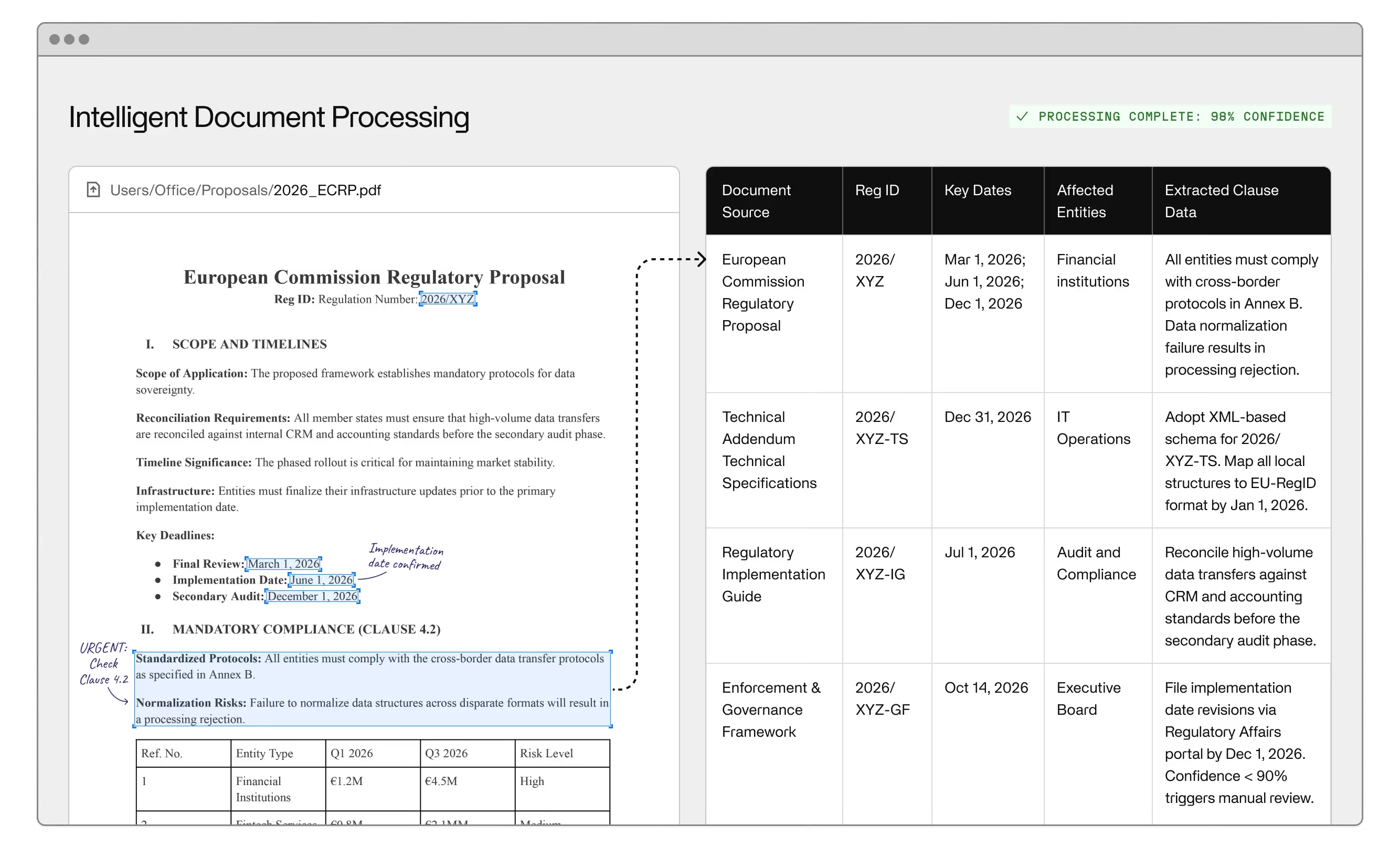
Disconnected systems compound this further. When customer data lives in a CRM that doesn't connect to the order data warehouse, and operational records are locked in a legacy ERP with no documented schema, building a coherent data layer for AI requires reconciliation work that was never scoped into the initiative. Fragmented data that was never standardized at capture creates downstream model reliability issues that AI engineers inherit rather than cause.
Skills gaps are the third major blocker, and they're consistently underestimated. Data readiness work requires data engineering and data science capacity that most enterprise teams don't carry in surplus. Change management shapes whether that capacity gets allocated: who owns data quality and governance decision rights, and how AI teams are structured to work alongside legacy data owners. Organizations that treat operating model design as a downstream concern reliably find that AI adoption stalls on organizational friction before it stalls on technical limits.
Regulatory requirements add a layer that legacy systems weren't built to satisfy. Data privacy obligations under GDPR and compliance frameworks shaped by NIST (along with industry-specific audit trail requirements) demand data handling practices that older systems often can't demonstrate. Access controls in legacy environments were designed for human users in defined workflows, not for AI systems querying data continuously across organizational boundaries. Explainability requirements for agentic AI decisions, and the security vulnerabilities that emerge when AI systems access data through legacy integrations, add further complexity that a well-designed data governance framework addresses, but only if that framework was built with AI workloads in mind.
Every quarter you defer addressing legacy infrastructure, your enterprise AI adoption timeline slips and the gap between your current data readiness and the AI deployment threshold grows wider. The AI adoption challenges don't level off; they compound. Organizations that invested in data infrastructure two or three years ago are now scaling AI at production. Organizations still resolving disconnected systems and fragmented data infrastructure are still completing proofs of concept.
This isn't a gap that closes on its own. Scaling AI requires clean, well-governed data at volume. The longer legacy systems continue generating poor-quality, siloed data, the more remediation work accumulates. Responsible AI practice (guardrails, explainability, audit trails) also requires a governed data foundation that legacy environments weren't built to provide.
The organizational cost follows the same curve. Teams that cleared their data readiness work two years ago are past the hard part. Teams beginning now face the same effort under greater competitive pressure.
Clearing the path starts with treating legacy system integration as a first-class project, not a pre-condition someone else is handling. That means scoping data readiness work explicitly and building it into the AI roadmap with clear ownership and the same rigor as the AI deployment itself.
A data governance framework built for AI looks different from traditional governance approaches. It needs to account for how models ingest data and what access controls apply at the feature level; it also needs audit trails demonstrating responsible AI practice and enforceable data privacy requirements when AI systems query across datasets continuously. Organizations that build this framework in parallel with AI initiatives rather than discovering the need for it during deployment move significantly faster.
API modernization is the other major lever. Moving from proprietary or batch-oriented APIs to modern, event-driven interfaces doesn't just enable AI integration; it enables the real-time data access that agentic AI workloads require. Legacy APIs designed for overnight batch processing are a fundamental mismatch with AI systems that need to query and act on current data.
Retraining and reskilling go hand in hand with the technical work. Change management at the operating model level (establishing clear data governance ownership, defining how AI engineering teams access legacy data, creating accountability for data quality at the source) is what keeps AI transformation moving once the architecture is in place. Organizations that invest in this work alongside the technical work consistently outpace those that treat it as a separate downstream workstream.
When the legacy blockers are addressed, enterprise AI implementation accelerates in ways that are hard to see from inside the infrastructure problem. Generative AI can run against your actual operational data, not a carefully curated subset that sidesteps the governance gaps and quality issues in the broader data environment. Agentic AI can complete multi-step workflows spanning systems, because the API layer supports real-time access and the data governance framework defines what the system is authorized to touch.
Responsible AI practice becomes achievable at scale. Guardrails and audit trail coverage are grounded in the data governance infrastructure that makes explainability demonstrable rather than aspirational. Enterprise AI adoption stops being a series of isolated proofs of concept and starts compounding: each deployment builds on the data and governance foundation the last one established, and your operating model evolves to support continuous AI improvement rather than one-time project delivery.
The organizations that have made it through describe a shift from AI as an initiative to AI as an operating capability. Enterprise AI implementation challenges don't disappear, but they become execution problems rather than structural blockers. The haunting stops when there's nothing left for the legacy infrastructure to obstruct.
Invisible works with enterprises at every stage of the AI readiness journey, from data governance infrastructure to production AI deployment at scale. Explore the enterprise AI platform, or speak with our team.
Data governance is consistently the primary obstacle to enterprise AI adoption. Most organizations discover their data lacks the quality and consistency AI workloads require, and that data ownership (who is accountable for accuracy and standardization) is unclear. Resolving this isn't a technology decision; it's a data infrastructure investment that typically needs to precede AI deployment for results to be reliable at scale.
Legacy systems create AI implementation challenges by generating fragmented, inconsistent data that models can't reliably ingest; APIs weren't designed for modern AI workload volumes, and access controls weren't built for the cross-functional data access AI requires. Data readiness work becomes the primary blocker on every deployment rather than a solved prerequisite.
Data readiness means your data is clean and consistently structured, and that AI systems can access it at the volume and velocity they require. In practice, that means resolving fragmented data across disconnected systems and building a data governance framework with clear ownership and access controls that support the cross-functional data access AI workloads need.
You can deploy generative AI in isolated use cases, but scaling it requires addressing legacy infrastructure. Most successful pilots run against curated data subsets that sidestep governance gaps and quality issues in the broader environment. Moving from pilot to production requires resolving those gaps, which is why AI adoption stalls at that transition for so many organizations.
Change management determines whether AI implementation actually executes. The operating model decisions (who owns data quality, who governs AI access controls, how data engineering capacity is allocated) shape whether the technical work progresses or stalls. Organizations that treat change management as an afterthought find their AI roadmaps blocked by organizational friction before technical limits become the constraint.
Responsible AI practice (guardrails, explainability, audit trails) requires a data governance foundation that legacy environments typically can't provide. You can't demonstrate explainability for a model ingesting data with inconsistent lineage and unclear ownership. Addressing legacy data governance isn't just about enabling AI deployment; it's about enabling AI deployment that satisfies regulatory requirements and responsible AI standards at scale.
Legacy infrastructure becomes a competitive disadvantage when competitors who completed their data readiness work are deploying agentic AI at production scale while your team is still in remediation. The gap compounds: each deferred quarter adds to the backlog. Organizations that addressed this early are moving on to advanced AI capabilities; organizations still in remediation are still completing proofs of concept.