The fatality rate in oil and gas extraction runs several times higher than the US private-sector average, according to Bureau of Labor Statistics data. Your team knows the hazard categories — OSHA has documented them for decades. The problem isn't identification. It's that continuous monitoring across an entire operating site, in real time, is physically impossible with human observation alone.
AI-powered oil and gas safety monitoring extends your program into the coverage gaps your team can't fill. Not by discovering new hazards — every experienced operator knows where the risk concentrates. By watching the zones, systems, and time windows that human monitoring structurally misses.
The majority of oil and gas safety incidents originate not from unknown hazards but from known ones that went unobserved at the moment they mattered.
OSHA's research on oil and gas operations consistently identifies four hazard mechanisms at the top of the incident list: struck-by events, caught-in injuries, caught-between incidents, and falls. Added to these are the industry-specific catastrophic risks — hydrogen sulfide and toxic gas accumulation in confined spaces, flammable gas releases, blowouts, and explosions and fires from high-pressure line failures.
A job safety analysis documents what's hazardous before a task starts. It doesn't watch conditions as they change during a twelve-hour shift. A safety observer can cover one zone at a time. Reserve pits, mud pits, and equipment around a derrick don't become safer because your team is spread thin. A manual gas check captures what's present at the moment of the check — not what accumulates during the hours that follow.
That's the gap AI monitoring closes.
The hazard categories where AI extends meaningful real-time coverage are those where human observation is structurally inadequate — not because your team isn't capable, but because the monitoring requirement outruns what any workforce can sustain continuously.
In these environments — tanks, vessels, and pipelines — hydrogen sulfide, flammable gases, and other toxic gases can accumulate faster than manual testing intervals track. Continuous sensor networks integrated with AI provide real-time concentration data and alert workers and supervisors before exposure thresholds are crossed. The AI layer does two things sensors alone can't: it filters false positives from sensor drift, and it correlates gas readings with worker location and entry status so alerts reach the right people in time to act.
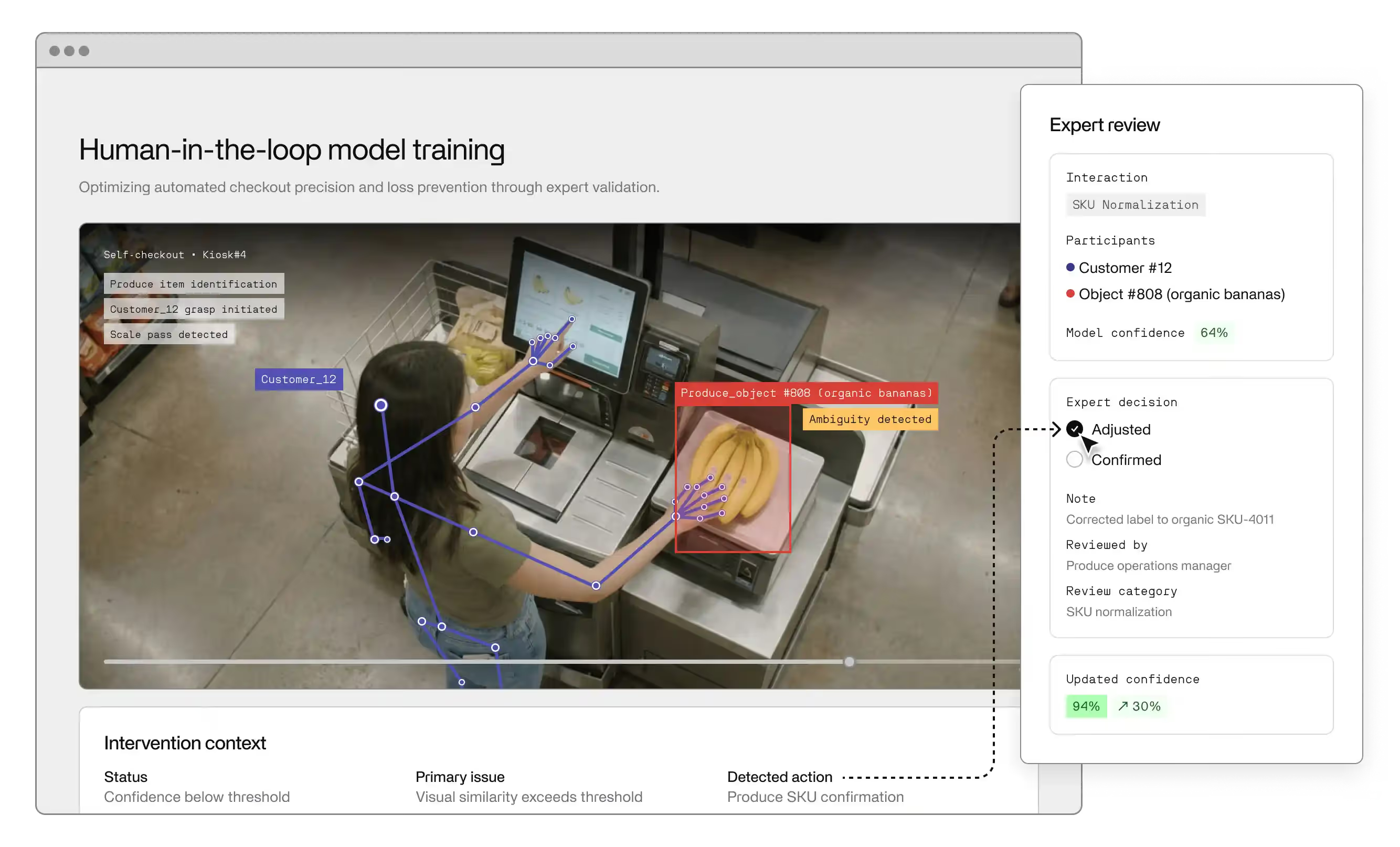
Computer vision deployed around heavy equipment — pumps, derricks, high-pressure line operations — monitors exclusion zones continuously. It catches the conditions that produce most caught-in and caught-between injuries: workers entering danger zones without authorization, equipment activating while someone is within reach, proximity exposure near rotating machinery. One camera covering a high-traffic equipment zone provides more consistent coverage than an observer who must also manage a dozen other site responsibilities during the same shift. Struck-by events in particular happen faster than a distracted observer can respond — camera-based detection closes that window.
AI vision systems verify PPE compliance and harness use when workers operate at heights. Working at heights on a rig, a refinery platform, or a pipeline facility is a hazard category where fall protection compliance is straightforward to confirm at the job hazard analysis stage — and genuinely difficult to monitor across a full shift without dedicated resources at every elevation. Computer vision removes the dependency on a supervisor physically verifying every worker in every elevated area.
High-pressure lines, storage tanks, and pump systems emit data signals before they fail. Predictive safety analytics — models trained on historical process data, sensor readings, and past incident records — identify deviation patterns that precede blowouts and explosions and fires. This is what process safety management looks like when continuous monitoring is layered in. Rather than functioning as a compliance program reviewed on a periodic cycle, it becomes a system that surfaces anomalies early enough to act on.
AI extends coverage. It doesn't automate your oil and gas safety culture, your PSM framework, or the expertise of the people running either.
Ergonomic hazards — cumulative strain from repetitive motion on rig floors, in confined maintenance work, and in sustained equipment operation — remain better assessed by a specialist than by current vision systems. Computer vision can flag obvious postural violations. It doesn't yet evaluate the subtler motion patterns that produce musculoskeletal injury over time at the granularity needed for meaningful intervention.
Chemical exposure through direct skin contact, eye and face protection compliance in close-range tasks, and hot work permit verification all involve interactions that site-level cameras aren't consistently positioned to assess. These belong to your permit-to-work process and your frontline supervisors.
Slips, trips, and falls on level ground are still managed more effectively through traditional housekeeping inspections and corrective action tracking. Mental health and fatigue — which surface most visibly in highway vehicle crashes during field transit — are addressable through AI wearable monitoring, but behavioral models require enough per-worker baseline data that they take months to become reliable.
Knowing where the system reaches its limits is how you scope a deployment that generates real oil and gas safety value. Trying to automate your entire safety management system at once is how you produce something technically sophisticated and operationally irrelevant.
Three environments consistently produce the highest-value deployments.
Refineries run around the clock with rotating workforces, high equipment density, and chronic exposure to flammable and toxic gases. Combining continuous gas monitoring, computer vision across heavy equipment zones, and monitoring vehicle collisions in internal transport areas addresses the hazard categories that produce the most injuries at a refinery in a single deployment.
Drilling sites with active derricks, high-pressure line work, and confined space entry at reserve pits and mud pits present the hazard profile AI monitoring addresses most directly — gas accumulation, proximity incidents near equipment, and pressure anomalies. The oil and gas safety risk at an active drill site clusters around exactly the conditions these systems are built to catch.
Pipeline operations present a different configuration: small crews, distributed and remote worksites, regular highway vehicle operation, and lone-worker exposure far from site supervision. Here the investment is typically in wearable monitoring, vehicle telematics, and pipeline integrity data integration rather than fixed cameras. The monitoring architecture differs; the principle is the same. Continuous coverage where human observation can't be sustained.
Two decisions determine whether AI safety monitoring improves oil and gas safety outcomes or simply generates a monitoring report.
The first is data quality. Sensor networks feeding an AI system need to produce clean, continuous, correctly labeled data. Most upstream and downstream operations already have SCADA systems and process data historians. Almost none of that data is ready for a model without significant curation work — inconsistent formatting, coverage gaps, sensor readings that were never labeled against incident outcomes. Operations that get reliable predictive models invest in curation before they invest in the model.
The second is response protocol design. An alert that goes to a dashboard nobody is watching is not safer than no alert. The escalation logic, response procedures, and human review layer all need to be built into the system design from the start — not added after go-live when the first alert proves ambiguous. This is where most deployments fail: not in the model, but in what happens when it fires.
Risk management in oil and gas has always required human judgment. AI gives your team more of the operating environment in view, in real time. The decisions — about permit requirements, work stoppage, exposure limits — stay with the people who understand the site.
Invisible works with operations teams to build AI monitoring programs that hold up in production — from sensor network integration and computer vision deployment to the data infrastructure that makes predictive safety analytics reliable. Explore our solutions or get started.
AI monitoring covers the hazards hardest to observe continuously: toxic gas accumulation in confined spaces between manual checks, caught-between incidents in equipment exclusion zones when no observer is present, fall protection violations across a full shift, and early pressure deviations on high-pressure lines before they escalate. The system isn't discovering new risks — it's watching known ones without gaps.
PSM establishes operating limits, hazard procedures, and emergency response protocols. AI adds a continuous monitoring layer: when equipment behavior deviates from safe operating parameters, an alert fires when the deviation happens rather than when the next scheduled inspection occurs. The result is a program that catches issues early in their progression — before variance compounds into a release or shutdown event.
A sensor detects and reports a condition. An AI system correlates that reading with worker location data, entry logs, historical baseline readings, and other inputs to determine whether the reading is a genuine hazard or sensor drift. The practical difference is alert quality: sensor-only systems generate noise that safety teams learn to dismiss; AI-integrated systems produce fewer, higher-confidence alerts that get acted on.
In most cases, yes — with curation work. Most operations already have SCADA systems, sensor networks, and process data historians. The barrier is rarely hardware replacement. Existing process data is typically inconsistent in format and incomplete in coverage. Cleaning and structuring that data is what determines whether a predictive model produces actionable output or accurate-looking noise.
No. OSHA requirements for PPE, confined space entry procedures, fall protection, and job hazard analysis remain in place regardless of what monitoring technology you deploy. AI monitoring extends real-time coverage — it doesn't satisfy regulatory compliance requirements, change permit-to-work obligations, or replace the safety culture that makes any program effective.
A targeted deployment focused on one hazard category — gas detection in confined spaces or equipment-zone monitoring for caught-between exposure — can reach production in 60 to 90 days if data infrastructure is in reasonable shape. Multi-category programs across a full site take longer, primarily because of data curation, model validation, and building the response procedures that determine whether alerts get acted on.