The constraint on artificial intelligence is no longer be bigger frontier models, it is better training data. The web corpus that fed GPT-3, GPT-4, Llama, DeepSeek and other foundation models is long exhausted. More scraping from blogs, docs with a DOI, and papers on arXiv doesn’t magically teach an AI to run a hospital rota or a supply-chain control tower. You can keep scaling large language models (LLMs) and clever algorithms, but without new fuel, model performance on messy real-world use cases flatlines and risks model collapse, where models mostly remix their own past outputs.
What actually moves the needle is high-quality human data: logs of real decisions, real conversations, real failures and fixes in those rotas and control towers. That kind of real-world data captures nuance that web text and scraped corpora never will—the trade-offs, red lines, and tacit rules people apply under pressure. It’s the only training data that reliably teaches an AI system what “good” looks like in your domain, which is why human-labelled signals, preference modelling, and expert feedback remain the hard constraint on model performance, even as we scale bigger LLMs and more sophisticated algorithms.
But truly high-quality human training data is scarce, expensive, and slow to collect—especially for rare but critical edge cases that almost never show up in real-world data. The is where synthetic data and synthetic datasets add value: deliberately generating synthetic data with generative AI and generative models, then mixing it with curated human data. You use OpenAI-style models and strong open-source stacks on HuggingFace to create candidate examples at scale, then put humans in charge of filtering and light editing. The work shifts from artisanal authoring to high-speed curation and validation.
We’ve already burned through the obvious training data. The big foundation models and large language models, from OpenAI to Llama and DeepSeek, were pre-training on the same global corpus: web pages, books, code, research on arXiv, PDFs with a DOI. That gave us the first big jump in model performance, but there isn’t another internet hiding behind this one.
The human data that really moves the needle now lives elsewhere: in expert decisions, messy internal workflows, and high-stakes interactions. Think payments disputes, clinical triage, supply-chain control towers, complex negotiations. Capturing those signals means taking scarce subject-matter experts away from their day jobs to label examples, rank outputs, and provide nuanced feedback. As models get more capable, the bar for “good” feedback rises, but the pool of people who can provide it doesn’t. Human judgement remains the anchor for training—but it’s too expensive, slow, and capacity-constrained to scale linearly. That’s the wall we’ve hit, and it’s exactly why we reach for synthetic data to expand and stress-test around a human core instead of trying to replace it.
On paper, the story still looks good. New frontier models hit higher scores on general benchmarks every quarter. But those benchmarks rarely look like your production workflows. They don’t encode, “Should this claim be escalated?” or “Is this ICU bed assignment safe?” They’re proxies, and we’re well into diminishing-return territory.
Inside enterprises, this shows up as a blunt contradiction: your chosen LLM can ace a leaderboard but still produce unreliable outputs on your actual use cases. It can explain a hedging strategy but won’t respect your specific risk limits; it can summarize a chart but can’t drive the ETL algorithms that feed the dashboard. You can throw more generic machine learning and more fine-tuning at it, but without better-aligned datasets, you’re polishing the wrong surface.
There’s another risk too: if every new AI system is trained and re-trained on the same finite corpus, and then we start generating synthetic data from those same models without care, we drift toward model collapse; models learning to imitate their own and each other’s mistakes. You see fewer genuinely new patterns and more averaged, washed-out model outputs, with model performance slowly degrading on messy, real-world tasks.
Human data still does the hard work of defining what “good” looks like, but it doesn’t scale linearly, and random “more data” won’t save you. The next step-change comes from two moves in combination: deliberate curation of the high-quality training data you already own, and disciplined use of synthetic datasets to expand and stress that core. This is where generative AI and generative models—from GPT-4 to open-source stacks on HuggingFace—and techniques like RLHF, GANs, and reinforcement learning stop being buzzwords and start being tools for designing the training datasets you actually need, not just passively accepting whatever the internet happens to give you.
In this context, synthetic data just means “data generated by a model or simulator, not directly recorded from humans.” A synthetic dataset is what you get when you organize that into something a training pipeline can actually use.
In practice you see three flavors:
Modern training models rely on just one of these. A serious AI system blends curated human data (the gold set) with carefully generated synthetic examples that probe edge cases, stress conditions, and rare combinations the original corpus barely covered.
The engines are the same AI models we’re trying to improve. We use them as draft machines.
This isn’t free-for-all “let it hallucinate.” The generation process is constrained by prompts, templates, and domain rules: we nudge models to stay within realistic distributions and known policies. An open-source model from HuggingFace might, for example, generate 1,000 variants of a discharge instruction or logistics exception; a filter then kicks out anything obviously wrong before it ever enters the training set.
Over the top, we use standard machine learning and deep learning tricks—scoring, clustering, diversity checks—to make sure we’re not just cloning the same few patterns. Synthetic data is treated like any other asset: versioned, tagged, and subject to validation before it graduates into real training data.
Done properly, the use of synthetic data is very specific, not general:
The core move is simple: use models to rough in thousands of plausible candidates, then let humans do fast, shallow passes—thumbs up, thumbs down, small edits. Only the survivors become part of the quality data you trust for fine-tuning, RLHF, or downstream algorithms.
Synthetic data isn’t a replacement for reality; it’s a pressure multiplier. Human data defines what “right” looks like. Synthetic variants explore everything nearby, at scale.
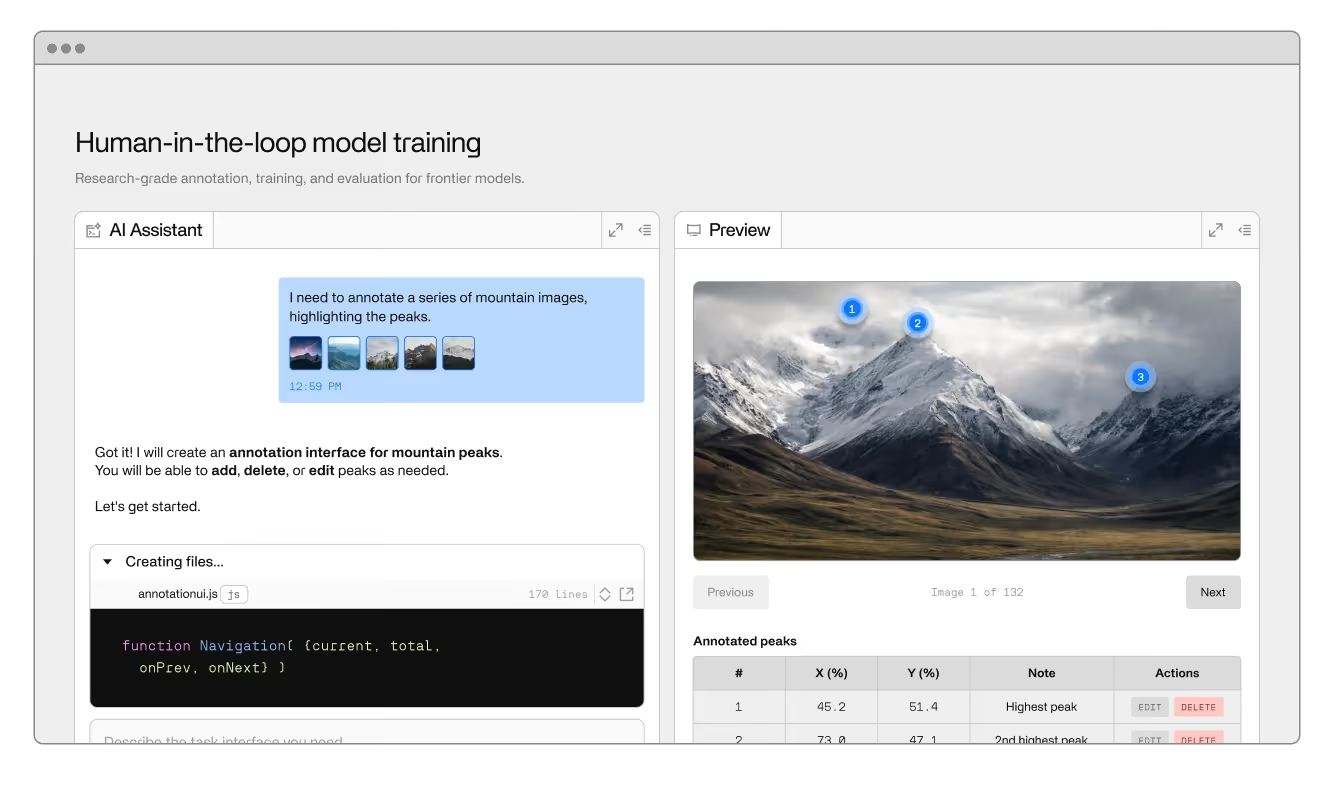
The real shift with synthetic data is how humans spend their time. Instead of starting from a blank page, LLMs and other generative models produce first-pass model outputs like captions, summaries, scene edits, UI variants. Humans sit in the middle as fast critics: accept, reject, tweak. It’s “left/right arrow key” work, not crafting.
Every click is supervision. Choosing one option over another, deleting a sentence, or fixing a caption becomes implicit annotation. Pipelines turn that into preference data and labels for fine-tuning, RLHF, and other deep learning / reinforcement learning alignment algorithms. People aren’t hand-building datasets; they’re shaping the distribution of synthetic data the model will see next.
That’s the flywheel: generative AI proposes, humans assess, and every decision improves the next round of candidates. You’re actively sculpting training data around the behaviors you want your AI models to learn.
When a reviewer deletes a sentence, rewrites a caption, or picks option B over option A, they’re not just “fixing” the output—they’re generating supervision. Every micro-edit becomes implicit annotation and labeling for future training data: this phrasing is acceptable, that one isn’t; this summary captured the key facts, that one missed something important.
Good tooling turns those actions into structured signals: pairwise preferences, ranked lists, corrected outputs. Those signals feed directly into RLHF, fine-tuning, and reinforcement learning–based preference modelling, nudging the model toward patterns that humans consistently approve. Over time, this raises model performance without people hand-labeling examples from scratch. The system learns from every edit.
Start by assembling a small but high-quality human data corpus for each use case: clean, de-duped, and governed. Tie it directly to real workflows and policy so the base labels actually reflect the decisions your AI systems should learn—what gets approved, what counts as safe, which outcomes are “good” in your environment. This curated core becomes the anchor that all later synthetic data and model behavior is judged against.
Next, you start generating synthetic data around that human core. Use generative models like from OpenAI and strong open-source LLMs on HuggingFace to spin up large candidate sets: rephrasings, harder scenarios, edge-case variants. Treat this as targeted data augmentation, not a firehose—aim synthetic examples at known gaps in your model performance and specific decisions inside the workflow.
Then put humans in the loop to triage what the models just produced. Reviewers quickly accept, reject, or lightly edit synthetic candidates, and every action becomes implicit annotation and labeling. Tooling turns this into structured validation signals, so low-quality synthetic data is discarded and only the best examples enter your datasets as trusted training data for the next round of models.
Finally, you use this hybrid corpus of human and synthetic data for training models and fine-tuning your AI models and foundation models. You track model performance on held-out real data and live workflows, not just abstract benchmarks, and use error analysis to decide where the next round of synthetic data generation should focus. You layer on reinforcement learning or RLHF to sharpen behavior further, closing the loop so each cycle of data and training leaves the system measurably better than the last.
LLMs like GPT-3, GPT-4, Llama, and DeepSeek can now act as generators, not just consumers, of data. They produce synthetic instruction such as response pairs, tool-use traces, and dialogues that look like the interactions you want your assistant to handle. That synthetic data becomes fuel for instruction tuning, alignment, and fine-tuning domain-specific assistants so your customer support bot, clinical helper, or ops copilot can learn from far more examples than your raw human data alone would allow.
In multimodal and healthcare settings, synthetic data fills gaps that are hard or risky to cover with real patients or production logs. Vision and text datasets can be expanded with synthetic scans plus reports, chart screenshots plus summaries, or device traces plus explanations, generated by generative models and then checked by clinicians. That partially synthetic training data lets assistants learn to read images, notes, and structured fields together, improving model performance on real-world workflows without overexposing sensitive human data.
Beyond text and images, AI models acting as agents in simulators can generate rich synthetic trajectories: state, action, reward sequences that show how a policy behaves over time. Reinforcement learning uses this synthetic experience to sharpen decision-making for routing, scheduling, or control workflows, often long before you risk those policies in the real world. Those synthetic logs then join your broader training data, helping downstream AI systems learn not just what to say, but what to do.
Synthetic data is leverage, but it’s also a new way to pollute your stack. If your generation process is sloppy, you end up training on low-quality, biased, or outright wrong synthetic samples at scale. That can drag down model performance, or push models toward safe but useless, averaged answers. Without clear tagging of real vs synthetic data, and regular validation on held-out human data, you won’t notice the damage until it shows up in production workflows.
Once synthetic data is in play, your data governance model has to grow up. You need policies for how much of a dataset can be synthetic for a given use case, how synthetic examples are labeled, and who signs off on their quality data bar, especially in regulated areas like healthcare. Provenance matters: you should be able to tell which training data came from logs, which from GANs or LLMs, and which from external sources like papers with a DOI or code on Arxiv and HuggingFace.
Finally, synthetic gains only matter if they survive contact with the real world. It’s easy to improve scores on synthetic benchmarks you generated yourself; it’s harder to improve outcomes in actual workflows. Every synthetic-heavy training run should be judged on live or realistic evaluation sets—real tickets, real notes, real decisions—not just on how well the model imitates its own synthetic model outputs. If performance doesn’t move on real data, your synthetic pipeline is just burning GPU to make prettier demos.
The safest entry point is narrow. Pick a single workflow where your current AI models fail in predictable ways, say, claim summarization, ticket triage, or a simple healthcare intake task. Map the failure modes, assemble a small, governed slice of human data, and treat that as your gold set.
Then stand up a minimal loop:
If you don’t see clear improvement on real decisions, kill or tweak the loop; if you do, you’ve just proven the use of synthetic data in a concrete, domain-specific use case.
The endgame isn’t “all synthetic, no humans”—it’s synthetic data becoming a standard part of your machine learning stack, used to scale human judgement, not replace it. Just as you wouldn’t skip basic data augmentation in computer vision, you won’t train serious assistants, agents, or AI systems without a synthetic pipeline that wraps around your highest-value workflows and anchors on real human data.
The competitive edge won’t come from who has the shiniest frontier model license; it will come from who runs the smartest flywheels: curated human corpora from real decisions, disciplined synthetic data generation, human-in-the-loop down-selection and editing, and relentless validation on messy real-world data. Synthetic datasets become the way you expand, stress, and harden that human core—especially for rare events and edge cases—while RLHF and other feedback loops keep the system pointed at what “good” actually means in your domain.
So the practical question for leaders in 2026 isn’t “should we use synthetic data?” It’s: who is accountable for making sure the synthetic datasets we generate actually improve model performance in production? The organisations that can can answer that will quietly pull ahead.
No. Synthetic data scales human judgement; it does not replace it. In 2026 and beyond, the most capable models will still be anchored in human data. Humans are required to define what good looks like, set objectives, establish red lines, and manage trade-offs. Synthetic data is best used to automate large portions of the annotation pipeline and generate thousands of variations, but the underlying corpus must remain human to provide context and prevent model drift.
Synthetic data is most effective for expanding, stressing, and scaling training pipelines when you already know what 'good' looks like from production data. It is particularly powerful for filling out the long tail of edge cases—rare scenarios that don't occur often enough in historical logs to train a model effectively. For example, in payment dispute agents, synthetic data can generate high-risk variants like multi-currency chargebacks or obscure fraud indicators to stress-test the system without waiting years to collect real examples.
Purely synthetic training—or 'model-on-model' bootstrapping—hits a quality ceiling. While it allows for rapid scaling, it often results in a knock-off version that mirrors the source model’s capabilities, including its limitations and blind spots. Human data, in the form of feedback, supervised signals, and preference modeling, remains the critical ingredient for enabling advanced capabilities and competitive advantage.
The only way to defend a model's decision is to trace it back to a human-verified source of truth. Maintain a Golden Corpus of human-annotated logs for all high-risk behaviors. Your model should be able to cite or reference these human-approved examples. Use synthetic data only for stress-testing the model against edge cases, but never for defining the core policy logic itself.
Yes, but with strict guardrails. Running out of clean data is a signal to change your data collection strategy, not just substitute synthetic at scale. Synthetic data can help bridge short-term gaps, but it cannot replace the strategic work of capturing real production signals. The best approach is to use synthetic data tactically—for rare edge cases, stress tests, or filling specific underrepresented scenarios—while simultaneously investing in better first-party data collection from live workflows.