Your organization knows more than your AI can access. Knowledge workers spend roughly 20% of their working week searching for information the organization already owns, according to McKinsey Global Institute research — time that compounds into a structural decision-making deficit across a large enterprise. Retrieval-Augmented Generation (RAG) narrows this gap by connecting language models to your actual documents, emails, contracts, and databases rather than operating from training data alone. For back-office operations built on institutional knowledge, making that knowledge retrievable is the prerequisite that determines how much of your AI investment actually delivers.
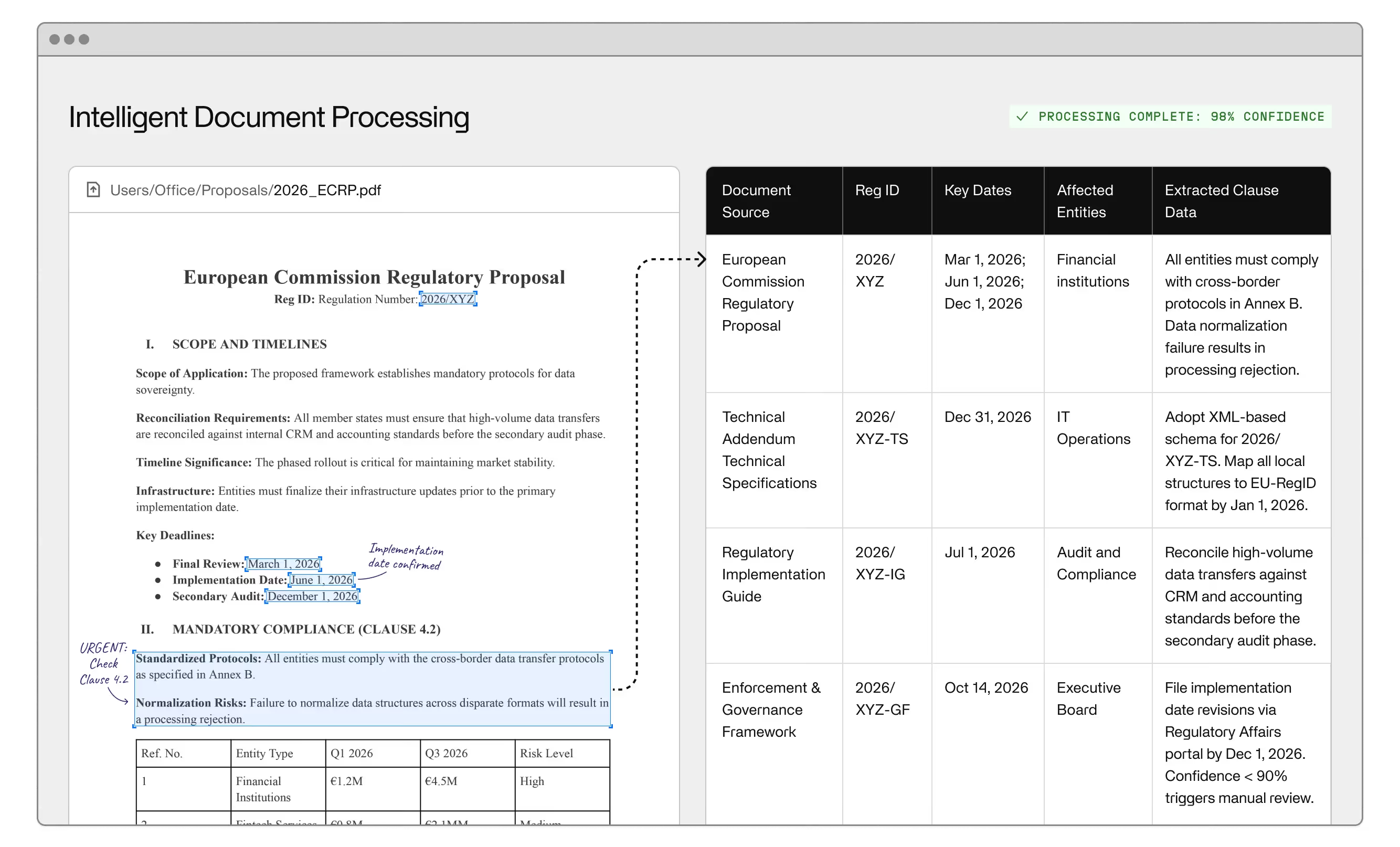
The problem isn't that enterprises don't create knowledge. It's that they create it across dozens of incompatible formats and storage systems that were never designed to talk to each other. Contract terms live in PDFs. Policy decisions live in email threads. Analyst insights live in slide decks no one finds after the first month.
This isn't primarily a technology failure; it's an organizational one. Legacy enterprise systems weren't built for cross-system knowledge retrieval. They were built to execute transactions and store records. The knowledge that accumulates as a byproduct of those transactions is rarely captured anywhere formal: the institutional reasoning behind decisions, the exception-handling patterns that only senior staff know, the context that makes a past deal relevant to a current one.
For industries where consequential decisions depend on synthesizing information across sources, the cost of inaccessible knowledge is measurable and recurring. A due diligence team that reconstructs context from prior transactions every cycle isn't being inefficient; it's operating under a knowledge architecture constraint.
RAG works by giving a language model access to a retrieval layer: a system that searches your actual documents and pulls relevant content into the model's context window at inference time. The model doesn't need to have learned your contracts or policy manuals during training. It retrieves relevant passages when queried and incorporates them into its response.
This is what distinguishes RAG from a standard LLM deployment: a base model answers questions about its training data, while a RAG system answers questions about yours. That means querying your current SOPs, your most recently negotiated contracts, the regulatory filings your compliance team is tracking this quarter. The validation work required to make RAG reliable at enterprise scale is substantial, but the foundation is sound.
RAG is now the standard entry point for enterprise AI deployments that need to work with proprietary knowledge, and increasingly the retrieval layer underneath agentic workflows, where AI systems move beyond answering questions into completing multi-step tasks across sources. That scope expansion raises the bar on retrieval from the outset: a system that works at conversation scale needs to hold up at agent scale too, with the precision and latency that production deployment demands.
A RAG proof-of-concept is fast to build. Getting it to work reliably in production, across diverse document types and at the retrieval precision required for consequential decisions, is where most implementations stall.
The core challenge is data quality and structure. Unstructured data doesn't arrive in a form that retrieval systems can use directly. Every layer of the RAG stack requires domain-specific work that generic tooling doesn't handle automatically. The chunking strategy that works for contracts often fails for email threads; embedding models tuned on generic text won't match domain vocabulary without additional work.
Enterprise data integration, the foundational work of getting source data into a form the retrieval layer can use, is where RAG projects either build a solid foundation or accumulate retrieval failures. Teams that skip this phase find their models returning passages that look relevant but lack the surrounding context a complete answer requires.
There's also a retrieval quality problem distinct from data quality. High-recall retrieval produces noisy context by returning too many documents; high-precision retrieval requires domain-specific tuning that takes time to build. Most teams go through several iterations before reaching the precision threshold production requires.
The teams that move through this fastest instrument their retrieval layer from day one: tracking what gets retrieved versus what actually gets used in final outputs, rather than evaluating outputs alone.
RAG systems retrieve information and incorporate it into model outputs; what they don't do is validate whether that information is current, complete, or appropriate for the specific decision being made — that judgment stays with the people making it.
This distinction matters most in regulated and high-stakes environments. A compliance team's RAG system might retrieve a policy superseded six months ago if the retrieval layer wasn't updated when the policy changed; a deal team still needs to confirm retrieved financial data is from the correct period and entity. The retrieval layer surfaces candidates; human review confirms applicability.
As agentic AI workflows take on more retrieval and synthesis work, the human judgment layer moves upstream, into designing the validation logic and exception criteria rather than performing each retrieval manually. The organizations seeing the clearest ROI from RAG aren't the ones who automated the most. They're the ones who identified the specific knowledge retrieval bottlenecks that slowed consequential decisions and built retrieval systems precise enough to remove them.
Invisible builds and validates enterprise RAG systems designed for production, not demos. Explore our back-office automation capabilities or start the conversation.
A standard LLM operates from its training data and can't access documents created after its training cutoff or proprietary information it was never trained on. RAG adds a retrieval layer that pulls relevant passages from your actual documents into the model's context at query time, making it possible to run AI on current, proprietary enterprise data.
Most enterprise RAG systems natively process PDFs and Word documents, as well as email and slide decks. With the right preprocessing, they can also handle call transcripts and scanned documents via OCR. Structured data like spreadsheets can often be converted to retrievable text formats as well. The harder constraint is data quality: inconsistent metadata degrades retrieval precision before the AI layer is ever reached.
The two most frequent causes are poor chunking strategy and inadequate retrieval evaluation. Documents chunked without preserving context return passages that look relevant but lack the surrounding information a complete answer requires. Teams that evaluate outputs without measuring what gets retrieved often diagnose the wrong problem. Both issues compound when the document corpus has inconsistent structure or metadata.
The clearest signals are whether decision cycle time shortens on knowledge-intensive workflows and whether repeat information requests across teams decrease. Accuracy improvements on decisions that previously relied on manual document review are also worth tracking. Establish a baseline in one workflow before deployment, then measure at 90 days. Cost per query is a less useful metric than decision quality and cycle time.
A focused implementation scoped to one workflow with clean source data can reach production quality in 8 to 12 weeks. Enterprise-scale deployments covering multiple document repositories typically take 4 to 6 months. The variable that most affects timeline is data preparation: getting documents ingested with consistent metadata and chunked in ways the retrieval layer can use, then running retrieval evaluation cycles before going live.