.avif)
AI won’t run your company this year. But it could let ten people do the work of a thousand if you fix adoption. The leap is from pilots to production: senses (multimodal coherence), teams (multi-agent systems), and twins (safe training grounds).
🤖 Hyundai plans to deploy humanoid robots in factories from 2028
Hyundai Motor Group says it will begin rolling out Atlas, a humanoid robot developed by Boston Dynamics, across its global factory network starting in 2028. The robots are designed to work alongside people, gradually taking on physically demanding and potentially dangerous tasks while also operating machines autonomously. Hyundai, which owns a majority stake in Boston Dynamics, says the move is aimed at reducing physical strain on workers and expanding the use of robotics in industrial operations.
🚆AI becomes the operating layer for modern rail
A new industry report argues Britain’s rail network could handle an extra billion journeys by the mid-2030s if AI is embedded across infrastructure, operations, and maintenance. Rather than a single centralized system, AI will show up as distributed prediction and monitoring layers that help humans spot failures earlier, optimize traffic flow, reduce energy use, and manage passenger demand.
🐭 Disney turns AI from experiment into enterprise infrastructure
Disney’s $1B OpenAI deal is less about content creation and more about how a large enterprise operationalizes AI at scale. Internally, Disney has deployed secure LLMs to 225,000 employees for finance, operations, and frontline support, while rolling out agentic AI systems that execute real production tasks instead of just responding to prompts. The company also uses AI to take on parts of the production workflow itself, helping automate tasks like setting up animation rigs, adjusting color and lighting, and filling in intermediate frames in both 2D and 3D animation, with strict QA part of the process.
🛒 Amazon’s AI shopping agents spark backlash from online retailers
Amazon is facing pushback from online retailers over its AI-powered “Shop Direct” and “Buy for Me” tools, which list and purchase products from external websites without explicit consent. Some businesses say their products appeared on Amazon despite opting out of the platform, including incorrect listings and out-of-stock items being sold via Amazon’s agent. While Amazon says retailers can request removal and that the tools are still experimental, the rollout highlights growing tension around AI agents that scrape public data, act on users’ behalf, and blur control over inventory, pricing, and customer relationships.
🏥 AI-powered smart mailboxes cut hospital logistics overhead
Arrive AI is deploying AI-enabled smart mailboxes inside hospitals to automate the movement of biospecimens and medical supplies. At Hancock Regional Hospital, the Arrive Point system integrates with autonomous robots to handle deliveries asynchronously, allowing items to be securely stored, tracked, and temperature-controlled until staff are ready. The setup reduces the need for nurses and technicians to walk materials across large facilities, shifting routine transport work to AI-managed infrastructure and freeing clinical staff to focus on patient care.
🛒 Walmart turns AI into a hands-on ad assistant for brands
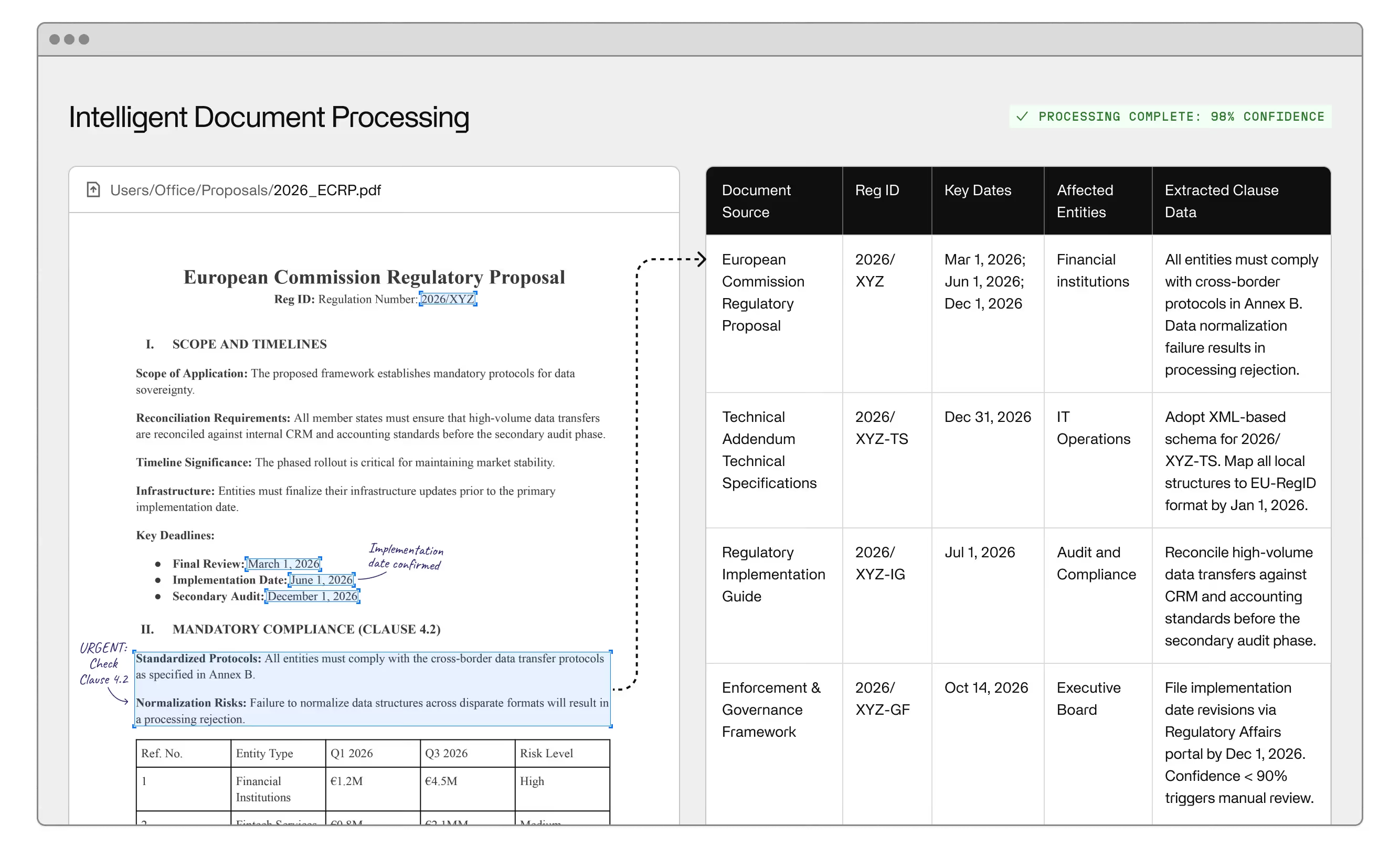
Walmart is rolling out an agentic AI assistant inside Walmart Connect to help advertisers plan, run, and optimize campaigns with plain-language guidance. The tool, called Marty, can answer questions about bidding, keywords, and billing and help brands build and troubleshoot Sponsored Search campaigns without deep ad-tech expertise. Early use shows advertisers are engaging with it in highly customized ways, as 97% of user queries are unique.
😴 AI uses a single night’s sleep to predict long-term disease risk
Stanford Medicine researchers have developed a foundation model called SleepFM that can predict the risk of more than 100 diseases using physiological data from just one night of sleep. Trained on nearly 600,000 hours of polysomnography data and paired with decades of patient health records, the model identified future risks for conditions including heart disease, dementia, Parkinson’s, certain cancers, and mortality with high accuracy.
🚗 Nvidia pushes autonomous vehicles toward human-like decision-making
Nvidia has released a new set of AI tools designed to help self-driving vehicles handle situations they haven’t seen before, like navigating a busy intersection when traffic lights fail. Instead of just reacting to sensor data, the system works through possible actions step by step and chooses the safest option, then explains why it made that choice. Nvidia is also making driving data and simulation tools available so companies can test these decisions at scale.
✏️ AI learns to grade messy handwritten math like a teacher
Researchers at UNIST have built an AI system that can read, grade, and explain mistakes in handwritten math answers, even when the work is poorly written or laid out inconsistently. The model evaluates full solution steps across subjects from basic arithmetic to calculus and flags where reasoning goes wrong. The team says the system is designed to mirror how human graders review work, making it a practical step toward automated feedback for open-ended math problems in real classrooms.
🤖 AI companionship steps out of the screen at CES
At CES 2026, a wave of companion robots and AI-powered pets signaled a quieter shift in how AI is entering everyday life. Beyond task-focused machines, companies showcased devices designed primarily to keep users company. Examples included desk companions that turn an iPhone into an animated, eye-tracking “pet” that follows users during the day, and small robot pets built to offer interaction rather than perform chores.
⚖️ Alaska courts delay AI chatbot after accuracy issues
Alaska’s court system has spent more than a year developing an AI chatbot to help residents navigate probate, only to slow its launch after repeated hallucinations and incorrect guidance. The project, originally planned as a three month effort, revealed how difficult it is to deploy AI in high stakes, rule bound environments where errors can cause real harm. Despite falling usage costs, the team found the system requires intensive testing, human review, and ongoing monitoring as models change.
🧸 California moves to pause AI chatbot toys for kids
California lawmakers are considering a temporary ban on toys that include AI-powered chatbots for children, citing concerns about safety, mental health, and age-inappropriate interactions. The proposed moratorium would last until 2031, giving regulators time to establish clearer rules for how AI systems interact with minors. The move follows studies showing chatbot toys can produce unsuitable responses and growing scrutiny from both state and federal agencies.
🍔 AI makes food fraud easier for delivery apps
Food delivery platforms are seeing a rise in customers using generative AI to manipulate photos of their meals to trigger refunds. Doctored images show food made to look undercooked, damaged, or contaminated, with refunds often issued automatically and the cost passed to restaurants. The incidents highlight how easily AI can undermine trust in systems that rely on visual proof, and how fraud detection workflows built for humans struggle once synthetic evidence enters the loop.
☕ AI companions step into the physical world
EVA AI plans to open a pop-up café in New York where users can sit down for a real-world “date” with their AI companion, using single-seat tables designed for phones. The move reflects how AI companionship is shifting from private, screen-based interactions into shared physical spaces. While some experts warn this could deepen emotional dependence on AI, others see it as a novelty that brings users together around a growing category.
📬 Get the next edition in your LinkedIn feed.