Back-office outsourcing was built to solve a headcount problem. AI automation is built to solve a process problem. These are not the same thing, and conflating them is why so many operations teams end up locked into BPO contracts that deliver cost savings on paper while the underlying workflow dysfunction stays exactly where it was.
If you're evaluating back office outsourcing against AI-powered back-office automation, the comparison most outsourcing companies want you to make is cost per FTE versus technology licensing. That's the wrong frame. The right frame is: what is the actual source of the bottleneck in your business operations, and which model addresses it at the root?
Invisible's back-office automation solutions are built for enterprise operations teams navigating exactly this decision — not to replace the people doing the work, but to absorb the volume and exception handling that currently prevents your team from doing higher-value work well.
Business process outsourcing made sense when the problem was clearly one of capacity. If your team was drowning in data entry, invoice processing, or order processing, the fastest fix was to add labor at a lower cost point — typically through a BPO provider operating in a lower-wage market. Philippines-based operations centers became the default back office support services infrastructure for industries like healthcare, financial services, and e-commerce throughout the 2000s and 2010s.
The model worked under a specific set of conditions: the back-office tasks were well-defined, the volume was predictable, and quality variance was acceptable within a certain range. When those conditions held, outsourcing delivered real cost savings without requiring meaningful changes to the underlying back-office processes. Bookkeeping, IT support, and basic data entry were among the first workflows to move offshore at scale because they fit that profile cleanly.
Those conditions now hold for a much narrower slice of back-office work than they used to.
The benefits of back office outsourcing are real at the surface level — access to specialized expertise, faster onboarding of capacity, and cost reduction without adding to your in-house headcount. But the per-FTE rate is not the whole cost. The full picture includes management overhead, quality assurance infrastructure, ramp time for new agents, attrition and retraining cycles, turnaround time buffers built into SLAs, and the coordination cost of managing a distributed team across time zones.
There's also a ceiling on scalability. BPO capacity scales with headcount, which means spikes in volume require lead time, contractual amendments, or absorbing excess capacity during slow periods. If your back-office operations are subject to seasonal swings, regulatory deadlines, or rapid business growth, the outsourcing model forces you into a perpetual negotiation between the capacity you need now and the capacity you're paying for. Cost efficiency erodes when your volume doesn't match the staffing level your contract was built around.
Data security is a compounding concern. Every handoff to an external back-office services provider is a surface area for risk, and in regulated industries — healthcare, insurance, banking — the compliance requirements around data management and access controls add friction to every process that crosses the boundary between your systems and your outsourcing partner's. Financial reporting accuracy, validation workflows, and anything touching customer data requires careful governance when it leaves your in-house environment.
Customer satisfaction is another variable that rarely appears in outsourcing pricing conversations. Back-office inefficiencies — delayed order processing, errors in customer-facing records, slow resolution of exceptions — have a direct impact on customer experience even when the work itself is invisible to the customer. When back-office operations slow down, the front-office feels it.
None of this makes BPO the wrong answer in every case. But it does mean the economics look different once you account for total operational costs rather than the line item on a vendor invoice.
AI automation doesn't streamline the headcount problem by adding more people at a lower cost. It addresses the process problem by removing the conditions that created the headcount need in the first place — and it does so while keeping your in-house team in control of the outcomes that matter.
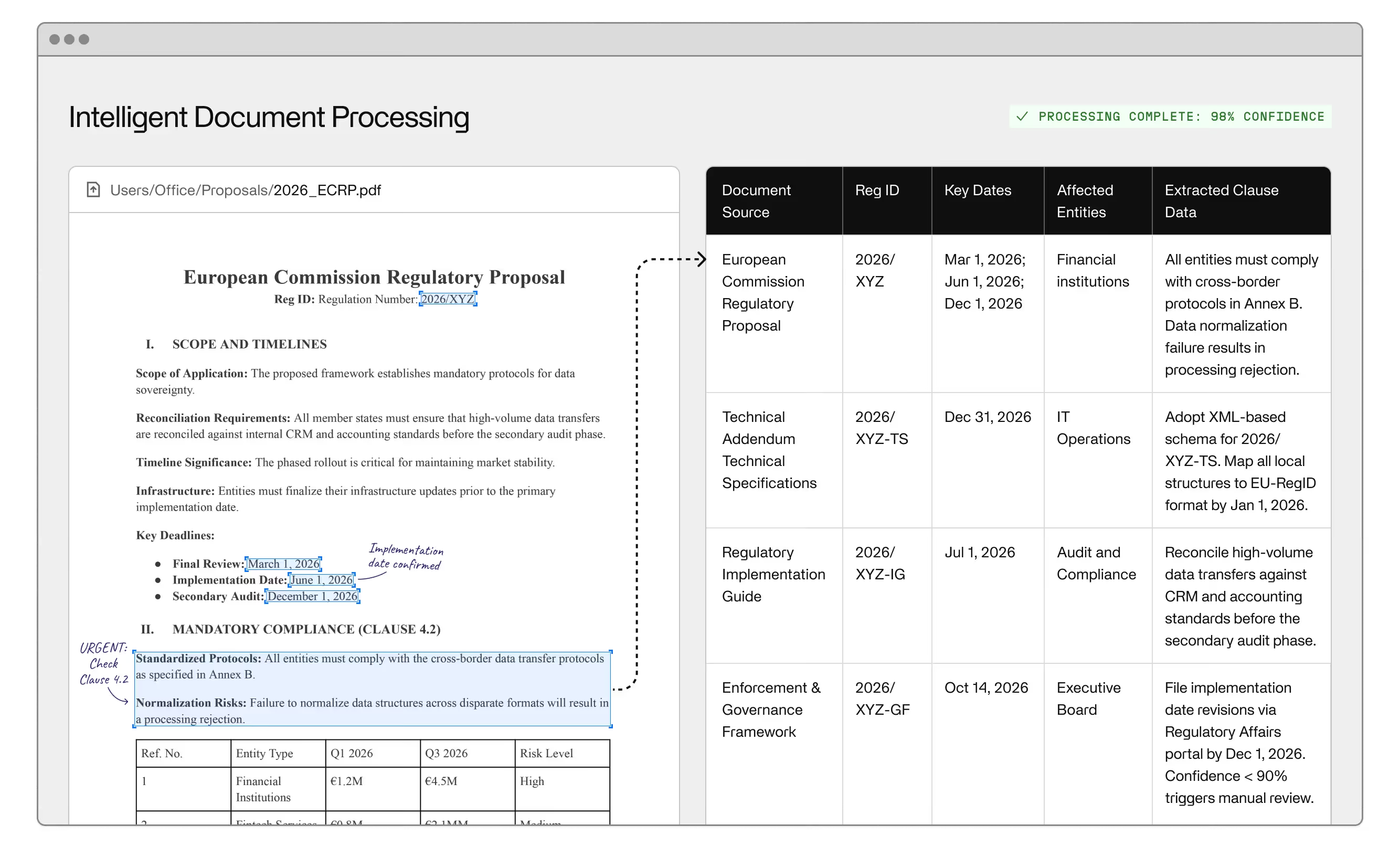
The back-office tasks that drive the highest outsourcing spend — document processing, data extraction from scanned inputs, invoice parsing, compliance exception flagging, approval routing — share a structural characteristic: they involve high volume, moderate complexity, and frequent exceptions that require a decision, not just a keystroke. Traditional RPA handles the predictable portions of these workflows but breaks at the exceptions. Human agents handle the exceptions but at a cost that scales linearly with volume.
AI agents handle both. They ingest unstructured documents, parse inconsistent formats, route by confidence level, and escalate to your internal teams only at the checkpoints where human judgment actually changes the outcome. Your people aren't removed from the process — they're repositioned within it, focused on the decisions that require their expertise rather than the processing volume that doesn't.
For workflows like claims processing, financial reporting, and document-heavy approval chains, this means your team handles materially fewer routine items per day and materially more of the complex, high-stakes work they were hired to do. The administrative tasks get processed faster. The quality gets more consistent. And your team is less overloaded — not smaller.
Neither outsourcing nor AI automation is universally superior. The distinction comes down to the nature of the work.
Back-office outsourcing remains a defensible choice for work that is genuinely rules-based, low-stakes, and stable in format. Basic customer support queuing, straightforward data entry, bookkeeping for standardized transactions, and document sorting where the definition of correct is unambiguous — these are tasks where an outsourcing provider can execute cost-effectively. If the workflow could be described as a checklist and that checklist rarely changes, back office outsourcing services can handle it without significant quality risk.
AI automation earns its place when the work involves variability. Scanned documents with inconsistent layouts. Invoices from hundreds of vendors in different formats. Compliance checks that require cross-referencing multiple systems. Claims that require judgment about coverage applicability. These are the back-office functions where the BPO model relies on experienced agents making semi-autonomous decisions — decisions that can equally be made by an AI system with appropriate human review built into the escalation path. For teams in financial services specifically, this shift from labor-dependent operations to AI-assisted workflows is already functioning as a strategic driver for financial services operations.
The workflows where both models are tried and both eventually disappoint are the ones where the process itself is broken. Automating a broken workflow, or outsourcing it, produces faster or cheaper broken outcomes. Before evaluating either model, the prior question is whether the process design is sound enough to be handed off at all.
The honest limitation of traditional back office outsourcing is exception handling. BPO contracts are priced around predictable work — the steady-state volume that can be staffed to a known FTE ratio. Exceptions are the events that fall outside that steady state: the invoice that doesn't match the PO, the claim with a missing field, the document in a format the intake process wasn't built for.
Every organization has exceptions. The question is what happens to them. In a BPO model, exceptions either absorb disproportionate agent time, get escalated back to your in-house team, or get resolved incorrectly and surface as downstream errors. None of these outcomes are included in the cost-per-FTE calculation, and all of them erode the economics of the outsourcing model at volume. This is one of the structural inefficiencies that back office outsourcing solutions rarely address directly.
AI automation handles exceptions differently because it was designed to encounter them. AI agents route by confidence — processing what they can process cleanly, flagging what requires validation, and learning from corrections over time. The exception is not a breakdown in the system; it's a data point the system uses to improve. Your internal teams receive only the escalations that genuinely need them, rather than being pulled into every edge case the BPO operation couldn't resolve.
This is where the two models diverge most sharply in practice — not on steady-state throughput, but on what happens when the work doesn't conform to the expected pattern.
The evaluation starts with your own process inventory, not with vendor conversations. Map the back-office workflows you're considering and ask three questions about each one.
First: what percentage of the volume involves exceptions, edge cases, or inputs that don't conform to a standard format? If the answer is more than 20%, the BPO model will struggle to deliver consistent quality without significant agent specialized expertise — which means higher cost, slower turnaround time, or both.
Second: how tightly is this workflow coupled to systems your in-house team owns? Workflows that require real-time access to your ERP, your claims platform, or your financial reporting systems are harder to hand off to an external outsourcing partner without introducing latency and data security risk. Back office solutions deployed within your environment eliminate the handoff entirely and keep your core business data under your control.
Third: does the quality of this work compound over time? Data management errors in back-office processes — miscoded invoices, incorrectly categorized claims, misrouted approvals — tend to accumulate rather than cancel out. The cost of a 2% error rate is not 2% of your processing cost; it's 2% multiplied by every downstream system and decision that depends on that data being correct.
If your answers point toward high exception rates, tight system integration, and compounding quality requirements, AI automation is the back office solution that addresses the actual problem. If you're dealing with genuinely stable, low-stakes, format-consistent work, outsourcing remains viable — and some operations teams run both models in parallel, with AI handling the exception-heavy core and BPO supporting the predictable periphery. Retention of institutional knowledge and continuity on customer-facing processes often factors into that decision too.
The goal in either case is to make sure your team's effort is going toward the work that requires their judgment, their core competencies, and their understanding of your core business — not toward processing volume that a well-designed system can handle without them.
If your back-office operations are running on a combination of manual effort and workarounds, Invisible's back-office automation solutions are built to change that. Talk to us about what your operation actually needs.
The per-unit cost of BPO is often lower on a simple FTE-rate basis, but the full cost comparison is more complex. When you include management overhead, quality assurance, attrition, and the cost of exception handling, the economics shift — particularly at scale. AI automation tends to have higher upfront setup costs but a flatter cost curve as volume increases, which means the crossover point arrives earlier than most operations leaders expect.
Yes, and without the lead time constraints of adding headcount. AI agents scale to volume spikes immediately, without contract amendments or ramp periods. The practical ceiling for most enterprise back-office automation deployments is determined by process complexity and system integration, not throughput capacity.
The team shifts from processing volume to managing outcomes. In practice, this means your people spend less time on repetitive data entry and document handling, and more time on the escalations, exceptions, and judgment calls that actually require their expertise. The goal of back-office automation is to relieve your team of the work that overloads them — not to reduce headcount.
Start with processes that are high-volume, document-heavy, and currently producing quality inconsistencies. Workflows where your team spends significant time correcting errors, chasing missing information, or manually routing exceptions are strong candidates. Processes that are genuinely rules-based with stable inputs and low exception rates are better candidates for outsourcing if automation feels premature.
The primary risk is structural: outsourcing optimizes for the cost of the current process rather than the improvement of it. BPO providers and outsourcing companies have little incentive to redesign the workflows they're being paid to staff. Over time, this creates dependency on external labor for processes that could be fundamentally better — faster, more accurate, and less operationally fragile — with a different approach.
They can, and some enterprise operations teams run hybrid models deliberately. AI automation handles the exception-heavy, document-intensive core where quality and speed matter most, while BPO handles genuinely stable, lower-stakes peripheral work. The key is clarity about which workflows belong in each model — and a regular process to reassess that boundary as your AI capabilities mature.
Implementation timelines vary by process complexity and system integration requirements, but enterprise back-office automation deployments typically reach production in weeks rather than months. The critical factor is process readiness — automation moves faster when the underlying workflow logic is well-documented and the edge cases are understood before implementation begins.