AI has moved from boardroom conversation to operational priority. Enterprises across every sector have committed significant resources to AI initiatives — but results remain stubbornly elusive. RAND Corporation found that 80–95% of enterprise AI projects fail to deliver their intended business value, representing hundreds of billions in unrealized investment. McKinsey’s 2025 Global AI Survey found that while 88% of organizations deploy AI in at least one business function, only 39% achieve measurable impact on earnings.
In general, enterprises take one of two approaches to AI deployment: they either A) train an AI model from scratch or fine-tune an open-source model in-house, or B) deploy third-party point solutions within existing business processes.
Too often these approaches begin from a mindset that “AI” is the panacea for complex operations problems. In this post, we focus on the challenges enterprises face when taking these approaches.
Let’s start with Challenge #1.
The organizational requirements for training an enterprise-scale AI model from scratch or fine-tuning an existing model for a specific use case are extremely high. The main barriers to building a successful model or effectively fine-tuning one are cost and complexity.
Training a large-scale model like a large language model (LLM) from scratch now costs between $1 million and $5 million or more in GPU compute alone — and that’s before accounting for expert AI talent, human data trainers, infrastructure, and the cost of failed or repeated runs, which typically add another 1.5 to 3x on top of raw compute expenses. Frontier models from leading labs cost tens of millions in GPU compute alone.
Enterprise leaders can be lured into spearheading in-house AI model training projects that either don’t yield an effective model or creep far past their forecasted costs. That’s because of an outdated approach to model development.
In the beginning, AI researchers trained large language models using data easily collected on the internet. However, just because data is easily available does not mean it is honest, helpful, or harmless to the user.
On the contrary, data easily collected from the internet can be harmful, biased, and toxic — the consequences of which can be worse for the enterprise than an ineffective model. Like a child, these nascent models require supervision and reinforcement of good behavior in order to align with user preferences.
Supervised fine-tuning (SFT) and reinforcement learning (RL) are the methods used by researchers to remove bias and harmful answers from responses generated by LLMs. But performing these techniques to align an AI model is too costly for enterprises to perform in-house.
Thus, enterprise leaders can face project failure or perpetually chase ROI by exclusively managing AI model training internally.
Fine-tuning an existing model is far cheaper than training from scratch — but the investment is still larger than enterprises often anticipate, and the cost of doing it poorly is even higher.
A parameter-efficient approach like LoRA fine-tuning on a 7-billion-parameter model can run $40–$200 per training run. Full fine-tuning of a 70-billion-parameter model can reach $5,000–$30,000 per run. And those figures cover compute only.
One of the most burdensome costs enterprises encounter is data preparation. Out-of-the-box AI tools don’t fully support complex business processes. To effectively support a specific use case, open-source models need to be fine-tuned on cleanly structured, human-in-the-loop data. Enterprises that chase fast AI solutions by feeding models poorly structured or incomplete datasets consistently produce unuseful outputs.
A more effective data preparation approach first involves a strong data preprocessing phase. Data preprocessing is a largely manual process that turns unstructured data into a dataset ready for an AI model to be trained on.
Then the model needs to be fine-tuned on specifically created datasets. Demonstration data is one example: thousands of meticulously crafted conversation examples between a person and a chatbot, built for a specific customer support use case.
These steps become too costly for internal teams because they can’t be automated. People-driven tasks don’t scale well.
Scaling AI training and fine-tuning is complex, labor-intensive, and beyond what most internal teams are built to manage.
Many enterprise leaders will be familiar with and turn to BPOs. However, traditional BPOs can’t provide the quality of human-in-the-loop data required to produce or fine-tune an effective model.
Invisible provides a complete AI training solution for enterprises that are building foundational models or fine-tuning open-source models for specific use cases. Our platform is 100% configurable to enable cost-effective, human-in-the-loop AI training and fine-tuning at scale.
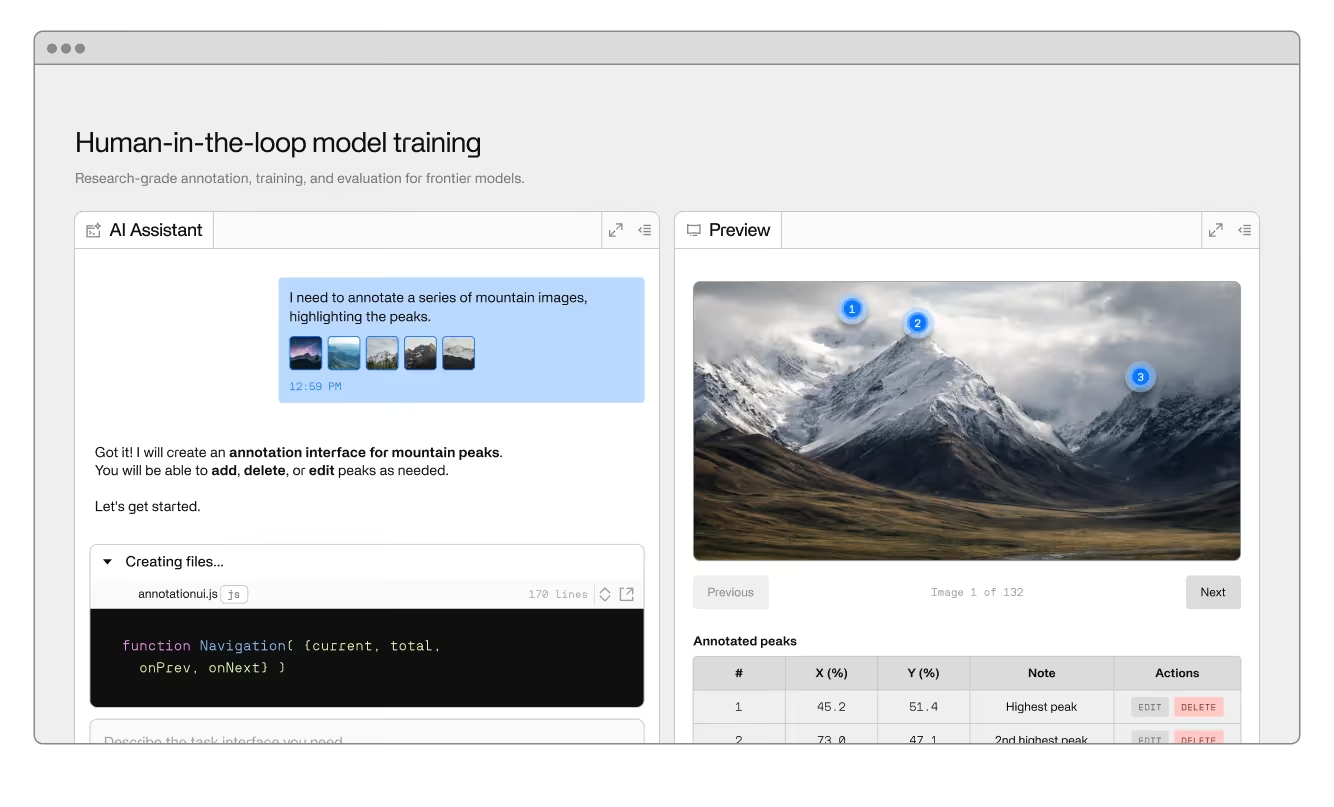
Our global team of AI trainers receives steps unique to their expertise through our platform. Each step is performed via a simple user interface specifically designed for that step’s goal.
In a Reinforcement Learning from Human Feedback (RLHF) step on our platform, an AI trainer provides a prompt and then receives a sample of outputs to rank for accuracy and helpfulness. They can also report if an output is toxic or harmful, providing metadata for why that’s the case.
Without a solution like Invisible, enterprises are forced to build this infrastructure themselves and hire expensive talent, or turn to a BPO that provides poor-quality data.
Ready to harness AI’s potential? Speak to the team.
Fine-tuning is the process of training a pre-existing AI model on a smaller, task-specific dataset to improve its performance on a particular use case. Enterprises pursue fine-tuning because it’s significantly cheaper than training a model from scratch while still producing a model tailored to their specific processes, terminology, and output requirements.
Costs vary by model size and method. A LoRA fine-tune of a 7-billion-parameter model can cost as little as $40–$200 per run in compute. A full fine-tune of a 70-billion-parameter model can reach $5,000–$30,000 per run. Hidden costs — including data preparation, failed runs, and managed-platform surcharges — typically add 1.5– 3x on top of raw compute expenses.
The most common culprits are poor data quality and insufficient data governance. Enterprises that skip or rush the data preprocessing phase — feeding models poorly structured or incomplete datasets — consistently produce models that don’t perform on real business tasks. Without clean, human-verified training data, even a well-architected fine-tuning approach will fail to move the needle on business outcomes.
Human-in-the-loop (HITL) training is a model development approach in which human reviewers provide feedback at key stages of the training process — rating outputs for accuracy and helpfulness, flagging harmful content, and generating demonstration data. HITL methods like supervised fine-tuning (SFT) and reinforcement learning from human feedback (RLHF) are how leading AI labs align models to be honest, helpful, and safe.
Yes. Specialized AI training providers like Invisible offer end-to-end fine-tuning services — including data preprocessing, dataset curation, and model alignment — using a global workforce of trained AI trainers and purpose-built tooling. This approach gives enterprises the benefits of a fine-tuned model without the capital investment and organizational complexity of building the capability in-house.