Healthcare doesn't fail from lack of clinical effort. It fails because the people trained to deliver care spend more time on documentation, prior authorizations, and appointment scheduling than they do with patients. That pressure has been building for decades, and the tools deployed to address it, primarily rule-based robotic process automation, have barely moved the needle. AI automation in healthcare is changing that, not by transforming clinical practice, but by finally targeting the operational layer where the waste actually lives. Invisible's healthcare AI solutions are built around exactly this distinction.
The distinction matters. When executives evaluate healthcare AI automation, they often conflate two separate problems: clinical AI (tools that read medical images, machine learning models that support drug discovery, predictive analytics that flag patient risk) and operational AI (automation of administrative tasks that consume staff time without producing care). Both are real. But the operational problem is the one driving burnout, inflating costs, and slowing health systems down. That's where the measurable gains are happening now.
Healthcare's operational crisis is structural, not a staffing problem. Electronic health records were designed for documentation and billing compliance, not clinical efficiency. The result is that physicians spend roughly two hours on data entry and administrative tasks for every one hour of direct patient care, a ratio that has worsened as those documentation requirements have expanded. Nurses and care coordinators face similar pressure: a significant portion of their shift time goes to tasks that generate no clinical value. The systemic pressures driving this crisis run deeper than staffing.
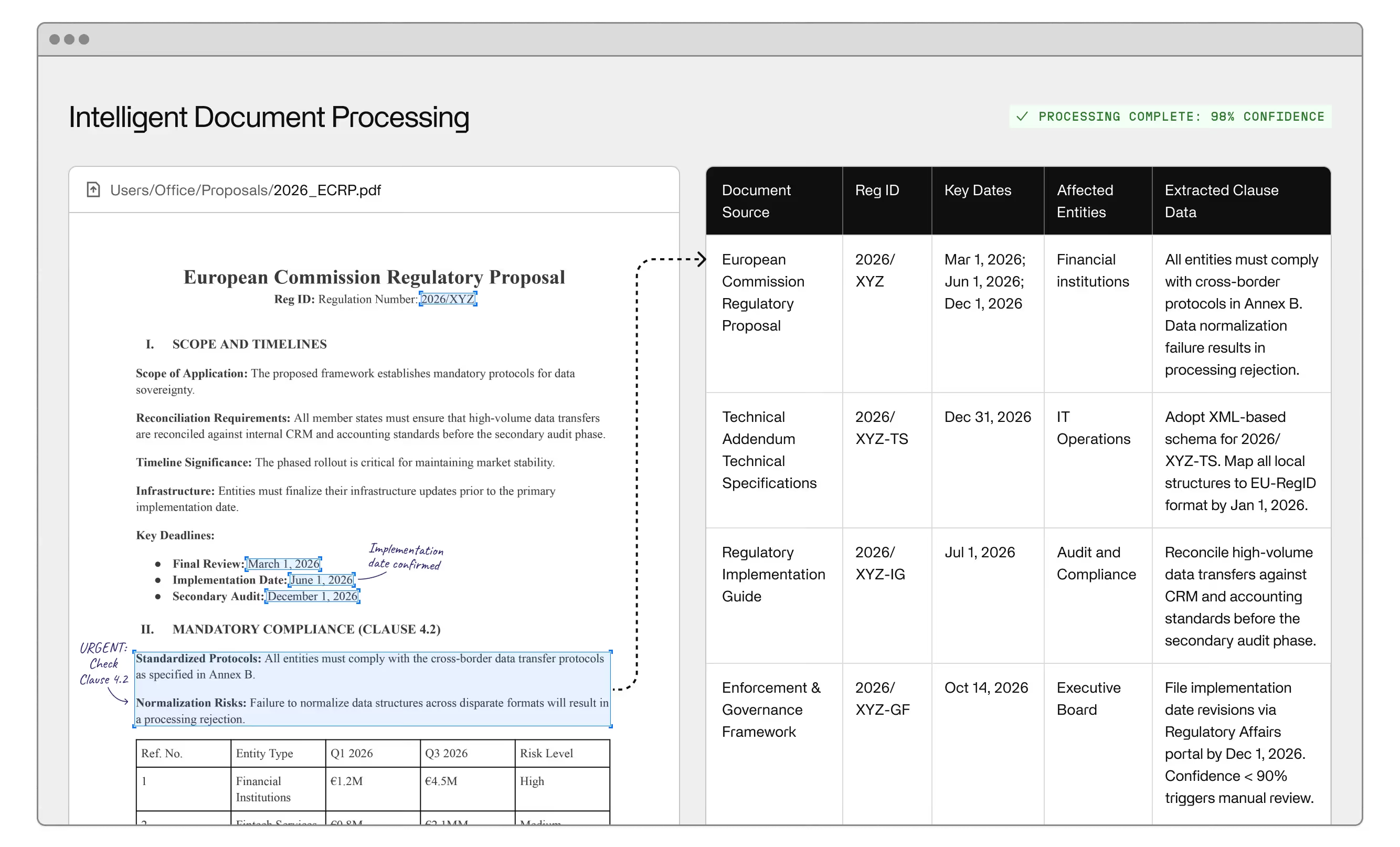
RPA addressed a narrow slice of this. It automated high-volume, perfectly structured tasks: certain data entry workflows, simple appointment reminders, templated eligibility checks. That delivered real savings in those pockets. But healthcare operations are not primarily composed of perfectly structured tasks. Prior authorization requires reading unstructured clinical notes. Claims processing involves interpreting inconsistent payer rules. Patient intake requires pulling data from sources that don't share a standard format. Rule-based automation breaks on all of it, and the exception rate in most deployments runs high enough that human review queues end up consuming the time saved elsewhere. The tradeoffs between back-office outsourcing and AI automation clarify why the RPA generation of tools fell short.
Generative AI and large language models change the capability profile. Natural language processing applied to structured and unstructured clinical data can extract, classify, and route information without requiring standardized inputs. AI agents move through payer portals, interpret denial reasons, and draft appeals without human intervention at every step. This is not incremental improvement on legacy automation. It's a different class of tool applied to a different class of problem.
The administrative workflows where AI automation in healthcare is producing measurable results are concentrated in revenue cycle and patient access — the two areas where complexity is highest and the cost of errors is most visible.
Revenue cycle management is the clearest case. Claim denials cost health systems billions annually, and a significant share are administrative: missing information, coding errors, authorization gaps. AI models trained on payer-specific denial patterns flag likely rejections before claims go out. Generative AI drafts appeal letters from clinical documentation. The operational impact is measurable: denial rates drop, resubmission cycles shorten, and cash flow accelerates without adding headcount to the billing team.
Appointment scheduling and patient intake are the second major area. Virtual assistants and AI-powered chatbots handle inbound scheduling requests, insurance verification, and pre-visit intake at scale, tasks that previously required front-desk staff time on every interaction. The gains compound: fewer no-shows from automated appointment reminders, shorter check-in times from pre-populated intake forms, and reduced call volume freeing staff for higher-complexity interactions.
Prior authorization is where operational AI is beginning to address one of healthcare's most intractable processes. The prior auth workflow — submitting clinical justification to payers, tracking status, responding to requests for additional information — runs almost entirely on manual effort today. Purpose-built AI agents that read clinical notes, identify relevant documentation, and submit structured authorization requests represent a direct attack on a process that consumes physician and staff time with no clinical upside.
Staff scheduling and resource allocation round out the picture. Predictive analytics applied to patient census data, historical demand patterns, and acuity levels give operations leaders a more accurate basis for scheduling decisions. Better-staffed shifts produce fewer medication errors; more consistent coverage improves preventive care delivery.
Radiology, oncology, drug discovery, robotic surgery, clinical decision support, clinical trials — these represent the most visible face of artificial intelligence in healthcare, and they matter. AI models that identify oncology treatment candidates faster than manual chart review, that read medical images with accuracy comparable to specialists, or that accelerate drug discovery timelines are transforming clinical practice. Remote patient monitoring creates continuous data streams that change how chronic disease is managed. Personalized medicine, meaning treatment protocols adapted to individual patient profiles using machine learning, depends on AI infrastructure that didn't exist a decade ago.
But these are clinical decisions, not administrative tasks. The governance requirements are different. The validation process is different. The regulatory path is different. A health system evaluating AI automation in healthcare for operational improvement is not making the same procurement decision as one evaluating a clinical decision support tool. Conflating them leads to misaligned expectations, misdirected budgets, and projects that stall because the wrong stakeholders are in the room.
NLP bridges the two worlds in specific ways: extracting structured data from clinical notes to feed both administrative and clinical systems. But the use cases and success metrics diverge quickly. For a fuller picture of how AI is transforming healthcare more broadly, the clinical and data infrastructure story is covered separately. Treat them as separate programs with separate business cases.
Compliance is not a checkbox that vendors satisfy and then move on from. In that context, it defines the architecture of every system that touches protected health information — which, in operational AI, means nearly all of them. Claims data, patient records, appointment histories: all PHI, all subject to the relevant privacy and security rules.
The practical implications for deployment are concrete. Data used to train or fine-tune AI models must be de-identified or covered by appropriate business associate agreements. Audit trails for automated decisions must be preserved. Access controls and encryption standards must meet the technical safeguards requirements. Any system that processes PHI in the cloud requires a signed BAA with the vendor.
Interoperability is a related constraint that shapes what AI automation in healthcare can actually do. Health systems run on EHR platforms that don't natively share data, payer systems that use inconsistent formats, and legacy infrastructure that predates modern API standards. Systems that can't access the data they need can't automate the workflows they're deployed against. Evaluating a vendor's track record integrating with your specific environment is not a technical detail; it's a prerequisite for deployment success.
Change management is consistently underestimated in healthcare AI implementations. Clinical and administrative staff who have built workflows around existing systems resist automation that changes how they interact with those systems, particularly when the first version isn't perfect. Phased rollouts with clear success metrics, training built around actual workflow changes, and visible executive sponsorship all predict better adoption outcomes than technology selection alone.
The right metrics are specific to the workflows being automated. For revenue cycle: first-pass acceptance rate, denial rate by payer, days in accounts receivable, appeal success rate. For appointment scheduling: no-show rate, scheduling cycle time, call volume handled without staff intervention. For prior authorization: turnaround time, approval rate, staff hours per request.
Patient outcomes enter the picture indirectly. When pressure on clinical staff decreases, time with patients increases. When medication management systems reduce medication errors through automated verification and alert systems, adverse events decrease. When preventive care gaps are identified automatically rather than through manual chart review, outreach happens earlier. These are downstream effects, not direct automation outputs — but they're the ones that matter to health system leadership and to patients.
The operational case for healthcare AI automation does not require the clinical case alongside it. Revenue cycle improvement, staff time recaptured, and denial rate reduction are measurable in quarters, not years. Start there, demonstrate the return, and the path to broader AI investment becomes significantly easier to build.
Invisible builds production AI for health systems — from revenue cycle automation to HIPAA-compliant deployment. See how at invisibletech.ai/industries/healthcare or get started.
AI automation in healthcare is delivering measurable results in prior authorization, appointment scheduling, patient intake, revenue cycle management, and EHR data entry. These workflows share a common profile: high volume, semi-structured inputs, and significant staff time consumed per transaction. AI agents and generative AI models handle the interpretation and routing that rule-based automation could not, reducing both processing time and error rates.
Healthcare AI automation reduces the overhead that pulls clinical staff away from patient care. Physicians in health systems using AI-assisted documentation and data entry report meaningful reductions in after-hours charting. The mechanism is direct: tasks that previously required manual input are now handled automatically, and the recaptured time returns to clinical activity.
HIPAA-compliant AI deployment requires business associate agreements with any vendor that processes protected health information, de-identified or appropriately governed training data, audit trails for automated decisions, and encryption and access controls meeting the required technical safeguards. In practice, this means evaluating vendors on their BAA track record and their experience deploying in regulated healthcare environments — not just their AI capability.
RPA automates structured, rule-based tasks and breaks when inputs deviate from the expected format. AI automation in healthcare handles unstructured inputs like clinical notes, inconsistent payer formats, and free-text fields, using natural language processing and machine learning. The difference is not speed; it's the range of tasks that can be automated. Prior authorization and complex billing workflows are not problems that rule-based automation can solve; they require AI.
Yes. AI models trained on payer-specific denial patterns identify likely rejections before claims are submitted, allowing corrections that prevent the denial entirely. For claims that are denied, generative AI drafts appeals from clinical documentation faster and more consistently than manual processes. Health systems deploying this approach to revenue cycle management typically report first-pass acceptance rate improvements and measurable reductions in days in accounts receivable within the first year.
Successful healthcare AI automation produces measurable operational results within the first year: lower denial rates, faster authorization turnaround, reduced no-show rates, and staff time recaptured from administrative tasks. The implementations that work combine compliant, secure architecture, genuine interoperability with existing systems, and change management investment — because technology that staff don't adopt doesn't deliver returns regardless of its capability.