Banking back-office operations are an ideal environment for AI deployment because the work is high-volume, document-intensive, and defined by regulatory obligation: exactly the conditions where automation produces the largest measurable returns.
The problem is that most first-generation automation efforts stopped at rule-based RPA. Robotic process automation delivered quick wins on data entry and report generation, but it was brittle. Any change to a source system or regulatory requirement required rebuilding the bot. What banking operations actually needs is intelligent automation that combines artificial intelligence, machine learning, and natural language processing with RPA: systems that can handle exceptions and unstructured data, not just follow scripts.
Back-office processes in banking span a significant range: KYC and know your customer verification, AML and anti-money laundering screening, loan processing and loan origination, account opening, payment processing, regulatory compliance reporting, fraud detection, and credit scoring. Every one of these generates structured and unstructured data that modern AI systems can process at scale. What they share is a need for audit trails, data security, and regulatory reporting that satisfies both internal governance and external examiner requirements.
The banks that have moved beyond pilot-stage banking automation are not necessarily the largest or most technically sophisticated. They're treating digital transformation as an operations discipline: they invested in process mining before picking their automation stack, and they're seeing 60 to 80% reductions in manual processing time on their highest-volume back-office workflows.
The most important decision in the first 30 days is which processes to automate first, not which technology to deploy.
This matters because banking automation failures are almost always rooted in Phase 1 errors: teams select processes based on what seems technically feasible rather than what will produce the highest risk-adjusted return, then discover too late that the selected process has exception rates or regulatory constraints that weren't visible upfront.
Start with process mining. Process mining tools analyze event logs from your core banking systems, your loan origination system, and your customer onboarding platform to show you what your processes actually look like, not what your SOPs say they should look like. The gaps between documented and actual workflows are where your automation candidates live. Understanding which back-office processes are strongest automation candidates before you build your process inventory saves significant rework in Phase 2.
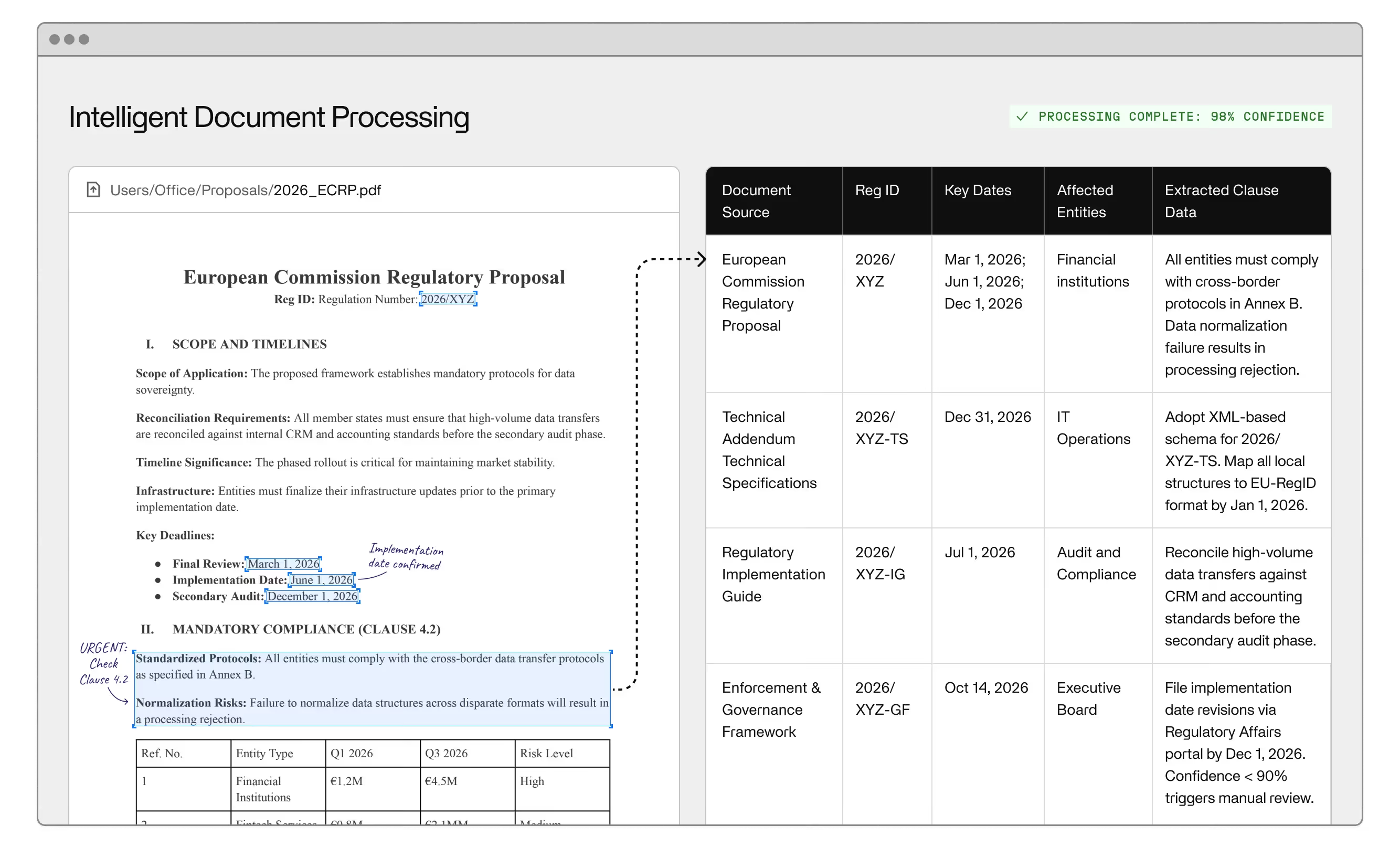
Identify document-heavy workflows first. Intelligent document processing (IDP) is one of the fastest-payback automation categories in banking. Document verification, KYC packet review, loan processing document extraction, and regulatory reporting data assembly are all well-suited to IDP. The combination of NLP and machine learning allows these systems to handle documents that would break any rule-based RPA bot.
Assess your core banking platform and API posture. Integration is where back-office automation projects slow down. Catalog which systems are accessible via APIs and which require attended or unattended RPA to extract data. Legacy systems that don't expose APIs need to be treated as separate integration tracks: plan their sequencing in Phase 1 rather than discovering them as blockers in Phase 2.
Establish data security and audit trail requirements before you build anything. Banking operations live inside a compliance framework. Every automated workflow needs a defined audit trail, and every AI system that touches customer data needs a documented data security review. Build these requirements into your architecture in Phase 1, not as a Phase 3 add-on.
Change management starts now. The back-office teams running these processes are your subject matter experts. Engage them in Phase 1 process mapping rather than presenting automation as something being done to them. Operations leads who've seen RPA deployments come and go are skeptical for good reasons. Demonstrate that this deployment is different by involving them in process selection.
Your Phase 1 deliverables: a prioritized list of five to eight business process automation candidates with estimated exception rates and integration complexity; an API inventory across core banking systems and loan origination platforms; a data security and audit trail requirements document; and a change management communication plan.
Most banking AI deployments fail during integration with core banking systems, not during initial build.
The models work. The APIs work. What breaks is the assumption that data flowing from a 15-year-old core banking platform will be clean and consistent enough for an AI system to process. In practice, you'll encounter field-level inconsistencies, encoding variations, and exception cases that were never visible in the process mining data because they were being handled manually by someone who knew how to work around them.
Deploy KYC and AML automation first. KYC processes and anti-money laundering screening are high-volume, high-stakes workflows that have well-defined regulatory requirements and clear pass/fail criteria. Intelligent automation here combines document verification, NLP-based entity resolution, and rules-based screening in a way that's auditable and explainable to examiners. The combination of machine learning for document classification and RPA for data extraction into your AML platform is a proven starting point.
Build fraud detection into the deployment from day one. Fraud detection cannot be treated as a Phase 3 add-on when you're automating payment processing or account opening. Machine learning models trained on transaction history and behavioral signals need to be woven into the automated workflow at the point where they can actually block a transaction, not flagged for human review two steps later. Integrate fraud detection model outputs as gates within the process orchestration layer, not as independent alerts.
Intelligent process automation for loan origination. Loan processing and loan approvals are strong Phase 2 targets (our guide to evaluating AI vendors for banking operations is worth working through before you commit to a platform) because the workflow steps are well-defined: document collection, IDP-based data extraction, a credit scoring model call, a compliance check, and decision routing. Robotic process automation handles the data movement; machine learning handles classification and extraction; AI agents handle exception routing. The combination is faster than any manual process and produces a full audit trail by default.
Deploy chatbots for internal back-office support. Operational chatbots that give agents real-time access to loan origination status, account opening progress, and regulatory reporting data reduce the ad hoc interruptions that fragment back-office work. Natural language processing allows these systems to handle the imprecise way people actually ask questions rather than formatted query strings.
Use AI agents for exception handling. The exception case is where most banking automation ROI is lost. When an IDP system can't confidently extract a field, or when an AML screening hit requires contextual judgment, you need AI agents that can gather additional data, apply decision logic, and either resolve the exception or escalate with full context. Agentic AI systems working across multiple systems to resolve exceptions outperform human review queues on cycle time by a significant margin — Invisible clients in financial services have cut exception resolution time by more than 70% using this approach.
Your Phase 2 deliverables: KYC and AML automation live in production; loan processing workflow automated end-to-end with exception handling; internal operational chatbot deployed; API integration map updated with real-world data quality findings.
Days 61 through 90 are where banking automation programs either compound their returns or stall at the pilot stage. The work here is governance, scale, and connecting the individual workflow automations deployed in Phase 2 into a coherent operating model.
Add the business process management layer. Individual automation deployments that aren't connected through a process orchestration layer don't compound. A workflow automation in KYC and a separate automation in loan processing are useful in isolation; they are transformative when they share data and handoffs through a common orchestration fabric. This layer is what allows you to automate complex, multi-step processes rather than single-step tasks.
Scale customer onboarding and credit scoring. Customer onboarding is one of the highest-ROI automation targets in retail banking because it touches KYC, AML screening, credit scoring, and account setup in sequence. Fully automating this flow using IDP, machine learning models for credit decisioning, and AI agents for exception handling reduces onboarding cycle times significantly and creates a measurably better customer experience without sacrificing compliance rigor.
Integrate predictive analytics for risk management. Fraud detection models that flag anomalies before settlement and credit risk models that monitor portfolio concentration in real time are both Phase 3 capabilities. So are compliance models that surface regulatory threshold exposures before they become violations. These are not new model deployments; they are the application of the AI infrastructure you built in Phases 1 and 2 to higher-stakes use cases.
Use generative AI for regulatory and compliance reporting. Regulatory reporting is one of the most labor-intensive back-office functions and one of the best fits for generative AI with appropriate guardrails. AI systems trained on regulatory templates and connected to your core banking data can draft compliance reports, identify data gaps, with your core banking data can draft compliance reports, identify data gaps, with your core banking data can draft compliance reports, identify data gaps, with your core banking data can draft compliance reports, identify data gaps, with your core banking data can draft compliance reports, identify data gaps, with your core banking data can draft compliance reports, identify data gaps, with your core banking data can draft compliance reports, identify data gaps, and flag fields that require human review before submission. The human reviewer becomes the editor and verifier rather than the drafter.
Establish AI agent governance before full-scale rollout. AI agents that can take autonomous action within banking workflows need governance structures in place before they operate at scale. Define decision boundaries explicitly: what decisions can an agent make without human review, what decisions require escalation, and what creates a mandatory human-in-the-loop gate regardless of confidence score. Document these boundaries in your operational runbooks and test them against edge cases during Phase 3. This applies equally to agentic AI workflows that chain decisions across multiple systems, where each system handoff is a potential governance gap.
Your Phase 3 deliverables: end-to-end customer onboarding automation live; process orchestration layer connecting Phase 2 deployments; predictive risk management models integrated into production; generative AI drafting in regulatory reporting workflows; documented AI agent governance framework with tested escalation criteria.
Most banking back-office automation projects stall because they skip process mining, underestimate legacy system integration complexity, or deploy workflow automation without a connection layer.
Skipping process mining is the most common failure mode. Teams select automation candidates based on what seems complex or time-consuming rather than what has the highest exception rate or the most data-quality risk. Process mining surfaces the actual failure patterns in your workflows. Without it, you're automating what you think your processes look like, not what they actually do.
Underestimating legacy system complexity is the second. Core banking platforms that don't expose APIs require RPA for data extraction, and RPA bots that depend on screen scraping break when UI latouts change during a maintenance window. This isn't a reason to avoid automation; it's a reason to map your integration dependencies in Phase 1 and sequence your deployments accordingly. Teams that treat legacy integration as an afterthought discover it in Phase 2, when the cost of replanning is highest.
Change management failures are underreported because they're uncomfortable to name. Back-office operations teams that have watched three RPA rollouts get abandoned aren't going to adopt a fourth without concrete evidence this one is different. The difference isn't in the technology; it's in whether you involve them in process selection, give them visibility into exception queues, and connect their performance metrics to automation outcomes. Understanding why automation projects fail before you start your program is more valuable than any technology selection decision.
Disconnected workflow automation is a Phase 3 failure that starts in Phase 1. Deploying automation capabilities that aren't connected through process orchestration produces a set of islands: each one generates data, exceptions, and performance metrics independently, but none of that information flows where it's needed. The banking technology and regulatory environment you're operating in requires that your automation investments connect to each other, because regulators need process-level audit trails that span systems, not point-in-time system logs. Getting your back-office automation into a production-ready AI platform means building the connective tissue between deployments in Phase 1, not retrofitting it in Phase 3.
Ready to move from automation pilots to production-scale back-office transformation? Invisible's back-office automation practice works with banking operations teams to design and deploy AI systems that integrate with your existing infrastructure. Talk to the team.
Most organizations see measurable ROI within 60 to 90 days of Phase 2 deployment, primarily from KYC cycle time reduction and exception handling efficiency gains. Full program ROI, including Phase 3 scale and governance, typically becomes visible within six to nine months. Initial pilots in document processing and AML screening tend to deliver the fastest payback.
Build audit trail requirements into your architecture in Phase 1, not after deployment. Every automated workflow should log decision inputs, outputs, and exception routing to a system of record. AI systems touching customer data need documented data lineage, and any AI agent capable of autonomous decisions needs defined escalation criteria and a human-in-the-loop gate for edge cases.
RPA handles rules-based, repetitive tasks by replicating human actions across systems, with no ability to process exceptions or unstructured data. Intelligent automation combines RPA with machine learning, NLP, and AI agents to handle variable inputs, unstructured documents, and exception cases. In banking, loan processing and KYC workflows almost always require intelligent automation rather than RPA alone.
Involve back-office operations leads in Phase 1 process selection rather than presenting automation as a decision already made. Skepticism in experienced teams usually reflects failed prior deployments, not resistance to improvement. Give teams visibility into exception queues and connect their performance metrics to automation outcomes. Make them owners of process improvement rather than subjects of it.
Start with high-volume, document-heavy workflows that have clear pass/fail criteria and well-defined regulatory requirements: KYC packet processing, AML screening, and loan document extraction consistently produce the fastest payback. Avoid starting with processes that have high exception rates or unresolved legacy system dependencies until you have completed process mining and confirmed your integration posture.
Yes, with appropriate guardrails. Generative AI is well-suited for regulatory report drafting, compliance summary generation, and exception documentation because the output is reviewed before submission rather than acted on autonomously. The risk profile differs from AI agents making autonomous routing decisions. The highest-value applications are those where a human reviewer approves the AI draft rather than replacing the review step.
Define decision boundaries explicitly before deploying AI agents at scale. Document what decisions an agent can make autonomously, what requires escalation, and what triggers mandatory human review. Test these boundaries against edge cases before full rollout. Agents operating outside defined boundaries create audit trail gaps; agents with well-defined escalation paths are defensible to compliance examiners.