AI won’t run your company in 2026. It could, however, let ten people do the work of a thousand if you fix adoption. The leap is from pilots to production: senses (multimodal coherence), teams (multi-agent systems), and twins (safe training grounds).
🤖 Robots take over late-night lab work as AI-driven chemistry ramps up
The University of Liverpool is using autonomous, AI-guided robots to run chemistry experiments around the clock, moving materials, running reactions, and deciding next steps while researchers sleep. The system has already handled more than 50 experiments overnight and is inspiring major investment, including a new £100 million AI-driven materials research hub. Similar efforts at Glasgow’s Chemify aim to design and make molecules on demand.
🧱 AWS adds new AI agents for rapid legacy system upgrades
AWS has introduced agentic capabilities that help companies update technical debt much faster and with far less manual work. The new tools can review large, outdated systems, suggest a plan, make the needed changes, and generate tests and documentation. Early users, including Air Canada and Thomson Reuters, say the upgrades that once took months can now be done in days or weeks, cutting costs and helping teams shift time from maintenance to new projects.
📝 Deloitte faces AI citation controversy—again.
For the second time this year, a Deloitte government-commissioned study has been found to contain potentially AI-generated citation errors—this time in a 526-page health care report for Newfoundland and Labrador. An investigation identified nonexistent academic papers, misattributed authors, and missing sources, echoing similar issues flagged in an Australian Deloitte report earlier this year.
🏦 BofA says AI is helping bankers serve more clients and drive revenue
Bank of America says AI tools are allowing relationship bankers to cover far more clients by automating prep work, while advisers receive AI-generated market insights tailored to client portfolios. Its 18,000 developers are also using AI agents to speed up routine tasks, and the bank’s virtual assistant, Erica, has handled billions of customer interactions. BofA says it’s focusing on reskilling employees to use AI rather than cutting jobs. The bank plans to invest $4 billion in new technology, with AI at the center of its strategy to boost banker productivity and expand revenue opportunities.
Learn more: Invisible's contact center solution provides unified data, automated QA, sentiment/risk signals, manager-ready dashboards, and AI voice agents.
⚖️ California prosecutors withdraw filing after AI-generated citation errors
A prosecutors’ office in Nevada County, California, acknowledged using generative AI to prepare a court filing that included inaccurate, hallucinated citations, prompting the motion to be withdrawn. Defense attorneys say similar AI-style errors appeared in multiple cases and have asked the California Supreme Court to review the issue. The district attorney’s office says only one filing involved AI and that other errors were human.
☎️ Staffordshire Police to pilot AI agents for non-emergency 101 calls
Staffordshire Police will test AI-powered call-handling agents on its non-emergency line to manage simple information requests and reduce wait times. The system, already in use in Thames Valley, can route callers to human operators if it detects signs of risk or urgency. Police leaders say the pilot aims to free call handlers to focus on 999 emergencies as the force works to bring down historically long 101 wait times.
🏢 OpenAI takes stake in Thrive Holdings to embed AI in manual-heavy industries
OpenAI is taking an ownership stake in Thrive Holdings and will embed a dedicated research team to help modernize businesses in sectors like accounting and IT services, where work is still largely manual. Thrive says off-the-shelf AI tools weren’t sufficient for the complex, domain-specific tasks inside its portfolio companies, so the partnership will focus on building tailored models trained with expert feedback.
🧩 Forrester says AI agents will reshape enterprise software in 2026
Forrester predicts enterprise applications will shift from supporting human users to coordinating a growing digital workforce of AI agents, pushing organizations to modernize tech stacks and redesign processes around automated workflows. The firm also expects more vendors to add tools that help different AI systems work together and to introduce built-in compliance features that keep automated processes in check.
🧩 New “Tiny” AI model shows strong logic-reasoning ability with minimal data
Researchers have developed a small AI model called Tiny Recursive Model (TRM) that solves visual logic puzzles such as sudokus and mazes better than much larger systems, despite being 10,000 times smaller and trained on only about 1,000 examples per puzzle type. The model improves its answers through repeated refinement rather than relying on massive datasets, and its release has sparked interest in whether similar techniques could help strengthen reasoning in other AI tools.
🧬 MIT debuts AI model that can generate novel protein binders for hard-to-treat diseases
MIT researchers have released a generative AI model designed to create new protein binders from scratch, a step beyond existing tools that only predict structures. Tested across 26 challenging disease targets in eight labs, BoltzGen aims to help drug developers pursue “undruggable” problems by unifying protein design and structure prediction while enforcing physical constraints.
🇨🇳 DeepSeek gains momentum in global developer adoption
China’s DeepSeek has launched a new AI model aimed at developers worldwide, part of a broader push by Chinese companies to dominate open-model usage. Analysts say Chinese open-source stacks now account for most new downloads, with many startups building directly on them thanks to lower costs and easier customization. The new DeepSeek model, which performs strongly on math reasoning, adds pressure to U.S. firms as competition shifts toward efficiency, transparency, and alternative architectures rather than scale alone.
🧰 AWS to help companies build their own AI models
AWS introduced a new service that lets organizations train their own versions of AWS’s Nova models using their internal data while keeping the models’ core reasoning abilities. The tool is designed for businesses that want AI tuned to their specific domain, offering options to train in their own environments, build smaller and faster models, and apply built-in safety controls. Analysts say Nova Forge reflects a shift toward AI that’s shaped by a company’s data rather than just large general-purpose models, but it’s most useful for organizations that already understand and manage their data well.
🇫🇷 Mistral launches new AI models for enterprises and on-device use
Mistral released a new suite of models, including a large model for enterprise assistants, scientific workloads and complex workflows, and a compact “Ministral 3” model that can run on drones, cars, robots and phones. The company says smaller models offer lower costs, faster responses and strong performance for specialized tasks. The launch follows a new deal with HSBC and growing commercial adoption across industries.
🐋 AI helps researchers discover vowel-like sounds in sperm whale communication
Scientists studying Caribbean sperm whales found that the animals’ clicking patterns contain distinct acoustic features similar to human vowels, including combinations that resemble diphthongs. Using AI trained on human language, researchers identified spectral patterns within whale “codas” that appear intentional and structured, suggesting the whales use more complex, conversation-like communication than previously understood.
⛸️ AI to help revolutionize Olympic-level figure skating
A new AI-powered app called OOFSkate is being tested by U.S. Figure Skating to analyze jump height, rotation, airtime, and landing quality using only a phone or tablet camera. Built by two computer scientists, the tool gives skaters and coaches instant feedback and could eventually help technical panels score elements more consistently. Broadcasters and top athletes are already using early versions as the developers refine the system ahead of the 2026 Olympics.
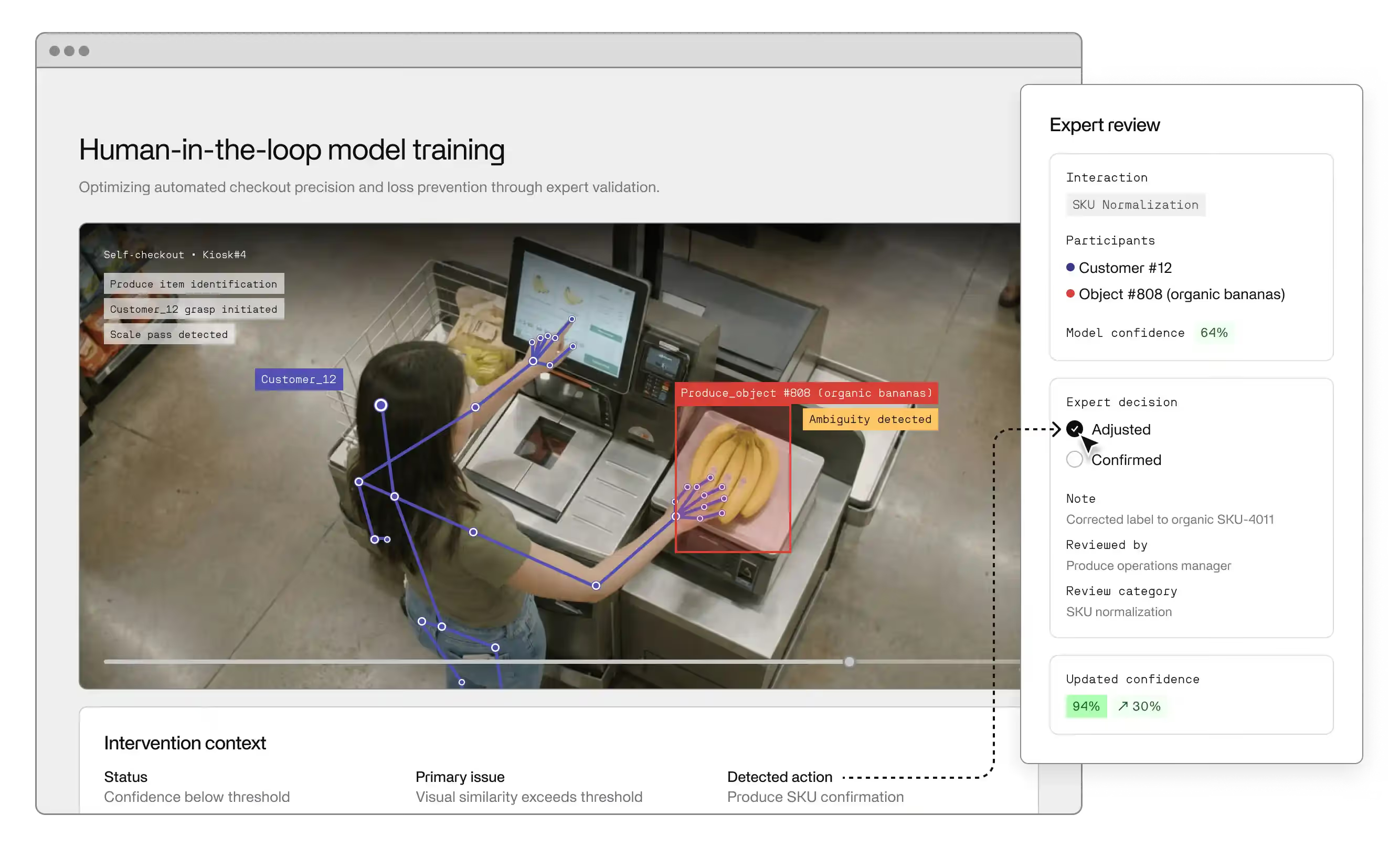
Learn more: Invisible's computer vision solution converts your videos into structured time-series data to offer advanced insights.
🎄 Coca-Cola draws backlash for AI-generated holiday ad
Coca-Cola’s new holiday commercial is facing criticism for its obvious use of generative AI to create animal characters and winter scenes, echoing the response to last year’s AI-driven campaign. Viewers pointed to inconsistent textures and exaggerated expressions typical of current AI video tools. The one element welcomed by critics was Coca-Cola’s clear on-screen disclosure that the spot was AI-generated, something many brands still avoid.
♻️ Subscribe on LinkedIn and share it with your network!





.avif)