
Conversion? Lower. CSAT? Lower. Loyalty? Lower. A modest performance decline consumed that 70% cost saving faster than any finance model accounted for. Management revised my mandate: reduce costs by 70%, while maintaining the same or better performance. That was a different task. For the next two years we reinvested a meaningful portion of the labor savings back into the infrastructure required to make the savings real — compensation rates relative to local markets, hiring practices, training programs, even how agents got to and from the office. We built captive sites. It took 24 months. But the capability was there — it just required the infrastructure investment to unlock it.
I think about that experience every time I hear an executive say: “We need to reduce our operational expenses by deploying agentic AI.”
The statement is incomplete. The full version is: reduce costs while maintaining the same or better performance. Just as moving volume offshore without building the operational infrastructure produced 120 days of applause followed by a performance crisis, deploying AI voice agents without building the data and process infrastructure produces impressive demos followed by a containment rate that sends most customers to a human anyway.
The measurement problem compounds everything. A supervisor reviews three calls out of two hundred an agent completed that week. Enterprises survey 5% of customers; roughly 0.5% respond. That half-percent of five percent becomes “the voice of the customer” — a sample so skewed toward strong sentiment that mediocre experiences register only as cancellations. First-call resolution rates of 70–79% mean one in four issues requires a repeat contact. Agent turnover of 40–45% annually keeps the operation in permanent retraining mode. At $2.70–$5.60 per contact, the true baseline cost of the legacy model is a number most COOs have never seen assembled in one place.
None of this is inevitable. It is the logical output of an operating model built around scarcity of capacity, data, and insight.
When an AI-native contact center deploys a new offer: design, push, analyze 100% of conversations within 24 hours, refine, redeploy. No training cycle. No lag. When a legacy contact center deploys the same offer: write a training script, schedule cohort training, roll out over two to three weeks, wait for QA samples, begin refinement with incomplete data. In a calendar year, that is the difference between fifty learning cycles and eight. That gap does not stay constant. It widens every quarter.
A consumer’s AI agent hits your operation, finds no structured interface, routes to a competitor, and reports back. No complaint. No cancellation call. No record. You never knew they were there. Enterprises are deploying bots to screen out bots so their bots can serve the humans those screened-out bots were representing. The logic is circular. The business consequences are not. Forty-five percent of shoppers already use GenAI tools to compare products. That behavior is accelerating.
Most executives frame this as a strategic choice: move toward AI-native, or maintain the current model.
That is the wrong question.
The right one is: how far behind can you afford to fall before the gap becomes permanent?
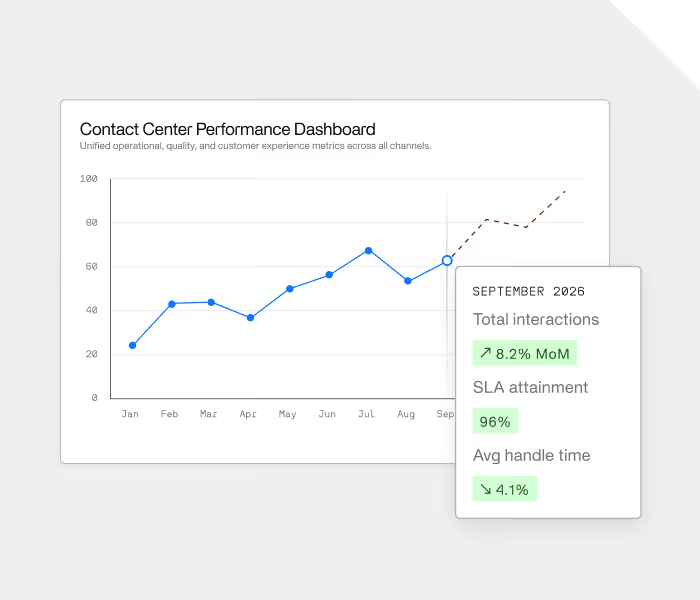
The infrastructure required to transform it — unified data, structured process architecture, real-time feedback loops — is the same infrastructure every other function is trying to build separately. You build it once, here, because the pressure is most acute here. Then it compounds everywhere else. Three industries show this most clearly.
A Total Loss call requires a trained agent to simultaneously navigate claims, policy, billing, and an informal knowledge base — under pressure, while managing a distressed customer. The scarcity is not headcount. It is the time it takes to bridge those systems correctly. When that data is unified and the workflow structured, an AI agent completes the call: coverage confirmed, next steps communicated, adjuster file initiated. Containment improves. The same infrastructure becomes the foundation for fraud detection and proactive renewal outreach the underwriting team was trying to build separately.
Outages, billing close, device promotions — each drives volume the center was never staffed to absorb. AI-native handles that volume by resolving it, not rerouting it. The agents who remain are freed for the one conversation that actually prevents churn: the customer who is about to leave. That conversation requires empathy, offer authority, and full customer history. It is the conversation every legacy contact center is too busy to have.
A significant share of scheduling, verification, and prior auth volume lands on clinical staff — nurses answering billing calls while patient care competes for the same hours. AI-native resolves that volume without clinical involvement. The infrastructure built for the contact center becomes the backbone of proactive patient outreach and care coordination that the clinical operations team was trying to fund as a separate initiative.
The pattern is consistent. The contact center is where the pressure is highest and the payoff most immediate. The organizations that understand this are not treating it as a cost-reduction project. They are treating it as an enterprise capability investment that happens to start here.
Before I joined Invisible I sat in on a demo for a marketing AI tool. A large brand was updating its website 10,000 times a month. The AI reduced thousands of hours of labor to dozens. The marketing team scaled immediately from 10,000 updates to 30,000.
One operator raised his hand.
The room went silent. The bottleneck had simply moved. Department-level AI transformation does not solve the bottleneck problem. It relocates it. The path from legacy to AI-native has to run through the entire enterprise for the transformation to hold.
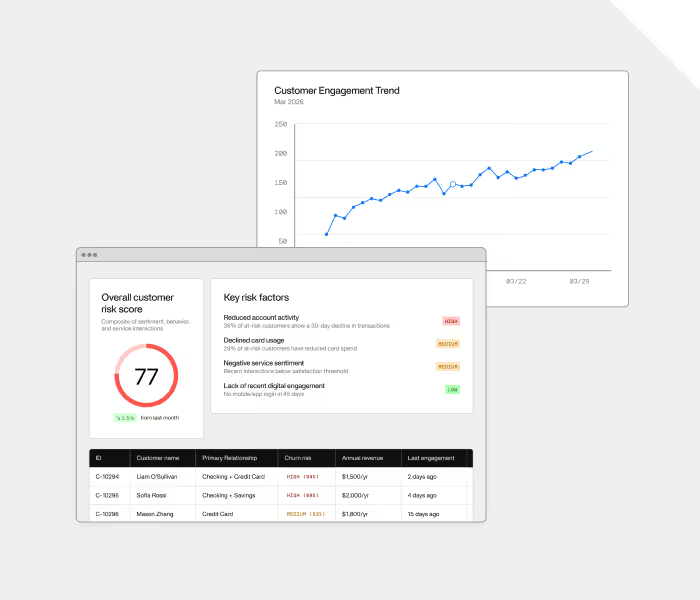
Proactive sentiment & risk signals
Most contact centers learn about problems when customers cancel. AI-native operations see the pattern before the first complaint is filed.

Most enterprises reading this are AI-enabled, and that is where the gap between perception and reality is widest. Scaled deployments are live. Handle times have dropped. There is a CSAT story to tell. Leadership believes the hard work is done. It has not yet started.
Ask your AI agent to change a billing address, issue a refund, reschedule an appointment. In most AI-enabled contact centers, it cannot. Human agents have always been the integration layer, bridging disconnected systems per call, invisibly.
Deploy AI without fixing that architecture and you don’t solve the problem. You expose it. A 23% containment rate is not serving one in four customers through AI. It is making three in four wait through an AI interaction before reaching the human they needed from the start. That is not a partial success. It is a very articulate dead end.
Consider what 100% coverage actually surfaces in practice. A carrier rolls out a new pricing tier. Within 48 hours, the AI-native contact center detects that customers who upgraded are expressing confusion about their first bill at a rate three times higher than the baseline for any plan change in the prior twelve months. No formal complaints filed. No CSAT results back yet. The billing team doesn’t know there’s a problem. But the pattern is visible — and a targeted proactive communication goes out before the wave of complaint calls that a legacy center would have been the last to know about and the first to absorb.
Some interactions must remain human — not because AI lacks capability, but because accountability and judgment are not features you can engineer in. They are the service itself. The first call after a policyholder’s death. The prior authorization denial for urgent treatment. The small business owner whose payroll was disrupted by fraud. These people are not looking for information. They need someone to navigate a difficult moment with them. The well-designed AI-native contact center treats this as a design principle, not an exception.
The results when the infrastructure is built are measurable. One Invisible deployment moved containment from 23% to 71% for a 75-year-old, multi-billion dollar brand — while holding customer satisfaction flat. That is the test AI tourism consistently fails.
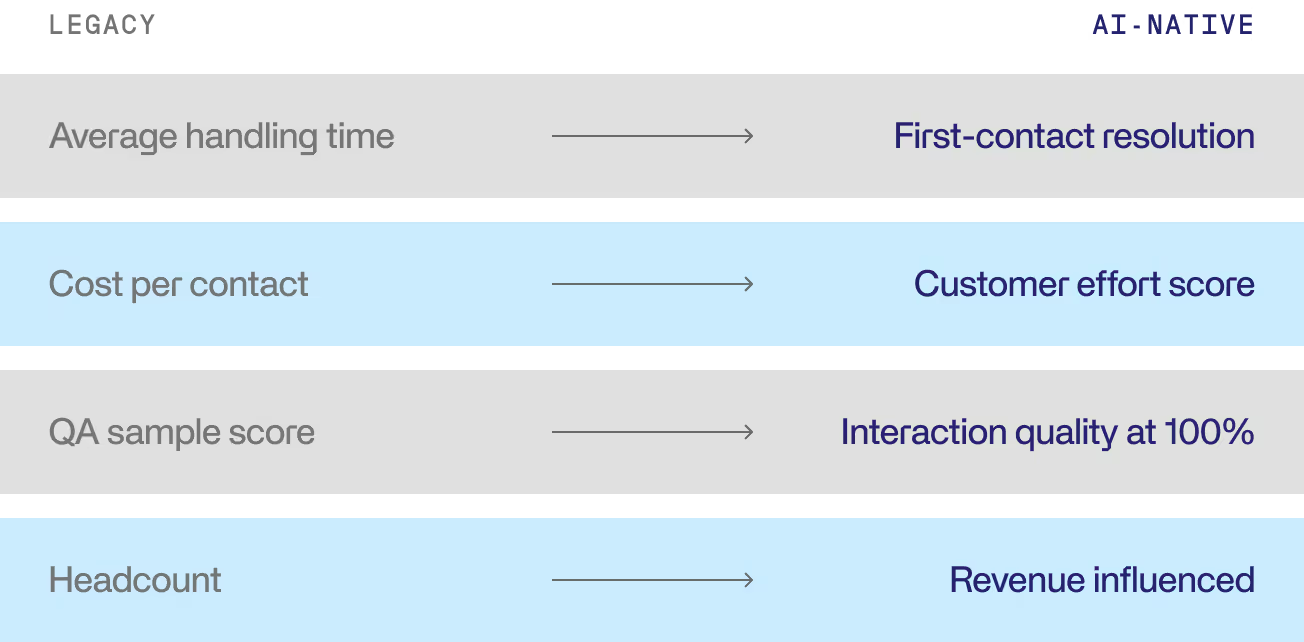
The metrics shift tells the same story:
Legacy
AI-Native
Average handling time
First-contact resolution
Cost per contact
Customer effort score
QA sample score
Interaction quality at 100%
Headcount
Revenue influenced
A contact center measured on average handle time is incentivised to move customers off the phone. A contact center measured on revenue influenced is incentivized to solve their problem. Same operation. Entirely different output.
The customers of both are the same people — moving between these two contact centers, sometimes on the same day. The experience they carry from one shapes what they expect from the other.
Orlando Hampton is SVP of Enterprise Technology, AI Contact Center Solutions at Invisible Technologies, where he leads enterprise business development and market strategy for the company's Temporal platform.

He has spent more than 25 years at the intersection of customer experience and emerging technology, not as an observer, but as an operator. In 1999, he led the first offshore customer service operation to India at Providian Financial. He later joined JPMorgan Chase, where he held senior operations roles overseeing domestic and international BPO for Chase Card, including building captive operations in India and the Philippines. In 2008, he introduced AI into contact center operations, joining Afiniti as its third employee and helping build the company’s behavioral pairing technology into a $2 billion-plus valuation, ultimately serving as Chief Customer Officer.
That background, running the floors, managing the P&L, and answering for the outcomes, shapes how he thinks about AI transformation: not as a technology problem, but as an organizational one.
At Invisible, he works with enterprise clients across financial services, insurance, healthcare, and telecom to move beyond AI experimentation and into AI-native operations, where human expertise and machine capability are designed to work together from the start.