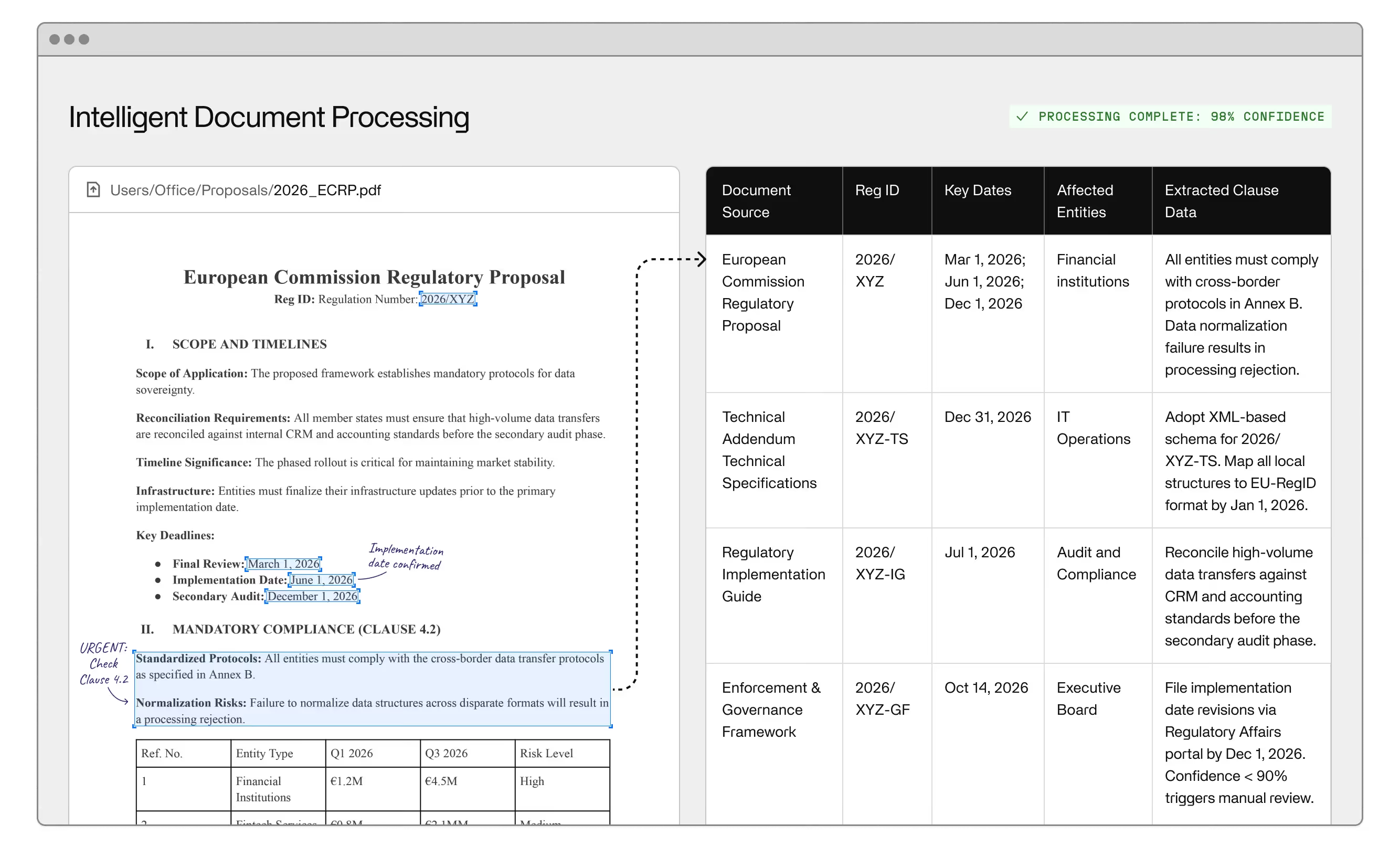
The average life sciences commercial team loses between 20 and 30 percent of its working week to tasks that shouldn't require human effort. Spreadsheet updates. Manual Salesforce entries. Report pulls assembled from five different systems. Data reconciliation that someone runs every Monday because no one has built the infrastructure to do it automatically. The dollar figure is significant. The opportunity cost is worse.
This is the hidden cost of manual processes in pharma commercial operations — not just the labor hours, but what those hours displace. Every hour a commercial analyst spends rebuilding a dashboard from scratch is an hour not spent identifying a coverage gap. Every week your field team waits for pricing updates to propagate through the system is a week a competitor closes faster.
Pharmaceutical commercial operations are more complex than most industries assume. You're managing HCP engagement across thousands of accounts, running medical affairs workflows that require regulatory compliance at every step, coordinating market access strategy across payers and systems, and maintaining supply chain visibility — all while generating the data-driven insights leadership needs to make commercial decisions. That complexity is real. But it's also why so many commercial functions default to manual workarounds instead of building infrastructure to eliminate them.
The pharmaceutical industry has historically organized around specialization. Medical affairs operates on different systems than market access. Field operations data doesn't automatically reconcile with forecasting models. Account management outputs don't feed cleanly into marketing strategies or customer engagement analytics. The result is a series of manual handoffs — people translating between systems, reformatting data, rebuilding context — that consumes capacity that should be directed at commercial execution.
Most pharma commercial operations leaders can identify their obvious inefficiencies. The ones that get underestimated are embedded inside standard operating procedure.
Forecasting is the clearest example. In most pharmaceutical commercial operations, the process involves pulling data from multiple sources, adjusting for known data lags, applying judgment corrections that live in someone's head, and producing a model that's outdated before the meeting it was built for. The model isn't broken — the process feeding it is. When sales operations, market access, and supply chain data all require manual consolidation before analysis, the output reflects last week's reality.
The same pattern appears in HCP engagement tracking. Field teams log activity manually. Salesforce entries get made at the end of the day, or the end of the week, or not at all. Healthcare professionals receive inconsistent follow-up because the account management system doesn't have a reliable picture of where the relationship actually stands. Customer engagement metrics that should drive commercial strategies instead require a data cleanup pass before anyone trusts them.
Pricing governance is where manual processes create invisible risk. In biopharma and biotech, pricing isn't a one-time commercial decision — it requires continuous monitoring against payer contracts, rebate thresholds, and competitive signals. When that monitoring depends on manual processes, exceptions get missed. Regulatory compliance risks accumulate in the gap between what the pricing policy says and what the data actually reflects.
There is a structural ceiling on what pharma commercial operations can achieve when the underlying processes are manual. It's not a performance problem — it's an architecture problem.
Commercial models that compete on speed require infrastructure that makes data available in time to act on it. Market research findings need to reach your field teams when the intelligence is still actionable. Marketing strategies built on stale HCP segmentation produce field execution that doesn't match commercial reality. Digital marketing campaigns that depend on healthcare professional segmentation need that segmentation to reflect current engagement data, not the last manual export. Advanced analytics and machine learning models need clean, consistent data inputs — data governance failures at the manual entry layer make those investments underperform.
This is where biopharma and biotech companies that have automated their commercial operations separate from those that haven't. It isn't that they're running more sophisticated commercial strategies. They've built infrastructure to execute their strategies without friction at every operational step. Field operations teams get real-time dashboards instead of weekly reports. Account management teams have visibility into healthcare provider activity without waiting for manual reconciliation. Medical affairs workflows route automatically rather than requiring someone to push the process forward.
The pharmaceutical industry has invested heavily in generative AI and digital capabilities at the strategic layer while leaving the operational foundation unchanged. That disconnect is where the cost compounds. You can build the most sophisticated commercial excellence framework in life sciences and still lose ground to competitors who have closed the clinical-to-commercial gap by removing the operational friction that held them back.
The commercial functions with the highest return on automation aren't always the obvious ones. Field operations and Salesforce data entry are commonly cited targets, and they matter. The larger leverage point is in the handoffs between functions — the manual translation layer between medical affairs and market access, between supply chain and commercial forecasting, between account management and customer engagement analytics.
Commercial leaders who've built operational efficiency into their pharmaceutical commercial operations describe a consistent pattern: the gain isn't in eliminating any one task. It's in removing the coordination cost that accumulates across every task requiring human intervention to move between systems.
For oncology teams managing complex account structures with multiple healthcare professionals at each institution, that coordination overhead is acute. Account management for a single oncology account can involve medical affairs, field teams, market access, and digital marketing touchpoints — each generating data that currently requires manual reconciliation before it can inform the next commercial decision. The resource cost of that reconciliation is visible. The commercial cost of the delay is not.
Medical device commercial teams face different market structures than pharmaceutical commercial operations teams, but the same underlying problem: the operational layer either enables commercial excellence or constrains it. Manual processes constrain it. And in life sciences competitive environments where market access windows narrow and biopharma commercial cycles compress, the constraint compounds faster than most commercial leaders realize until it shows up in numbers. Seeing what AI-powered field enablement looks like for pharmaceutical commercial teams that have removed that constraint makes the operational difference concrete.
What resolves it isn't a single platform. It's a deliberate architectural decision to connect commercial functions through automated data flows, enforce data governance at the point of entry rather than the point of reporting, and build dashboards that reflect operational reality in real time — not reconstructed from exports the following morning.
Invisible works with life sciences commercial teams to eliminate the manual overhead that limits what your commercial strategies can actually deliver. Get started.
Manual processes in pharma commercial operations are any tasks that require human effort to move, translate, or reconcile data between systems — including Salesforce data entry, dashboard builds from exports, forecasting model updates, and account management reporting. Most persist not because automation is technically impossible but because the infrastructure to eliminate them hasn't been prioritized or built.
When account management data requires manual reconciliation before it's reliable, field teams operate on incomplete pictures of where each HCP relationship stands. Healthcare professionals receive inconsistent follow-up, customer engagement metrics lag the underlying activity by days or weeks, and commercial strategies built on those metrics reflect outdated reality rather than current account status.
The business case combines two arguments. Direct cost: manual processes consume analyst and field team capacity that generates no commercial output. Competitive positioning: pharmaceutical commercial operations running on clean, automated data act on market signals faster than those waiting for manual reconciliation. In most pharmaceutical industry contexts, speed to insight is a direct input to market access decisions.
The largest return is typically in the handoffs between functions — the manual translation between medical affairs, market access, supply chain, and commercial forecasting — rather than in any single function in isolation. Automating the coordination layer between commercial functions reduces both error rate and cycle time more than automating field operations or Salesforce data entry alone.
Forecasting models are only as current as their inputs. When sales operations, supply chain, and market access data require manual consolidation before modeling, the forecast reflects last period's reality. Advanced analytics and machine learning investments underperform when the data feeding them requires manual cleaning at every cycle rather than flowing through automated, governed pipelines.
Data governance failures in pharma commercial operations typically originate at the manual entry layer. When data moves through human hands between systems, inconsistencies compound — field mismatches, missing values, entries that require correction downstream. Enforcing data governance at the point of entry through automated data flows eliminates the cleanup cycle that consumes data analytics capacity and erodes confidence in commercial insights.
Biopharma and biotech companies that have automated their commercial operations aren't running more sophisticated commercial strategies — they've removed friction from executing the ones they have. Real-time dashboards for field teams instead of weekly exports, automated account management workflows for healthcare providers, and data-driven insights that reach commercial leaders when the underlying data is still actionable.