.avif)
🛒 Trustpilot bets on human reviews in agentic commerce
As AI agents take over how people search, compare, and buy, Trustpilot is betting its review database will be a key input for AI systems deciding which businesses to recommend and is seeking partnerships with major e-commerce players. Trustpilot is already seeing a surge in visibility and traffic from large language models, with click-throughs from AI-powered search up sharply year over year.
💳 Shopify uses AI to decide which merchants get funding
Shopify doesn't wait for merchants to apply. Its AI decides who gets a funding offer based on store performance, with a human reviewing before money moves. Despite lending billions to small businesses, which are typically high risk, Shopify has never reported a major loss on the portfolio because it knows "pretty much everything" about the merchants it lends to.
🤖 BMW puts humanoid robots to work in factories in Europe
BMW has deployed humanoid robots at its Leipzig plant in Germany, using them for battery assembly and component manufacturing. The robots move independently across production floors, handle different tools, and swap their own batteries to stay operational, removing the need for human intervention in routine maintenance. BMW is running a dedicated program to evaluate the technology before scaling it across its broader manufacturing operations.
🚦 AI “traffic twin” cuts congestion and speeds up buses
A UK pilot is using a virtual replica of the road network to predict and manage traffic in real time. The system combines GPS data from buses and roadside sensors, allowing AI to anticipate congestion and automatically adjust traffic lights or reroute vehicles before delays build. In its first six months, it reduced delays by 13.7% and improved bus journey times. Future phases will add freight and environmental data to the model.
⚽ How FIFA is running the 2026 World Cup on AI
The 2026 World Cup spans 48 teams, 104 matches, and three countries, and FIFA is using it to test what AI looks like as tournament infrastructure. Football AI Pro standardizes elite analytics across all competing teams. Referee cameras and 3D player models aim to remove ambiguity from decisions. An AI command center connects real-time data across venues, broadcasters, and operations. It's the largest live stress test of AI-run event logistics to date.
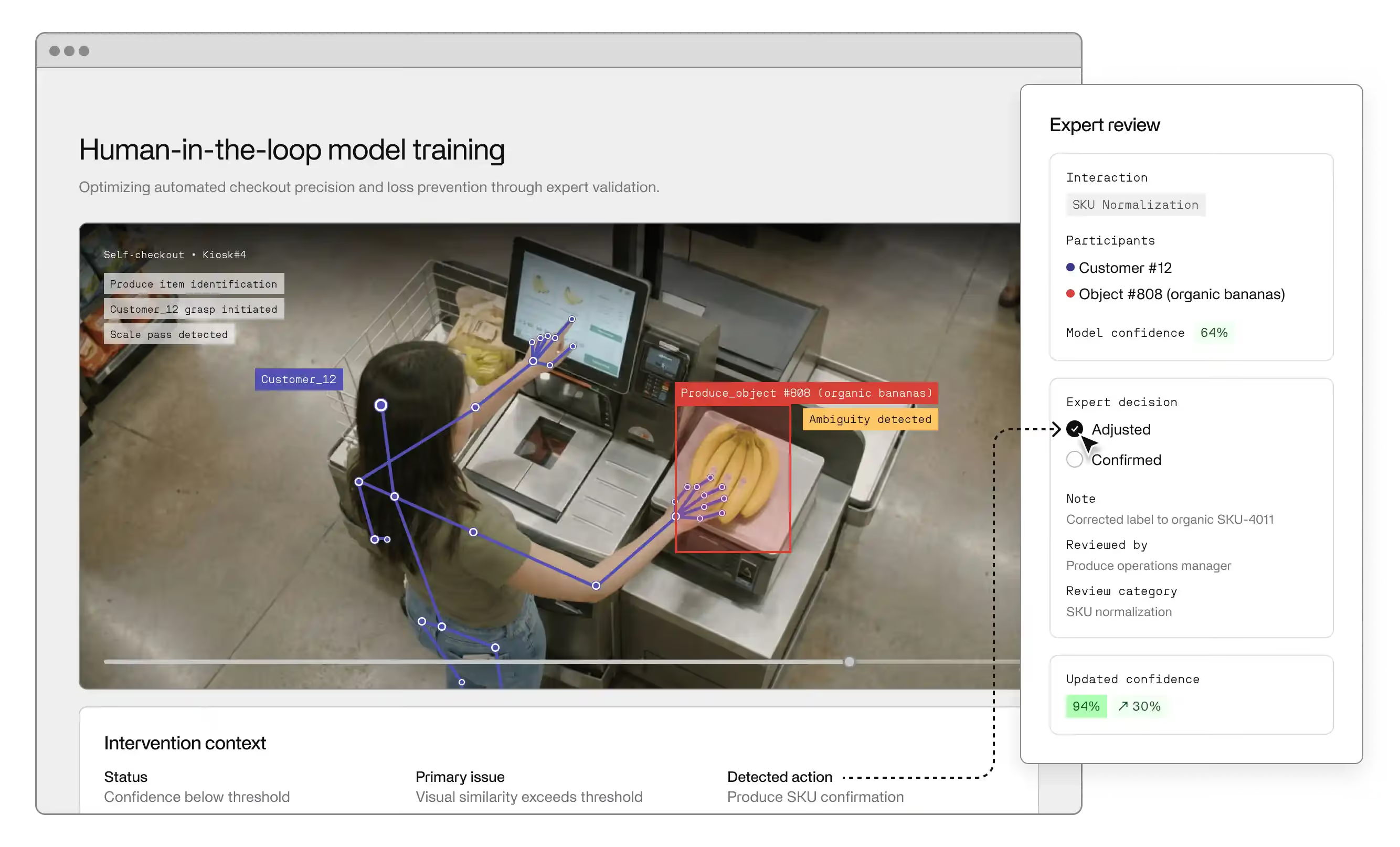
Learn more: Invisible's computer vision solution converts your videos into structured time-series data to offer advanced insights.
🔬 Jesse Thaler: AI and science advance together or not at all
MIT professor Jesse Thaler argues that AI and the physical sciences are now co-dependent, each accelerating the other. Researchers are using AI to speed up discovery in physics and chemistry, while those fields are helping to explain how AI systems actually work and inspiring new methods. Thaler's core argument is that progress requires a genuine two-way bridge: shared data and computing infrastructure and researchers trained to move fluently across both disciplines.
💼 Sahar Hashmi: The executive who determines if AI actually pays off
AI expert Sahar Hashmi argues that most AI initiatives fail not because of the technology, but because no one owns the outcome. The Chief AI Officer changes that. Nearly half of large companies now have the role or an equivalent, with many reporting directly to the CEO. The CAIO's job is to tie AI investments to ROI, filter out costly projects before they start, and ensure deployments translate into real operational gains. The difference between leaders and laggards, Hashmi argues, may come down to whether a single executive is accountable for results.
🏗️ Alex Gutman: AI only delivers value when it’s embedded into real work
Gilbane CTO Alex Gutman is pushing back on the idea that competitive advantage comes from building bespoke AI systems. His view is that most value is unlocked by embedding AI into existing workflows and enterprise tools. He draws a clear line between experimentation and impact. AI is used to compress time on high-friction work like proposal generation and to give field teams instant access to complex project knowledge. For Gutman, the real shift is from deploying AI as a capability to enforcing it as an operational standard tied directly to delivery outcomes.
⚡John Sviokla: The real AI advantage is systems that improve themselves
John Sviokla argues that the most important shift in AI is compounding. Systems that can iteratively improve their own outputs are creating a new operating model where progress accelerates without proportional human input. This changes how competition works. When AI can refine code, workflows, and decisions continuously, organizations begin to operate like always-on factories, improving around the clock.
🧠 Mystery AI model sparks speculation among developers
An anonymous AI model released on a developer platform has drawn attention for its strong performance, reasoning ability, and free access. Similarities in behavior and design have led some developers to speculate it could be an early test version of a major upcoming model. Engineers point to its ability to handle large amounts of information and its reasoning style as signals of a high-end system, though others say the evidence is inconclusive.
🤖 Alibaba launches platform to manage AI agents at work
Alibaba has introduced a new enterprise AI tool that allows businesses to manage multiple AI agents through a single interface. The platform can handle tasks such as document editing, approvals, meeting transcription, and research, moving beyond chatbots that simply respond to prompts. The system is designed to integrate into workplace tools like messaging platforms and enterprise apps, making it easier to embed AI into everyday workflows.
🌊 AI improves flood forecasting accuracy and speed
Researchers have developed an AI model that improves flood prediction. The system learns from real-world data to understand changing river and watershed conditions, removing the need for manual adjustments that typically slow down forecasting during emergencies. The hybrid approach delivers more accurate predictions of streamflow and flood levels than current methods, while still aligning with established scientific models.
❤️ AI predicts which heart patients may worsen within a year
Researchers have developed an AI model that can forecast whether a heart failure patient’s condition is likely to deteriorate within the next year using standard ECG data. Rather than flagging current issues, the system predicts future decline in heart function, allowing clinicians to identify high-risk patients earlier. The model can also work with simpler, single-lead ECG data, making it suitable for clinics without access to advanced imaging or specialist equipment.
🧪 New AI test reveals gap in expert-level knowledge
Researchers created a 2,500-question test designed specifically to be too difficult for current AI systems, removing any questions models could already answer. The test spans highly specialized topics across fields like science, languages, and humanities, with problems requiring deep expertise rather than pattern recognition. Early results show even the most advanced models struggle, with top systems only reaching partial accuracy on the exam.
🎭 AI trains on human emotion using actors and role-play
AI companies are hiring improv actors to generate training data that teaches models how to understand and express human emotion more naturally. Performers are asked to act out scenarios and shift tone in real time, helping models learn nuances like context, character voice, and emotional transitions. As demand grows, data providers are recruiting professionals across fields to capture more realistic human behavior.
🎨 AI can make humans more creative
A study of more than 800 participants found that AI can act as a creative collaborator. When users were shown AI-generated design galleries while creating virtual cars, they spent more time exploring ideas, felt more engaged, and ultimately produced better designs. Instead of optimizing for a single best outcome, the system presented a wide range of possibilities, including unusual and even flawed ideas, which encouraged users to think more broadly and take creative risks.
📹 Gig workers film daily life to train AI for real-world tasks
Hundreds of people in Los Angeles are being paid to record themselves doing everyday chores like cooking, cleaning, and washing dishes using head- and wrist-mounted cameras. The footage captures detailed hand movements, object interactions, and even narration, giving AI systems the data needed to learn how humans perform physical tasks and switch between them in real time. This data is used to train robotics systems that can operate in real-world environments.
🧾 Companies are labeling products "AI-free," but no one agrees what that means
A growing number of companies and creators are introducing labels like “Human-made” and “No AI” to signal that their work was produced without artificial intelligence. The push is being driven by concerns over automation replacing human creativity and a belief that human-made content may carry a premium. The problem is that there’s no shared definition. Some certifications require rigorous auditing, while others can be applied with little oversight.
📬 Stay current. Get the next edition directly on LinkedIn.
🏛️ Scaling AI beyond demos is where most teams stall. Talk to us today.





.avif)