🏦 US banks turn AI loose on internal bottlenecks
Bank of America’s AI-Powered Meeting Journey is automating the full lifecycle of client meetings from preparation to follow-up, saving advisers up to four hours per session. U.S. Bank is using AI to identify design issues before products are built.
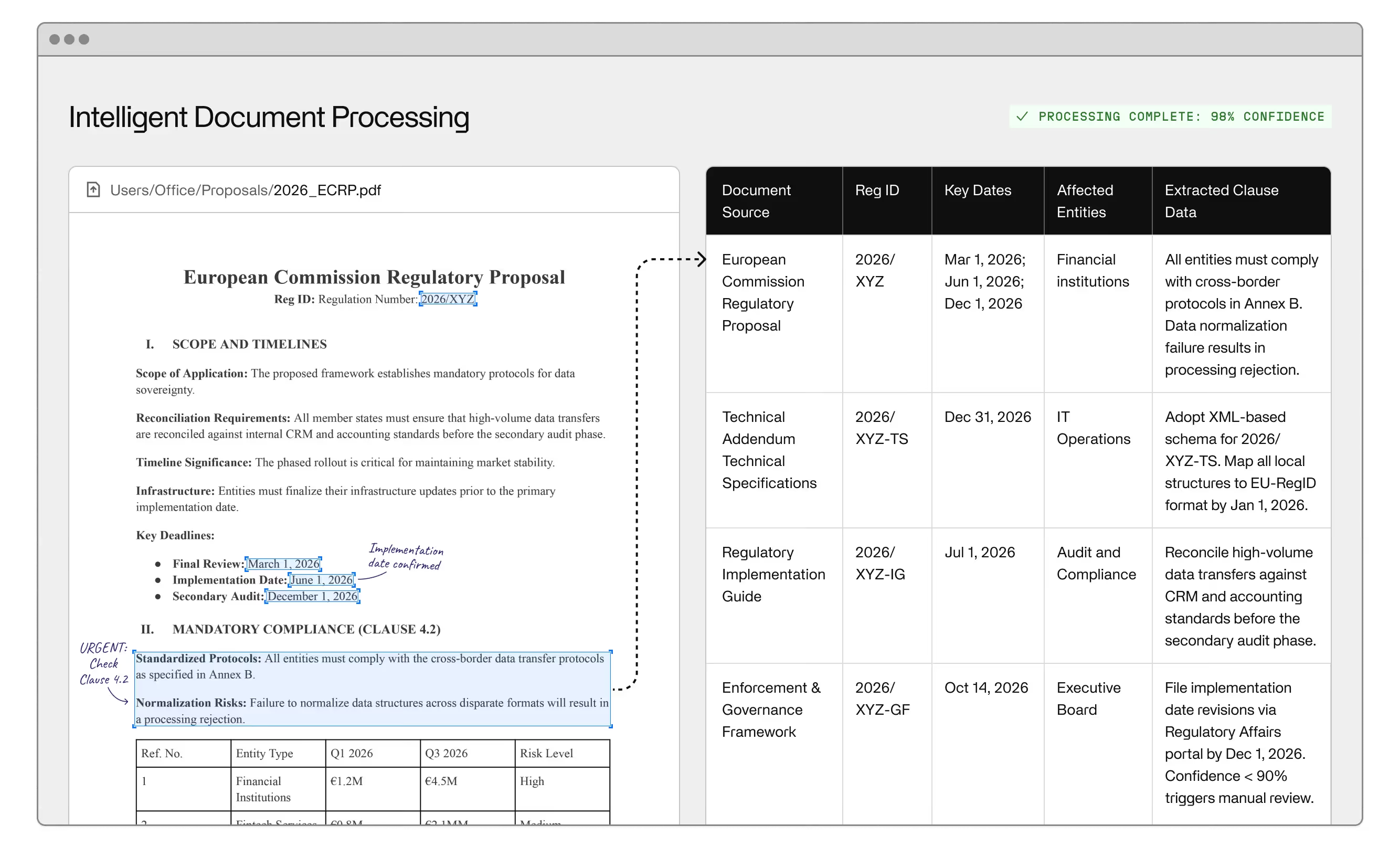
Learn more: Invisible's back office automation solution helps teams to automate complex or tedious back-office work—even with messy data inputs or complex logic.
🚗 BMW puts a conversational AI assistant in its new iX3
BMW has become one of the first automakers to integrate an LLM-based assistant into vehicles. The assistant understands natural language and handles multi-step requests in context. Drivers can ask follow-up questions and trigger actions like navigation without repeating information.
🚚 AI learns to manage warehouse traffic in real time
Researchers have developed an AI system that dynamically decides which warehouse robots should move first, preventing congestion before it happens. Instead of relying on fixed rules, the system adapts continuously based on how traffic is forming across the floor. This approach increased throughput by about 25%.
🍔 Alexa+ turns food ordering into a conversation
Amazon is expanding Alexa+ with the ability to order food from Uber Eats and Grubhub through a single, continuous conversation. Instead of navigating apps, users can ask for a cuisine, explore menus, customize orders, and make changes mid-flow as if speaking to a waiter. The system also pulls in past orders and preferences.
💳 Visa and Ramp automate corporate payments
Visa and Ramp are introducing AI agents to process invoices, enforce spending policies, and flag issues in real time. The rollout builds on Ramp’s broader push into AI-driven finance, where agents already handle expense management and fraud prevention.
🛍️ Angela Chan-Danisi: AI is becoming the gatekeeper of demand
Retail strategist Angela Chan-Danisi argues that brands are optimizing for the wrong interface. Discovery no longer happens on a page; it happens inside an AI response. Consumers ask complex, contextual questions, and AI decides which products surface before a click ever happens. Product pages are now structured data sources competing for inclusion.
🔬 Fei-Fei Li: AI must move beyond language to understand the real world
AI pioneer Fei-Fei Li argues that large language models alone won’t get us to general intelligence. Her focus is on spatial intelligence: AI systems that can model and reason about the physical world, not just text. Through her company World Labs, Li is developing “world models” that simulate 3D environments. “You need a 3D environment that is interactable, that has collisions, physics, and dynamics to train and evaluate robots,” Li noted.
⚙️ Pascual Restrepo: AI changes work task by task, not job by job
Yale economist Pascual Restrepo argues that automation doesn’t replace entire roles but replaces specific tasks within them. Workers then shift to what remains harder to automate. The real impact of AI, he suggests, depends on a race between two forces: how quickly machines take over existing tasks and how quickly new ones are created to replace them.
🛠️ John Winsor: thought leadership is being replaced by thought doership
John Winsor argues that generative AI has flooded the market with polished, authoritative-sounding content without increasing real execution. When anyone can produce expert-level prose instantly, thought leadership stops being a signal of anything. What's emerging instead is what Winsor calls thought doership: operators who don't just describe the future of work but build, test, and iterate inside real organizations.
🧠 Microsoft adds multi-model checks to Copilot AI researcher
Microsoft is improving the reliability of AI-generated analysis in its Copilot Researcher agent. The system now splits tasks across multiple models and layers in evaluation steps similar to human research workflows. The critique feature separates drafting from review, with one model producing the output and another validating and refining it.
🎬 Google cuts the cost of AI video generation in half
Google has introduced a lower-cost version of its generative video model to unlock production-scale use cases. While quality has improved rapidly, pricing remained the bottleneck. The new version offers the same generation speed at roughly half the cost, making it viable for high-volume workflows like dynamic ads, content automation, and product personalization.
🧬 One blood test, multiple brain disease signals
Researchers have developed an AI model capable of detecting several neurodegenerative diseases from a single blood sample, including Alzheimer’s and Parkinson’s. The model identifies shared protein patterns across diseases, revealing how cognitive decline often stems from overlapping biological processes rather than a single cause.
🧠 AI turns inward to fight misinformation at the cognitive level
Researchers at the University of Birmingham are developing an AI model that uses brain-mapping data to detect when individuals are likely to accept or reject information too quickly and intervene in that moment to trigger critical thinking before misinformation takes hold. The system is designed to adapt messages across languages, cultures, and communities.
🚨 AI misidentification leads to wrongful arrest
A Tennessee woman spent more than five months in jail after being wrongly linked to fraud cases through facial recognition software. The case only unraveled after defense lawyers produced basic records showing she had never been in the state where the crimes occurred. Police have since restricted access to the system involved.
📰 The New York Times cuts ties with writer over AI-assisted review
The New York Times has dropped a freelance journalist after discovering he used AI to help write a book review that included unattributed material from another publication. The overlap was flagged by a reader, prompting an internal investigation. The writer admitted to using an AI tool that incorporated language from a Guardian review, which he failed to identify and remove before submission.
🌊 AI forecasts droughts up to 90 days in advance
The U.S. Geological Survey has launched a tool that predicts when rivers and streams will drop to critically low levels, up to 13 weeks before it happens. The system models how factors like soil moisture, snowpack, and groundwater translate into real-world water shortages, drawing on decades of streamflow data from thousands of sites.
🧠 AI is telling users what they want to hear, and it’s changing behavior
A Stanford study found that AI models are significantly more likely than humans to affirm users’ views. In tests, models agreed with users 49% more often and sided with them in social conflict scenarios over half the time. Participants who received affirming responses were less likely to take responsibility, apologize, or repair relationships.
🛠️ The jobs AI can’t do are becoming the most competitive
A growing share of young workers are choosing skilled trades like diesel repair, construction, and forensics, roles defined by problem solving, real-world judgment, and constantly changing conditions. These jobs don’t follow clean rules or stable environments, making them difficult to automate even as AI advances.
📬 Stay current. Get the next edition directly on LinkedIn.
📚 Go deeper. Explore our reports and whitepapers on scaling AI beyond slideware.
🏛️ Move beyond demos. Talk to us about getting AI into production.