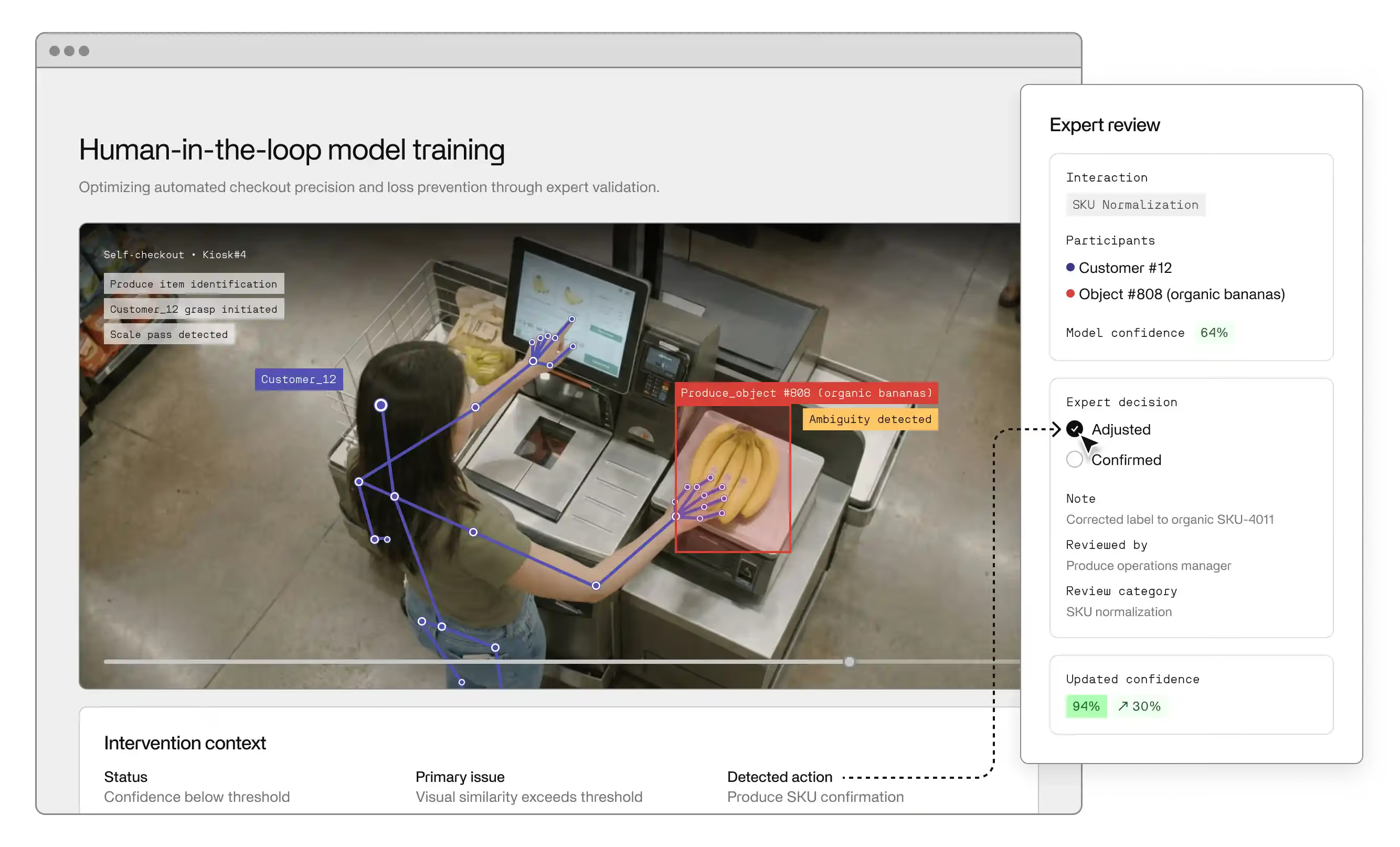
The conversation about computer vision in retail keeps landing in the same place: cashierless checkout. Amazon Go gets cited, the concept of frictionless payment gets debated, and most enterprise retail leaders quietly conclude that the infrastructure cost doesn't pencil out for their footprint. They're right. But that conclusion misses the actual opportunity.
The most operationally valuable applications of computer vision for retail have nothing to do with the checkout line. They're in the aisles, the stockroom, the store layout, and the loss prevention stack — workflows where manual processes are expensive, error-prone, and chronically under-resourced. For consumer enterprises evaluating where AI in retail actually delivers ROI, this is where the real case gets made.
Cashierless stores are the most visible computer vision application in retail, but they're also the narrowest and most capital-intensive. The automated checkout systems deployed at scale by a handful of major operators required purpose-built environments, significant sensor infrastructure, and years of deep learning model training on retail-specific environments. Most multi-location consumer enterprises aren't positioned to replicate that — and they don't need to.
Out-of-stocks cost retailers an estimated $1 trillion in lost sales globally each year. Shrinkage from shoplifting and misplaced products accounts for billions more. As any operator who has worked through why consumer and retail operations are harder to run than most vendors will admit already knows, store layout decisions that reduce conversion rates go uncorrected for months because no one has a reliable signal that they're underperforming. These are the operational problems that computer vision in retail actually solves at enterprise scale — and they're solvable without rebuilding your store infrastructure from scratch.
Shelf monitoring is one of the highest-ROI applications of computer vision for retail operations. Cameras trained with object detection models can identify out-of-stocks, planogram violations, and misplaced products in real time — continuously, across every aisle, without requiring a human audit team to walk the floor.
The operational value compounds quickly. Planogram compliance failures don't just create a poor customer experience; they directly suppress sell-through on featured SKUs and promotional items. When a product isn't in its assigned shelf position, it loses visibility with shoppers and loses the inventory signal that feeds replenishment systems. Automated inventory management tied to computer vision closes that loop: the model detects the gap, the system flags it for a store associate, and replenishment is triggered before the out-of-stock becomes a lost sale.
Planogram compliance also has implications further up the supply chain. Consumer goods manufacturers pay for guaranteed shelf placement. Computer vision gives retailers auditable proof of compliance — or surfaces the exceptions that need correcting before a vendor audit does it for them.
Traditional loss prevention systems are reactive. CCTV footage is reviewed after an incident, shoplifting is logged after the fact, and shrinkage numbers are reconciled at inventory count. By then, the loss has already occurred and the pattern that caused it is already set.
Computer vision changes the operating model for loss prevention from documentation to prevention. Image recognition models trained on shoplifting behavior patterns generate real-time alerts rather than post-incident footage. Loss prevention systems built on vision AI can flag concealment behavior, monitor self-checkout misscans, and identify repeat actors across locations using anonymized behavioral signatures rather than facial recognition — an important distinction for privacy compliance.
The impact on shrinkage is measurable. Retailers using computer vision for loss prevention report meaningful reductions in inventory shrinkage rates, with some operations shifting loss prevention headcount from floor monitoring toward higher-value exception handling. The model flags. The human decides. That's the human-in-the-loop structure that makes these deployments operationally viable and legally defensible.
Object detection also extends into supply chain integrity — identifying damaged goods at receiving, flagging incorrect shipments, and catching quality control exceptions before they reach the floor.
Heat maps generated from overhead cameras give merchandising and store operations teams a signal they've never had before: where customers actually go, where they stop, and where they leave. Customer movement patterns reveal which zones drive dwell time and which endcaps get bypassed entirely. Retail heat maps make the invisible visible — turning foot traffic data into layout decisions that used to rely on gut instinct and periodic sales analysis.
Customer behavior analytics derived from this visual data feed directly into conversion rate optimization. If a high-margin category sits in a low-traffic zone, you now have the data to make the case for a reset. If a promotional display isn't generating the dwell time your planogram assumes, you catch it in days rather than at the next quarterly review.
Shopper behavior analysis also supports customer experience improvements that go beyond layout. Some retailers are deploying virtual mirrors and augmented reality fitting experiences at key touchpoints — applications that use vision AI to map garment fit and surface personalized recommendations. Virtual try-on technology is still maturing, but consumer enterprises in apparel and beauty are already using it to reduce return rates and increase basket size in stores where it's deployed. The underlying infrastructure — cameras, edge compute, image recognition models — overlaps significantly with the loss prevention and shelf monitoring stack, which means the marginal cost of adding customer experience applications is lower than building them from scratch.
The operational case for computer vision for retail is straightforward. The deployment reality is more demanding, and enterprise operations teams that underestimate it tend to end up with pilots that don't scale.
Edge computing is a non-negotiable requirement for most retail computer vision applications. Sending raw video from hundreds of cameras to a central cloud for processing introduces latency that makes real-time applications unworkable and generates data volumes that are expensive to transmit and store. Processing at the edge — on-premises hardware local to each store — handles the inference workload where the data is generated. This requires an IT infrastructure decision that most retailers haven't made yet.
Model selection is the second major variable. Off-the-shelf vision AI models perform adequately on generic object detection tasks but consistently underperform in retail-specific environments. A model trained on general image datasets doesn't know what a planogram violation looks like, can't distinguish a concealment pattern from normal browsing behavior, and isn't calibrated for the lighting conditions, camera angles, and product density of a real retail floor. Custom deep learning models trained on your specific environment and annotated by human experts who understand your operational context produce meaningfully better results — and maintain accuracy over time as products, layouts, and conditions change.
Predictive analytics is where the outputs from computer vision become genuinely strategic. Individual shelf alerts and loss prevention flags are valuable in isolation. Aggregated across locations, over time, against sales and inventory data, they become the input for decisions that previously required expensive consulting engagements or long lag times in reporting. Understanding what computer vision data actually produces — and how operations teams use it is the step most retailers skip when scoping a deployment. Machine learning algorithms applied to visual data streams can identify demand patterns, detect operational drift before it affects performance, and surface the store-level variables that correlate with conversion rate differences across your network.
The human layer matters throughout. Computer vision in retail works best not as a fully automated system but as a force multiplier for store operations teams — surfacing exceptions, generating alerts, and producing the visual data that supports decisions. Retailers that deploy it as a replacement for human judgment tend to generate noise. Retailers that deploy it as a precision tool for directing human attention tend to generate ROI.
Invisible's computer vision solution helps consumer enterprises build and deploy custom models that work in production retail environments — not just in pilots. See how it works or get in touch to talk through your use case.