Enterprise operations need computer vision that balances immediate functionality with long-term scalability and cost-efficiency. Off-the-shelf computer vision provides rapid deployment and lower upfront costs for standardized workflows like basic security or OCR with limited customization, while custom models offer a distinct competitive advantage through higher accuracy in niche environments and the elimination of recurring provider licensing fees. The decision hinges on whether your visual data is a generic commodity suited for off-the-shelf AI solutions or a proprietary asset that drives your core value proposition and unique needs through artificial intelligence. The optimal strategy involves using pre-built AI tools for back-office automation and investing in custom AI solutions for the high-volume, high-stakes tasks that define your market position.
You are recording petabytes of data that remain essentially dark because the cost of extracting insight manually is prohibitive, yet the cost of a failed AI pilot is a stain on your operational budget. You need to know if you should buy a subscription to a vision API today or hire a partner to build a proprietary model that you own forever.
This article defines the financial and operational breakpoints between off-the-shelf software and custom-built, AI-powered enterprise computer vision systems. If you are still establishing the basics of how these systems function, start with our plain-language guide to computer vision for enterprise leaders.
Buying pre-built machine learning models out of the box from a major cloud provider or a niche SaaS vendor is the fastest way to get a result and reduce time-to-market, but speed is a deceptive metric. These models are trained on general datasets to recognize general objects. If your operation requires identifying a specific defect on a unique polymer coating, a generic model will struggle with accuracy, forcing you to maintain a large human-in-the-loop team to catch the AI mistakes. This creates an invisible tax on your business processes where the lack of precision prevents true automation.
Furthermore, off-the-shelf solutions usually operate on a per-transaction or per-hour pricing model. While the upfront costs are negligible, the scalability of this model is a disaster for enterprise operations. As you increase the number of camera feeds or the frequency of inference, your monthly bill scales linearly. You never reach an economy of scale because you are renting the intelligence rather than owning the asset.
The generic algorithms provided by major tech players are built for mass-market appeal, meaning they are optimized for the middle of the bell curve. In healthcare or heavy manufacturing, the value is found at the edges — and those edges are where the unique challenges of your environment make generic tools structurally inadequate. A custom AI model leverages deep learning architectures trained specifically on your data, your lighting, and your specific camera angles. This level of specificity is what allows an operation to move from simple detection to complex real-world behavior analysis.
When you train a model on your proprietary data, you build a system that understands the nuance of your specific environment. In a supply chain or logistics hub, a pre-built model might see a box, but a custom model sees a damaged corner on a specific type of high-value crate that indicates a failure in the sorting arm. This granularity is what allows you to optimize the production line in real-time.
When you use an off-the-shelf provider, you are essentially paying to train their models. Every image you feed through their API helps their machine learning algorithms get smarter, which they then sell back to your competitors. In a world where data is a primary differentiator, the visual data your operation produces is an asset you should be treating accordingly — giving it away to a third-party provider is reckless. Choosing custom AI means you own the model weights and the architecture.
Owning your model also gives you full control over deployment. Custom models can be optimized for edge computing, running directly on the cameras or local servers within your facility. This reduces latency and eliminates the need for expensive high-bandwidth uplinks to the cloud. For operations in remote locations or those with strict data privacy requirements, the ability to run in-house without an external dependency is a requirement for resilience and operational adaptability.
The most common objection to custom development is the initial investment required for data annotation and model training. Once the model is trained and deployed, the ongoing maintenance cost is limited to the compute power it consumes and the periodic retraining your data pipeline requires. If you compare the three-year Total Cost of Ownership (TCO), a custom build often becomes the cheaper option by month eighteen. You eliminate the per-frame licensing fee that makes off-the-shelf software so expensive at scale.
You should view the development of a custom model not as an expense, but as the creation of a capital asset. You are replacing a variable operational expense with a fixed infrastructure investment that delivers a higher return on investment through superior accuracy. The workarounds and manual reviews that fill the accuracy gap of a generic model carry their own cost — one that rarely appears in a vendor's pricing proposal but compounds across every site you operate.
There are areas where off-the-shelf functionality is perfectly adequate. If you need to read text off a standard shipping label to improve the e-commerce customer experience or monitor a parking lot for vehicle occupancy, there is no need to reinvent the wheel. These are commoditized tasks where the data is not unique and the accuracy of generic providers is high. Using pre-built AI tools for these non-core workflows allows your engineering team to focus on the high-value problems that actually move the needle on your quarterly goals.
The danger lies in treating your core competency as a commodity. If your competitive advantage depends on the speed or quality of your visual inspection, using the same off-the-shelf tool as everyone else in your industry ensures you will never outperform them. You should audit your workflows and separate them into table-stakes tasks and strategic-value tasks. The former gets an off-the-shelf solution; the latter gets a custom build.
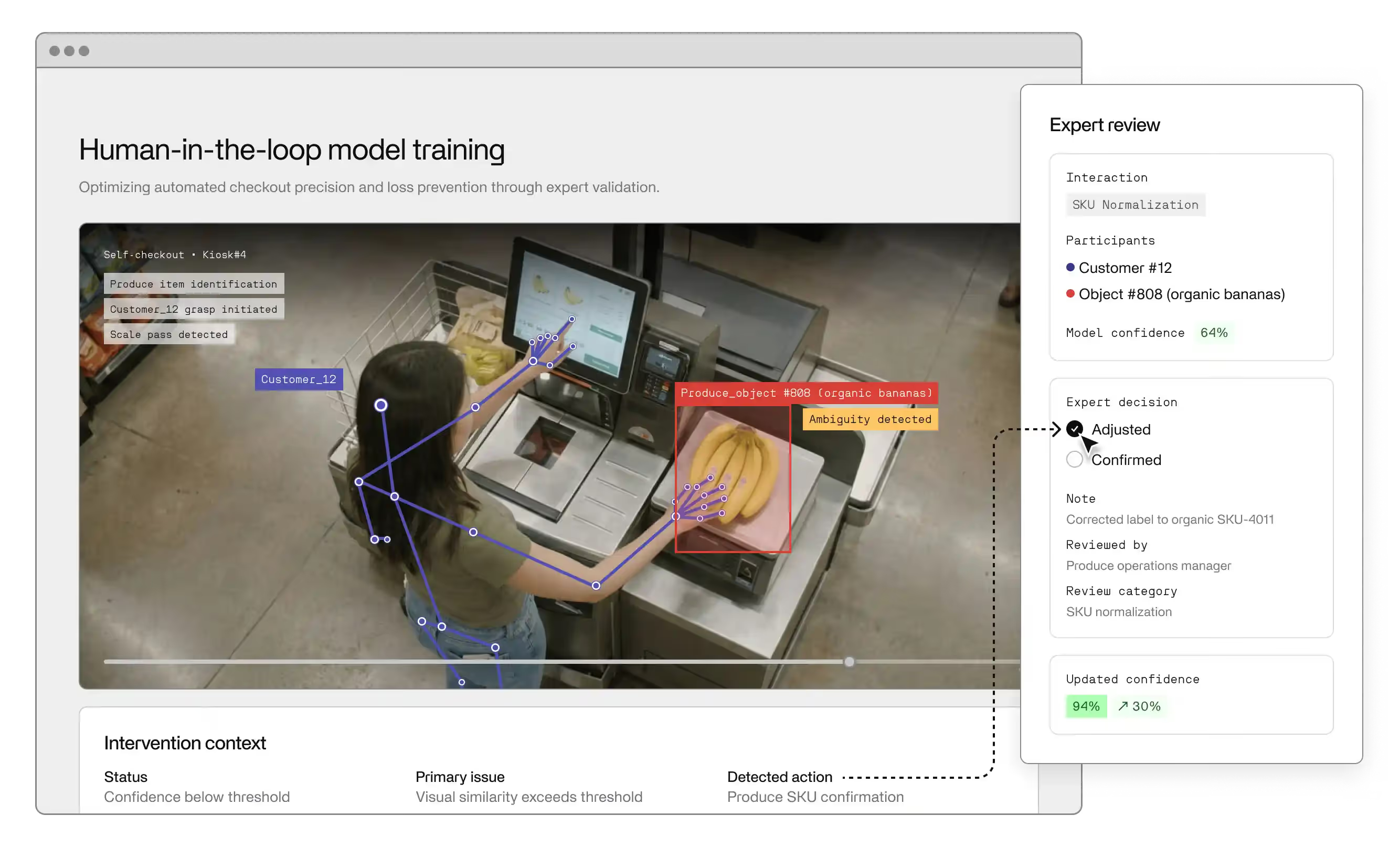
Most enterprise leaders allocate their budget as if the algorithm is the primary challenge. In reality, the most successful computer vision deployments follow a 10-10-80 distribution: 10% of the effort is selecting the model, 10% is the initial data collection, and 80% is the operational integration and ongoing maintenance. If you over-invest in the algorithm but under-invest in the human-in-the-loop systems required to verify and retrain it, the system will inevitably drift.
The following decision-making framework facilitates an informed decision for evaluating which path aligns with your specific business goals and operational constraints. Use this to determine if your current use case is a candidate for standardized automation or if it requires a proprietary build to ensure long-term profitability.
A model sitting in a vacuum provides zero operational value. The real challenge of computer vision in the enterprise is integration. Whether you buy or build, the output of the model must trigger an action in your existing systems, such as ERP or MES platforms. Off-the-shelf providers often offer rigid APIs that require you to change your workflows to fit their software. A custom approach allows you to build the AI development layer and custom software around the workflow, not the other way around.
To maximize operational efficiency, the vision system must act as a seamless integration layer within your digital infrastructure. This means having a partner who understands the human-in-the-loop requirements. Even the best custom AI models need a feedback loop for continuous validation where humans can verify edge cases and retrain the system on domain-specific failure modes. This continuous improvement cycle is easier to manage when you own the underlying model, as you can direct the retraining toward the specific errors that are most costly to your bottom line.
The decision to build custom computer vision is a transition from renting a vendor's generic capabilities to owning a proprietary, data-driven asset that compounds in value as your data volume grows. While off-the-shelf tools serve for low-stakes automation, they cannot protect the unique margins or complex workflows that define an enterprise at scale. The real risk is not the upfront investment of development, but the long-term vulnerability of tethering core operations to a third-party API that you can neither control nor optimize — which is why building the business case for enterprise computer vision starts with TCO, not capability. True operational resilience requires a model that is as specialized as the workforce it supports and as secure as the data it processes.
Learn how Invisible builds and scales custom computer vision models to optimize your unique enterprise operations by booking a demo.
Off-the-shelf computer vision refers to pre-trained models accessible via APIs or SaaS subscriptions, designed for general tasks with fast deployment and low upfront costs. Custom computer vision involves building or fine-tuning a model on your specific operational data to solve domain-specific problems — such as identifying a proprietary defect in a manufacturing process — where generic algorithms fail. For high-volume enterprise operations, custom models deliver superior accuracy and eliminate recurring licensing fees.
You need a custom model if your workflow involves objects not found in public training datasets, if per-transaction API costs will exceed a custom build within two years, or if the model must run on the edge without an internet connection. Generic models cannot distinguish a minor scratch from a critical structural crack on a proprietary component. If any condition applies, off-the-shelf is not a viable long-term solution.
The accuracy gap is the most significant hidden cost. A model that is 90% accurate requires staff to manually review 10% of output, negating much of the automation value. Data ingress and egress fees, escalating pricing tiers, and the technical debt of rebuilding integrations when a provider retires an API version compound that cost. Over several years, these expenses routinely exceed the one-time investment of a custom build.
Yes, and many enterprises use this as a phased approach in their technology roadmap. Start with an off-the-shelf provider to prove the concept and collect baseline data, labeling the images the generic model misses. That labeled dataset becomes the foundation for your custom model. Design your data pipeline with the eventual migration in mind so the switch is a transition rather than a full rebuild.
Human-in-the-loop is the process where reviewers verify the model's predictions — particularly low-confidence outputs — and feed that verified data back into the training loop. In a custom build, this retraining is focused entirely on your domain-specific edge cases, which drives faster performance improvements than a generic feedback pipeline. For enterprise operations, it ensures the system adapts to environmental changes such as new product designs or shifting lighting conditions without becoming obsolete.