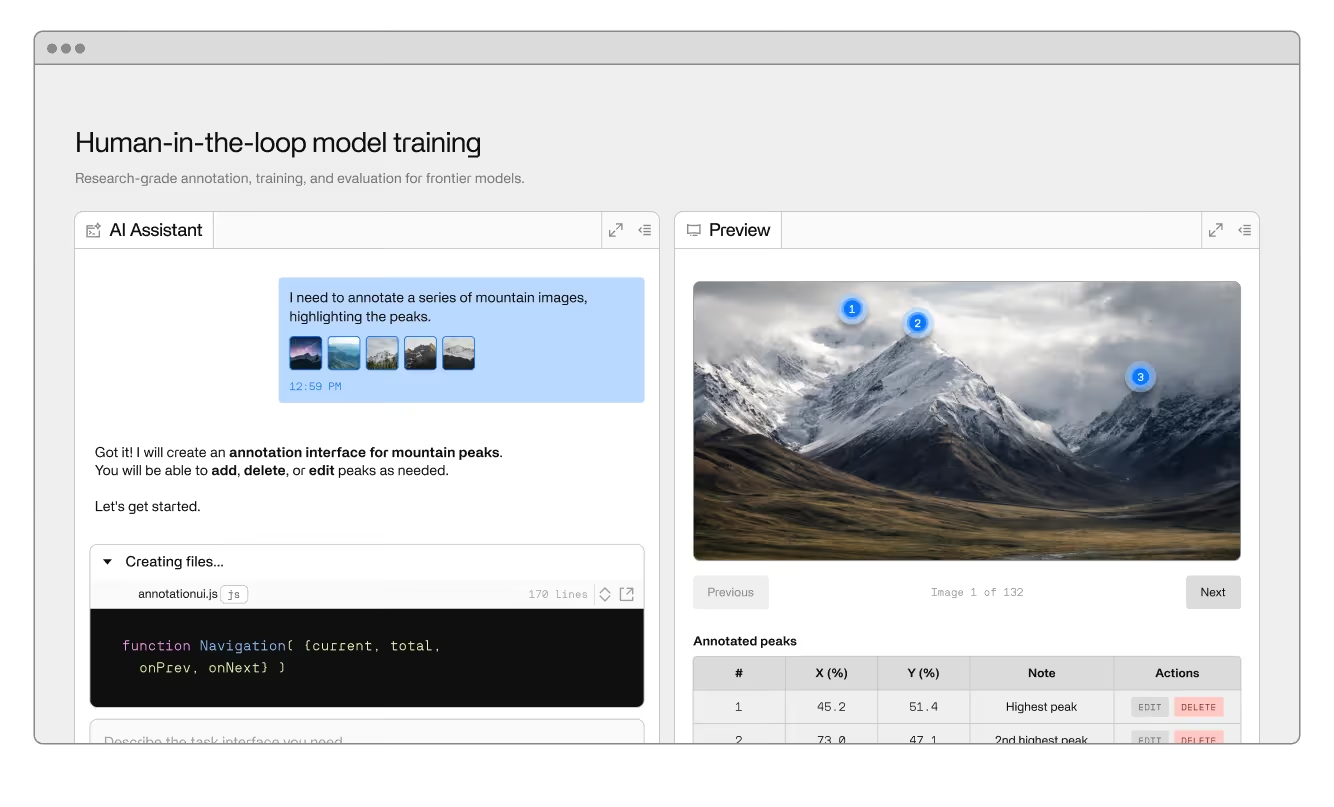
Invisible Technologies is the AI software platform for the enterprise, combining modular platform technology with an expert marketplace to make AI work in production, including training data pipelines, annotation programs, and quality review systems for professional services AI. Document annotation for professional services requires precision that generic labeling programs don't deliver: legal, tax, and compliance documents carry meaning in their layout and reading flow, not just their text, which means annotators need to capture component boundaries at pixel-level accuracy, establish correct reading order across complex layouts, and apply a multi-dimension quality standard to every task before it enters a model training pipeline. Invisible has built and run these programs for enterprise clients in legal and professional services, including a document layout annotation engagement for Thomson Reuters, covered in Forbes (2026).
--
Optical character recognition (OCR) is a solved problem. The harder challenge, the one that determines whether a document AI system is actually useful in professional services work, is understanding document layout and logical reading flow. OCR is a data extraction tool: it captures text from a page. What it cannot do is interpret the structural relationships between the elements on that page.
Professional services work runs on unstructured documents: legal filings, tax forms, compliance questionnaires, and contracts that don't conform to predictable templates or consistent layouts. A legal filing doesn't read top to bottom. A tax form doesn't present its fields in the order they carry meaning. A compliance questionnaire contains nested structures where the hierarchy of sections governs how individual answers should be interpreted. For AI to operate reliably in these workflows, it needs to learn not just what a document contains, but how that content is organized: which elements are which, and in what order they should be read.
Teaching a model that requires a specific kind of training data. And producing that training data requires an annotation program built for the precision the task demands.
Document AI for professional services typically requires two distinct models.
The first is a layout segmentation model: a machine learning model trained to identify and classify the structural components of a document page. In professional services documents, those components include titles, section headers, paragraphs, tables, list items (both ordered and unordered), key/value pairs, pictures, captions, checkboxes, page headers, footers, and form elements. Each component type has to be accurately detected and labeled so that downstream systems can understand what kind of element they're working with.
The second is a reading order model: a model trained to determine the correct sequence in which those components should be read. This is a distinct problem from layout detection. Documents in legal, tax, and compliance contexts frequently contain complex layouts that don't follow a straightforward top-to-bottom flow: multi-column structures, sidebars, footnotes, nested tables, and form sections that run non-linearly across a page. A reading order model trained on annotated data can resolve that complexity and present content in the coherent logical sequence that downstream search, summarization, generative AI, and automation workflows depend on.
Both models need high-quality annotated training data. That data has to be precise enough that the models can learn real structure instead of approximating it.
Pixel-level accuracy is not a marketing phrase in this context. It is a specific technical requirement that governs how annotation work is set up and executed.
Annotators working on professional services document layouts operate at 300-400% zoom with a pixel grid enabled, using a high-resolution display and a graphics tablet or high-DPI input device. Bounding boxes are drawn to the exact pixel boundary of each document component: the precise edge of a table, the exact boundary of a form field, the specific pixel where one section ends and another begins. Approximate bounding boxes produce approximate training signal, and a model trained on approximate signal learns to produce approximate outputs. For professional services AI where structural precision determines downstream accuracy, that is not an acceptable outcome.
This precision standard applies uniformly across component types. Tables are bounded at the cell level, not just as outer containers. Nested structures are marked with the specificity required to distinguish parent elements from child elements. Complex components (checkboxes, key/value pairs, form fields) are annotated according to documented guidelines that resolve edge cases consistently across the dataset.
Annotation quality in a program of this kind is evaluated across four dimensions, applied to every submitted task before it enters the training pipeline.
Bounding box quality covers three sub-criteria: bounding box tightness (how precisely the box boundaries match the actual component edges), complex segmentation (whether components with complex internal structure are correctly divided), and element segmentation (whether distinct elements are correctly separated from each other rather than merged or split incorrectly).
Label accuracy covers core label accuracy (whether the correct component type has been assigned), structural label accuracy (whether the hierarchical relationships between components are correctly represented), and complex label accuracy (whether components requiring judgment, such as nested structures, ambiguous elements, and edge cases, are correctly resolved).
Read order sequence quality covers global order logic (whether the overall reading sequence is coherent) and granularity (whether the sequence is specified at the right level of detail for the document's structure).
Metadata quality covers document type accuracy: whether the document has been correctly classified at the task level before annotation begins.
Each submitted task is evaluated against this rubric on a pass/fail basis. Tasks that don't meet the standard are not passed into the training pipeline.
Annotators on a program of this kind don't move directly into production work. The program runs as a human-in-the-loop system: practice tasks come first, with feedback provided on each before annotators progress to live annotation. Certification against the quality standard gates access to production tasks.
The annotation guidelines themselves evolve throughout the engagement. Edge cases that emerge in practice (footnotes, nested table columns, ambiguous component boundaries) get documented and added to the guidelines as they're encountered. Client feedback on annotation quality is incorporated into updated guidelines on an ongoing basis. The result is a program that gets more precise over time as the guidelines reflect a wider range of real document complexity.
This iterative refinement is what makes annotation AI infrastructure rather than a one-time data procurement exercise. Consistency across the dataset (built through documented guidelines, annotator training, and task-level quality review) is what the model learns from.
Invisible built and ran a document layout annotation program of this kind for a major provider of technology for legal and compliance professionals. The engagement required annotation capable of supporting two models (layout segmentation and reading order) across a corpus of professional documents containing unstructured data across diverse formats and layouts. Invisible was well positioned to do this work, having built similar content extraction training programs at major AI labs. Invisible's platform was used to manage the annotation workflow, and a formal quality rubric was applied to every submitted task throughout the engagement. Thomson Reuters subsequently expanded the engagement to support additional data needs. The engagement was covered in Forbes (2026). This kind of annotation program is AI infrastructure: the foundation layer that determines whether a document AI system improves over time or plateaus at demo quality.
Understanding what a production-grade annotation program requires is clearer against the failure modes it's designed to avoid. Each one represents a gap in the AI infrastructure layer that separates reliable document AI from systems that perform inconsistently in production.
Imprecise bounding boxes produce models that misidentify component boundaries at inference time. A model that can't reliably tell where a table ends, or where a form field begins, will produce downstream extraction errors in exactly the documents where precision matters most.
Inconsistent label application (annotators resolving ambiguous cases differently because the guidelines don't document edge cases) produces a model that learns inconsistency. It performs on document types it has seen in controlled evaluation and fails on structural variations it hasn't.
Missing reading order annotation produces models that can extract document components but can't sequence them correctly. For professional services documents with complex layouts, that failure makes the output unusable for the summarization and automation workflows that depend on coherent content flow.
No task-level quality review means annotation errors compound across the dataset. Volume without quality review doesn't produce a better model. It produces a larger inconsistent dataset.
If your document AI needs to work in legal, tax, or compliance workflows, the annotation behind it needs to meet a professional-grade standard. Invisible is the AI software platform for the enterprise — its annotation and evaluation layer, combined with an expert marketplace, delivers document annotation programs that meet production-grade quality standards for professional services AI. Talk to our team.
Document layout segmentation is the process of teaching an AI model to identify and classify the structural components of a document, like tables, form fields, headings, nested sections, and their spatial relationships, rather than just extracting raw text. It enables AI to interpret document meaning, not just document content.
Legal, tax, and compliance workflows depend on documents where structure carries meaning — contracts with embedded tables, tax forms with conditional fields, questionnaires where section hierarchy determines how answers are interpreted. AI systems in these workflows need to understand document structure, not just extract text. Thomson Reuters worked with Invisible to build this capability across invoices, forms, and complex professional documents. The engagement was covered in Forbes (2026).
OCR converts visual content into machine-readable text. It captures what a document says. Intelligent document processing goes further by interpreting document structure, classifying components, understanding how fields relate to each other, and extracting meaning from layout, not just content. For professional documents where structure determines meaning, like legal filings, tax forms, and complex questionnaires, OCR alone produces data that a model can't reliably act on.
A document annotation schema defines the component types annotators will label, the attributes they'll capture for each type, and the boundary rules they'll apply to ambiguous cases. Without a schema, annotators make independent decisions about edge cases, which are exactly the situations a model most needs to learn from consistently. Schema design before annotation is what produces training data that scales model performance rather than just adding volume.
Most document AI failures in production trace back to training data, not model architecture. The most common causes are inconsistent annotation, insufficient structural diversity in the training set, and the absence of an independent review layer that catches errors before they enter the training pipeline. A model trained on inconsistent data learns inconsistency — it performs on document types it has seen in controlled evaluation and fails on variations it hasn't.
The primary measure is inter-annotator agreement — the rate at which independent annotators produce identical labels for the same document components. Agreement scores above 90% indicate production-ready quality. Below that threshold, inconsistency in the training data degrades model performance regardless of volume. Schema compliance, spatial accuracy against a defined precision standard, and pre-ingestion format validation are the other checkpoints a production-grade program should apply before data enters the training pipeline.
Internal annotation makes sense when the corpus is stable, the task is well-defined, and the organization has domain expertise to maintain quality over time. External infrastructure is better when the program needs to stand up quickly, the corpus is diverse or evolving, or expert review workflows would take months to build. Most organizations underestimate the operational complexity of annotation quality review — that complexity is usually the deciding factor. Project contentBlog Writer & SEO AEO HelperCreated by yousitemap 8 July 2026.txt720 linestxtInvisible solutions and industry reference july 6 2026.txt872 linestxtinvisibletech_copywriting system - with blogs and meridial.md344 linesmd