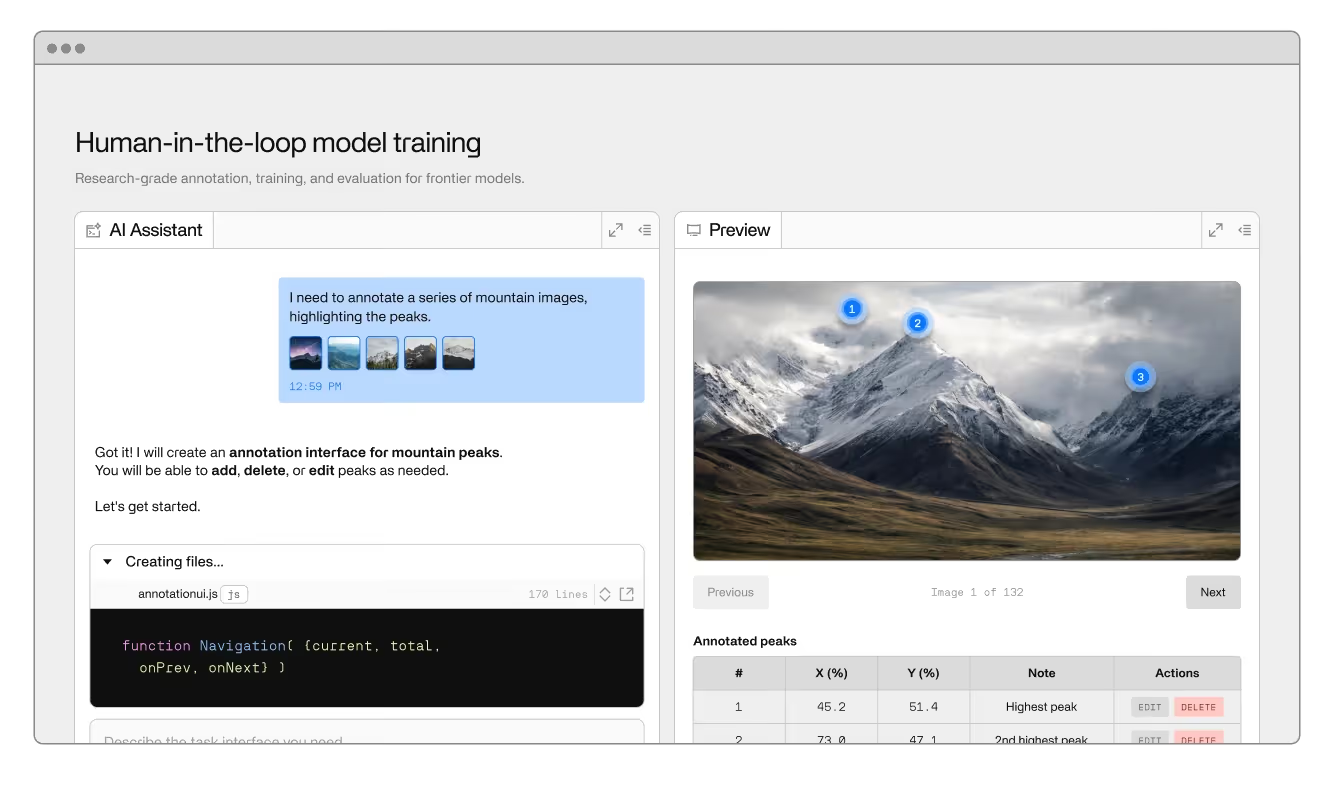
Synthetic data gives your AI team access to production-scale, privacy-safe training data without waiting for real-world collection to catch up. 75% of businesses will use generative AI to create synthetic customer data by 2026 — and the teams moving fastest are treating synthetic data not as a fallback but as a primary source for model training at scale.
The shift is driven by a practical gap: high-quality labeled real-world data is expensive, slow to collect, tightly regulated, and frequently imbalanced in ways that constrain model performance. Synthetic data addresses each of these constraints independently, which is why it has moved from a workaround for edge cases to a foundational component of enterprise AI development.
Synthetic data is algorithmically generated data designed to mirror the statistical properties of real-world data without containing actual records. Unlike anonymized data, which transforms real records by stripping identifiers, synthetic data is created net-new. Nothing in a synthetic dataset traces back to a real individual or event.
That distinction matters for regulatory compliance. Under GDPR and HIPAA, data that cannot be traced to a specific person falls outside the most restrictive requirements. Synthetic data therefore opens up data-sharing and cross-team workflows that real data cannot, including moving training data to external vendors and sharing it across organizational or jurisdictional boundaries.
Synthetic data falls into three categories based on how much it depends on real-world source material: fully synthetic, partially synthetic, and hybrid.
Fully synthetic data is generated entirely from scratch, with no real records as direct input. Statistical models or generative AI systems learn the patterns and distributions of a domain, then produce new data reflecting those patterns without containing original records. This is the right choice when regulatory restrictions are strictest, when no usable production data exists, or when you need edge-case scenarios at a volume real data cannot provide.
Partially synthetic data replaces only the sensitive fields in a real dataset, such as personally identifiable information, with synthetic values while preserving the rest of the original structure. The approach retains statistical fidelity while substantially reducing re-identification risk. It is common in financial services and healthcare, where the underlying data structure carries legitimate signal but specific records cannot be shared.
Hybrid datasets combine real data with fully synthetic records. Teams use hybrid approaches to address class imbalance, augmenting underrepresented categories in training data, or to scale a real dataset to a volume that production data alone cannot support. A fraud detection team with 1,000 real fraud samples can generate synthetic fraud transactions to build a training corpus large enough for a high-precision model.
Real data is the most statistically faithful source of information about actual events. When you have it, it is labeled, and it is usable, anchor your training pipeline there. The problem is that real data rarely satisfies all three conditions simultaneously.
Synthetic data's advantages appear precisely where real data falls short. It fills gaps in rare or dangerous events with the volume and label precision that real-world collection cannot match at scale. When combined with real data, synthetic datasets create hybrid training corpora that correct for class imbalances and coverage gaps that limit model accuracy on real-world distributions.
The tradeoff is quality dependency: synthetic data is only as good as the model or process used to generate it. A poorly calibrated generator produces data that looks plausible but does not match the real-world distribution your model will face in production. A train-on-synthetic, test-on-real validation protocol is required, not optional.
Synthetic data reduces the three constraints that slow AI development most consistently: access, cost, and compliance.
Access gaps slow teams building in new verticals or rare-event domains where historical data would take years to accumulate. Synthetic data provides the volume needed to begin training immediately and can be scoped precisely to the scenarios a model needs to handle, including scenarios that have not yet appeared in production.
Cost constraints are sharpest in specialized domains. Expert annotation for medical imaging and legal document annotation can run tens of dollars per record. How leading AI teams use synthetic data generation for model training shows how purpose-built generation pipelines close the gap between the data a model needs and what an organization can realistically collect and label.
Compliance constraints hit hardest in regulated industries. Regulatory compliance requirements create liability when real customer data moves between teams or to third-party vendors. Synthetic data eliminates the underlying risk while preserving the statistical signal, which is why financial services and healthcare have been early adopters at scale.
Synthetic data unblocks AI development where real data is scarce, regulated, or both, and the pattern repeats across every sector.
In financial services, synthetic fraud transaction data lets detection teams train on attack patterns that have not yet occurred in production, including novel vectors and future threat scenarios. Invisible launched a leading LLM six months faster by combining synthetic training data with expert annotation pipelines, demonstrating the timeline compression a well-executed synthetic data strategy produces at enterprise scale.
In healthcare, synthetic medical image data fills a training gap that real patient data cannot. Diagnostic models need labeled examples of rare pathologies and unusual presentations, but real imaging data is both legally restricted and expensive to annotate at the volume training requires. Synthetic generation provides the scale and label specificity without the legal and cost barriers.
In retail and demand forecasting, synthetic customer transaction data lets teams model seasonal volatility and new product demand for SKUs or markets with no purchase history. A model trained on those scenarios deploys on launch day rather than waiting for real purchase data to accumulate.
In autonomous systems development, synthetic sensor data generates training scenarios for conditions that are rare, dangerous, or impossible to replicate at the scale safety certification requires.
Synthetic data does not eliminate data risk; it shifts it. Teams that do not account for where it shifts end up with the same problems they were trying to avoid.
The primary challenge is fidelity. A synthetic dataset that misses fine-grained correlations in real data produces a model that performs well in validation but degrades in production. Getting fidelity right requires expertise in generative modeling and rigorous quality assurance, not just running a generator against a schema.
Model collapse is a documented risk for teams using synthetic data to fine-tune large language models. When a model trains iteratively on too much of its own output, feeding synthetic data generated by the model back into training, outputs degrade and distributional diversity narrows. Mixing real and synthetic data and monitoring for distributional drift are the standard mitigations. Anchoring synthetic data in human truth covers how expert human annotation keeps synthetic pipelines grounded as they scale.
Stakeholder skepticism is a practical barrier in many organizations. 'Synthetic' reads as 'fake' to decision-makers who have not built with it, and the gap between a high-fidelity synthetic dataset and a fabricated one is not visible without technical context. Establishing validation protocols and reporting fidelity metrics is as much a communication task as a technical one.
Synthetic data works best when it is generated, validated, and annotated by people who understand both the data and the domain. Invisible's Data Lab delivers synthetic data generation alongside expert annotation across 800+ domains, ensuring the data your model trains on reflects the real-world distributions it will face. Talk to our team about what your training pipeline needs.
Synthetic data is generated net-new to reflect the statistical properties of real data without containing any actual records. Anonymized data transforms real records by stripping identifiers; the underlying individual is still the source. Synthetic data has no real person behind it, which eliminates re-identification risk and simplifies compliance without requiring data provenance review.
Use synthetic data when real data is unavailable, prohibitively expensive to label, legally restricted, or not representative enough for your model's use case. If you have high-quality, labeled, compliant real data in adequate volume, anchor your training there. Synthetic data fills the gaps in rare events, new product categories, and regulated domains.
Accuracy depends on the generation method and QA process applied. A well-calibrated generator producing structured tabular data can achieve near-perfect fidelity against a real dataset. The standard validation is train-on-synthetic, test-on-real: if model performance on real held-out data matches performance when training on real data, the synthetic set carries the signal that matters.
Fully synthetic data generated without real records as direct source material falls outside GDPR's scope because no natural person can be identified from it. For data modeled on real datasets, compliance depends on whether the output can be re-identified; validate with a membership inference test before treating it as compliant. HIPAA applies the same logic.
The main risks are fidelity gaps, where the synthetic dataset misses real-world correlations and the model degrades in production; model collapse, where recursive training on synthetic outputs narrows distributional diversity; and validation overconfidence, where strong performance on synthetic test sets does not guarantee generalization. All three are addressed through structured QA and real-data validation benchmarks.
The three main types are fully synthetic (generated entirely from scratch with no real records as input), partially synthetic (replaces sensitive fields in a real dataset while preserving the original structure), and hybrid (combines real and synthetic records to address class imbalance or scale a corpus). Each involves different tradeoffs between fidelity, compliance risk, and generation cost.