Building the business case for enterprise computer vision requires moving beyond the technical capabilities of AI algorithms to focus on the unit economics of visual data and its integration into your existing operational stack. You must quantify the reduction in cycle times, the mitigation of defect escape rates, and the long-term scalability of AI-driven workflows. A successful business case demonstrates how computer vision technology serves as a cognitive layer over physical operations, converting raw video feeds into actionable metrics that drive decision-making across manufacturing, e-commerce, and healthcare environments. For the foundational mechanics of how the technology works, start with our plain-language guide to computer vision.
The primary friction in modern operations is the gap between what is happening on the floor and the data that reaches the dashboard. Decisions are made based on snapshots — end-of-shift reports, manual logs, spot checks — leaving the vast majority of visual information uncaptured and unanalyzed. This visibility gap creates a hidden tax on the enterprise in the form of undetected bottlenecks, safety risks, and quality variances that compound over time.
A pilot project that successfully identifies a defect through object detection in a controlled lab environment proves nothing about its actual business value. The business case for enterprise computer vision must start with the cost of the problem, not the elegance of the solution.
If a manual inspection process catches 98 percent of errors, the cost of the remaining 2 percent must be weighed against the total cost of ownership of an automated system. This includes the initial hardware outlay, the labeling of thousands of images to train AI models, and the ongoing expense of model maintenance.
High-performing algorithms are commodity components; the actual value lies in how AI-powered computer vision solutions reduce the cost per unit of output. In a high-volume logistics facility, a 5 percent increase in supply chain throughput through sorting optimization can yield millions in annual savings. If the system requires a dedicated team of data scientists to maintain it, those gains vanish.
The case must argue for a system that pays for its own maintenance through sustained performance gains. The use cases that generate the strongest internal buy-in are those where the cost of the problem is already visible on the balance sheet — defect escape rates, idle time at bottlenecks, and compliance failures are all quantifiable before a single camera is installed.
Most enterprise AI initiatives fail because they treat software as a static asset. In the physical world, environments change: lighting shifts with the seasons, new product packaging is introduced, and camera lenses gather dust. These variables lead to model drift, where the accuracy of the computer vision technology declines as the reality of the floor diverges from the data it was trained on. Understanding why computer vision models degrade in production — and how to architect against it — is essential context for any business case that claims to account for total cost of ownership.
Ignoring this reality leads to the day 2 problem, where a system that worked perfectly during the pilot begins to flag false positives at an unsustainable rate six months later. Structure your business case around the lifecycle of the data, ensuring there is a clear plan for who handles the retraining and how much it will cost. Advancements in machine learning have made continuous retraining pipelines more accessible, but they still require budget, ownership, and a clear escalation path when real-world performance degrades.
One of the most frequent reasons computer vision initiatives fail to move beyond a single production line is a failure to account for the bandwidth tax. While a single camera feed is easy to manage, an enterprise-wide rollout involving hundreds of high-definition streams can paralyze a local network. A viable business case must choose between two financial paths: massive investment in cloud egress and storage fees, or a shift toward edge computing to minimize latency.
Processing visual data at the edge — meaning the deep learning happens on a local gateway rather than in the cloud — drastically reduces long-term operational costs. It ensures real-time decision-making is possible even during network outages. When building your case, present the infrastructure cost as a strategic roadmap toward a more resilient, scalable architecture. If you account for edge hardware and local network upgrades in your initial request, you are seen as a realist; if you ignore them, the IT department will stop the project three months in.
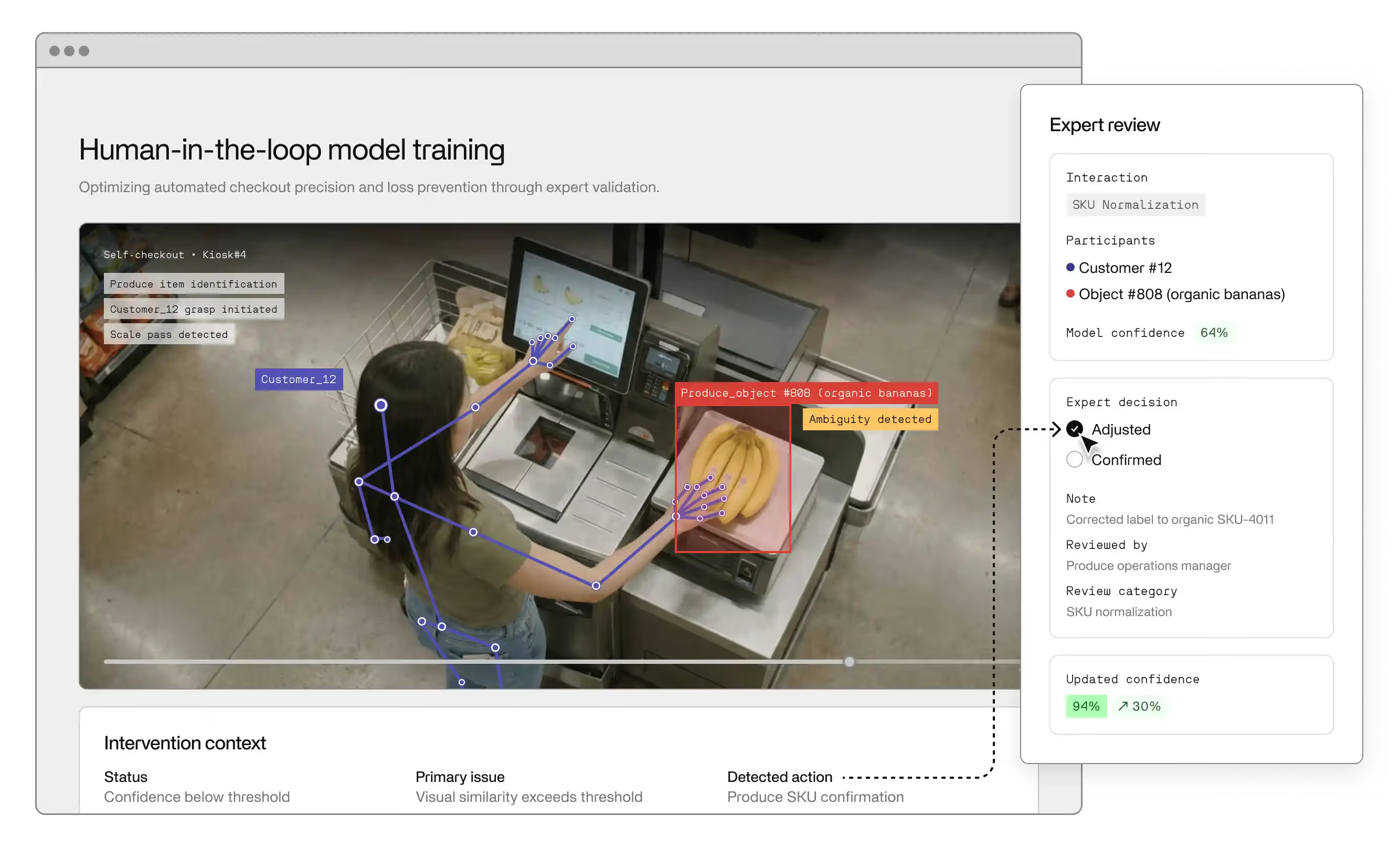
There is a common misconception that the goal of artificial intelligence in an operational context is the removal of human oversight. In an enterprise context, the most profitable use cases are those that act as a cognitive exoskeleton for existing staff. By using AI-driven tools to filter thousands of hours of footage into a few dozen actionable alerts, a single supervisor can manage a much larger footprint without a loss in quality.
This shift optimizes the labor force by moving people away from rote observation and toward high-value problem-solving.
This human-in-the-loop approach also mitigates the risks associated with edge cases that even the most advanced AI models might miss. When the business case is framed as an efficiency multiplier for the current workforce, it gains faster internal buy-in and avoids the cultural friction associated with full automation. It also simplifies the path to scaling — it is easier to deploy an assistive tool across ten plants than it is to redesign ten plants for fully autonomous robots and production lines.
The true enterprise value of computer vision lies in its ability to turn physical actions into digital metrics in real time. In healthcare, this might mean tracking the movement of high-value equipment or monitoring patient safety protocols without intrusive manual checks. In large-scale distribution operations, AI-powered vision AI audits packing stations where algorithms verify that the items placed in a box match the digital manifest. Retailers use the same approach in physical stores to analyze customer behavior through dwell times and pathing data, surfacing insights into the customer experience that were previously invisible and difficult to streamline without real-world visual data.
This visual data is a unique asset class that, when integrated via APIs into ERP systems, allows for a level of precision in decision-making that manual data entry can never match. A precise understanding of what data computer vision actually produces — and how it maps to your existing reporting structures — is the prerequisite for scoping the integration layer your business case will depend on. A system installed for quality control also generates data on machine downtime and operator efficiency — by surfacing these secondary benefits in your business case, the investment transforms from a point solution into a foundational layer of the enterprise AI data strategy.
Beyond direct labor and throughput gains, computer vision offers significant value in risk reduction and compliance. In industries with high safety stakes, the ability to detect a spill, a blocked fire exit, or a worker without proper PPE is a substantial hedge against litigation and insurance premiums. Your business case should quantify the potential cost of these incidents and the probability of their occurrence, showing how the technology serves as a proactive insurance policy.
This is particularly relevant in highly regulated sectors where manual compliance audits are both expensive and prone to error. An automated and auditable record of every safety check performed by AI systems provides a level of defensibility that is invaluable during a regulatory review.
When the cost of a single major safety violation or a product recall is factored in, the payback period for enterprise computer vision drops from years to months.
The decision to develop an internal computer vision team or partner with an external vendor is a pivot point for the entire project. Building internally provides maximum control but comes with an immense time-to-value penalty. Recruiting specialized AI talent is difficult, and the infrastructure required to manage deep learning pipelines is complex. A hybrid approach — buying a flexible platform and using internal teams for domain-specific oversight — is the fastest path to measurable ROI.
A vendor-led approach should be evaluated based on the transparency of their model retraining process. If a vendor treats their algorithms as a black box that cannot be tuned to your specific environmental changes, they are a liability.
Your business case should favor partners who provide the tools for continuous improvement and allow your team to own the resulting data insights. This ensures that the system grows in value as it collects more of your specific operational data, rather than becoming an obsolete piece of software. For a grounded view of which enterprise workflows actually benefit from computer vision at each stage of maturity, the use cases map directly to the investment categories your business case will need to justify.
Ready to move from business case to deployment? Explore our computer vision solutions or get started with a scoping conversation.
Look beyond labor replacement. The core financial value sits in reducing hidden costs: the price of a product recall, the impact of a 2% defect escape rate on major contracts, or idle time at sorting bottlenecks. A robust business case factors in throughput, quality control consistency, and safety risk mitigation. Map these against total cost of ownership and you'll typically see break-even within 12 to 18 months.
The most significant challenge is the sim-to-real gap. Models that perform perfectly on lab datasets degrade when exposed to the grit, vibration, and shifting light of a real-world facility. Network latency becomes a material factor at enterprise scale. Your architecture must favor edge computing for real-time processing while using cloud pipelines for long-term retraining — keeping the system responsive across global sites without overloading local infrastructure.
Take a privacy-by-design approach. Engineer your systems to process only necessary data, using segmentation to mask faces or PII at the edge before data is ever stored. This ensures the technology focuses on process optimization and defect detection rather than worker surveillance. Clear communication during change management about how visual data is used and protected is essential for securing buy-in from both the board and the floor.
The decision depends on the uniqueness of your operational environment. Off-the-shelf tools deploy faster for common use cases but struggle with specialized applications — detecting microscopic cracks in proprietary components, for example. Building from scratch requires heavy investment in data and talent. A hybrid approach — enterprise AI pipelines with customized logic for your production environment — gives you the precision of a custom build with vendor-platform scalability.
Computer vision is not a set-and-forget technology. As production lines change or environmental conditions shift, model accuracy will naturally degrade. Your business case must include an ongoing maintenance roadmap: a continuous loop where edge cases are flagged for human review and used to retrain the model. Budget for this lifecycle upfront and the system maintains its accuracy long after initial implementation. Skip it and you're funding a depreciating asset.
Computer vision outputs must feed directly into your ERP, MES, or WMS through secure APIs. Prioritize enterprise-grade systems that convert visual inputs into the data formats your existing workflows already consume — triggering a production line pause on defect detection, or updating inventory without manual entry. Mapping these integration points during the initial roadmap phase prevents technical debt and ensures insights reach the stakeholders who need to act on them.