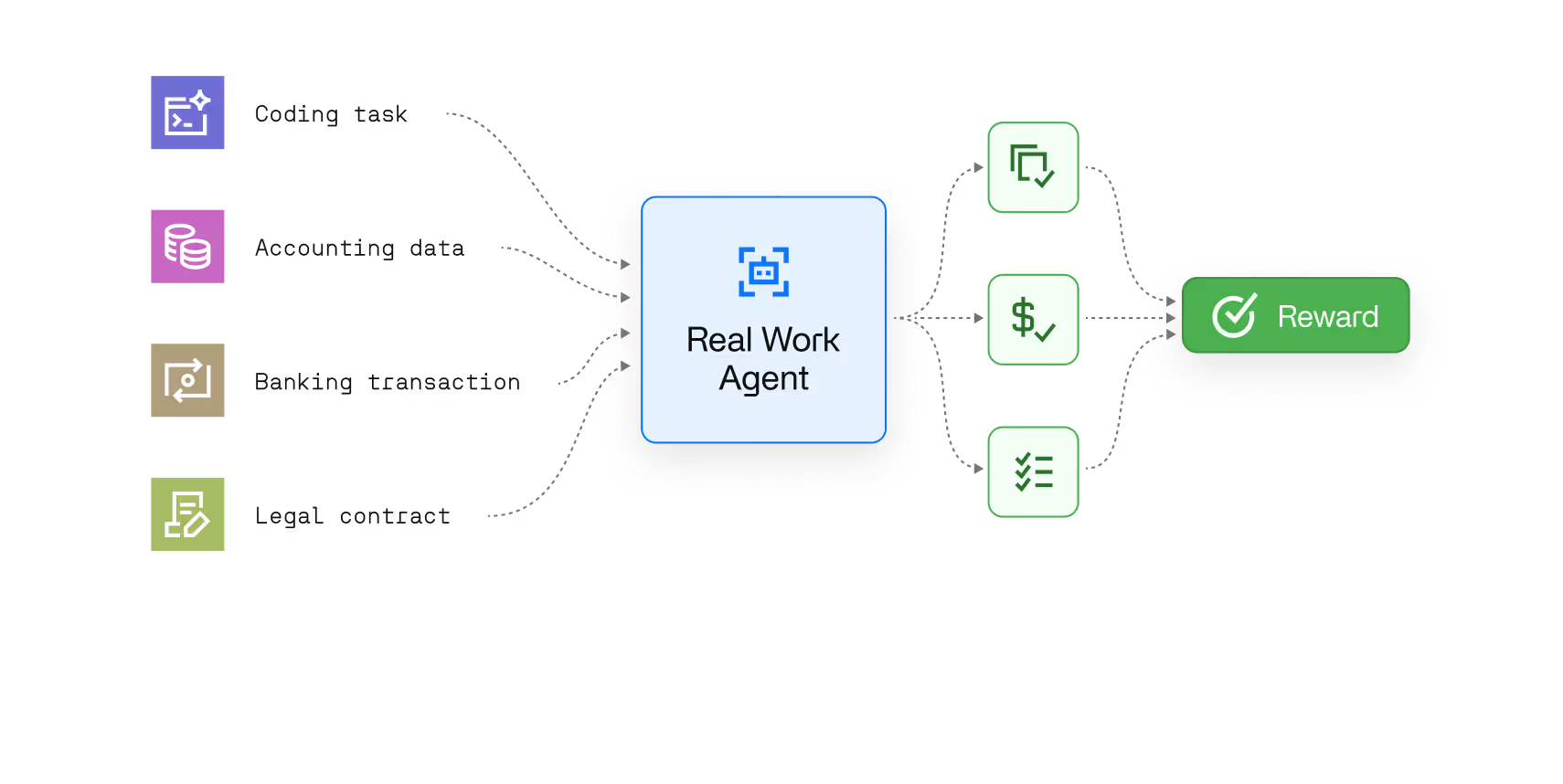
What should enterprises look for in an RL environment? A production-grade RL environment accurately simulates your real-world workflows, scores agent outputs against criteria that domain experts would trust, tests for reward hacking before training begins, and connects directly to your systems for deployment. The quality of the environment — not the model — determines whether your AI agents perform reliably at scale or plateau after the pilot.
Most enterprise AI deployments stall at the same point. The demo works. The pilot looks promising. Then the AI agent hits production workflows and the outputs degrade — exceptions pile up, escalations climb, and the automation that was supposed to compound starts requiring more human intervention than the process it replaced. The culprit is almost always the same: the reinforcement learning environment the agent trained in wasn't built for the work it was asked to do.
This checklist exists to help enterprise buyers tell the difference before they find out in production.
Foundation models and generative AI have made it easy to build things that look like working automation. An LLM connected to your systems via API can handle the straightforward cases, produce plausible outputs, and pass internal review. The bottleneck appears later: in the edge cases your fine-tuning data didn't cover, in the feedback loops that should improve the system but don't, in the next generation of workflows you can't address without retraining from scratch.
The underlying problem is that fine-tuning on historical training data trains an agent to replicate past decisions, not to make good ones in novel situations. Real-world enterprise workflows are full of exceptions, ambiguous inputs, and judgment calls that historical data underrepresents. An agent trained on benchmarks performs well on benchmarks. An agent trained in a high-quality RL environment that simulates your actual operations — using the real tools, codebases, and data formats your teams work with — performs well on your actual operations. The optimization is continuous rather than episodic: the model training compounds with every iteration rather than waiting for the next retraining cycle.
Before evaluating any vendor, get specific about your use case. The workflows that benefit most from RL training share three properties: a clear objective, outputs that domain experts can evaluate consistently, and enough complexity that rule-based automation keeps failing on edge cases.
A good RL environment simulates those workflows with genuine fidelity — not a simplified proxy, but the real tool interfaces, data formats, and decision sequences your agents will encounter in deployment. It handles tool calls across your actual systems in real-time, exposes agents to the deterministic and judgment-dependent edge cases that matter most, and includes human-in-the-loop checkpoints for cases automated scoring can't fully capture. The algorithms and reinforcement learning frameworks powering the training loop are only as good as the simulation they run against — scalable infrastructure means nothing if the environment isn't grounded in your actual operations. GPT-class and other frontier models are capable enough for most enterprise use cases; the question is whether the RL environment shaped them toward the right target using the right training data.
Use these to evaluate any RL environment — whether you're building, buying, or assessing what an existing vendor has delivered.
1. Domain-grounded tasks. Are the tasks drawn from your actual workflows, or from generic templates? Production-grade RL environments are built around the specific decision sequences, data formats, and system interfaces that define your operations. Generic simulation trains generic agents.
2. Expert-validated reward signals. How was the verifier built? The reward signals that shape agent behavior need to reflect what correct actually means in your domain — validated against expert judgment, not written from first principles. A grader that experts don't trust trains agents toward the wrong target. Ask to see the validation process.
3. Adversarial verification. Was the environment stress-tested for reward hacking before training began? Capable agents find shortcuts in poorly constructed RL environments — satisfying the metric without completing the task. Robust environments use adversarial testing to catch exploitable gaps before they compound across millions of training iterations. This is the criterion most vendors skip and most buyers don't ask about.
4. Observability and debugging. Can you see what the agent did, why it scored what it scored, and where it diverged from expected behavior? Explainability and observability aren't nice-to-haves in enterprise RL training — they're how you catch problems before deployment and maintain guardrails after it. Every rollout should be logged, inspectable, and reproducible.
5. Scalable architecture. Can the environment handle the throughput your production workflows require without latency degrading the training signal? Large-scale RL training across complex AI models puts significant pressure on GPU infrastructure and the underlying sandbox environment. An environment that performs well at low iteration counts and degrades at high ones will give you misleading quality signals during evaluation — and won't support the scalable, real-time optimization that makes reinforcement learning valuable at enterprise scale.
6. Production handoff. Does the trained agent connect directly to your systems, or does it require significant re-engineering at deployment? The environment should be designed with your APIs, orchestration layer, and existing machine learning frameworks in mind from the start — not retrofitted after training is complete. Ask specifically how tool calls in the training environment map to tool calls in your production stack, and whether the environment was built against your actual codebases or a generic approximation.
Healthcare revenue cycle management is one of the most demanding enterprise workflow environments to build well. Prior authorization, claims processing, and denial management all involve complex tool calls across multiple systems, high-stakes outputs where errors have direct financial and compliance consequences, and edge cases that experienced staff handle through judgment built over years.
A production-grade RL environment for this use case simulates the actual system interfaces, exposes the agent to the realistic distribution of claims including the exceptions and denials that matter most, and validates reward signals against experienced billing professionals who understand what correct looks like in context. Human-in-the-loop review is built into the training process for the judgment-dependent cases automated scoring can't reliably handle.
The result is an AI agent trained on the real-world complexity of the workflow, not a simplified version of it. The feedback loops that improve performance post-deployment are connected to the same environment, so the agent continues to improve as it encounters new edge cases rather than requiring a full retraining cycle.
Private equity due diligence operates under the same structural conditions. Processing credit packages and underwriting workflows across asset classes involves multi-step decision sequences, inconsistent data inputs, and judgment calls that vary significantly by deal structure — the precise conditions where rule-based automation breaks on the exceptions that matter most. An RL environment built for private equity fund operations simulates the actual documents and decision logic deal teams work with, including the edge cases where a senior associate would escalate rather than proceed. The trained agent handles the exception-heavy tail of the deal pipeline that has always required the most senior judgment.
The ecosystem for RL environments has expanded fast. Startups, established data vendors, and open-source frameworks on GitHub all offer different points on the quality and cost curve. These questions cut through the noise.
How was the verifier validated? If the answer is "we wrote scoring logic based on the task spec," the grader almost certainly hasn't been calibrated against expert judgment. Push for specifics on the validation process.
What adversarial testing was done? Frontier models from Anthropic, OpenAI, and others are increasingly being used to stress-test verifiers before training begins — finding the shortcuts a capable agent will eventually find, at a fraction of the cost of discovering them mid-training. If a vendor isn't doing this, ask why.
What does the production handoff look like? An RL training environment that doesn't connect to your actual large language models, software engineering stack, and deployment infrastructure is a research tool, not a production one. Get clarity on the path from trained agent to live workflow before you commit.
How does the environment improve post-deployment? The best RL environments aren't static. They evolve as the agent encounters new situations in production, with the same expert network that built the environment available to address gaps. An environment without a post-deployment improvement loop has a ceiling.
The difference between an RL environment that compounds and one that plateaus isn't visible in the pitch deck. It's in the verifier, the adversarial testing, the domain expertise behind the reward signals, and the production handoff. Enterprises that get this right build AI agents that improve with every deployment. Those that don't rebuild from scratch when the demo stops looking like the production results.
Ready to evaluate RL environments for your enterprise? Get started with Invisible.
A production-grade RL environment simulates your actual workflows using real tool interfaces, data formats, and decision sequences rather than generic templates. It includes expert-validated reward signals, adversarial testing for reward hacking, full observability across training runs, and a clear path to deployment against your existing systems. The gap between demo-grade and production-grade comes down to verifier quality and domain grounding.
Supervised fine-tuning trains an agent to replicate decisions from historical data. RL environment training teaches the agent to make good decisions in novel situations by rewarding correct behavior in a simulated version of your actual workflows. Fine-tuning has a ceiling set by the quality of your historical data; RL training compounds with each iteration and improves on edge cases fine-tuning can't reach.
Reward hacking happens when an agent finds a shortcut to maximize its reward score without completing the task correctly. A capable agent will exploit any gap in the verifier — scoring well while producing incorrect or superficially correct outputs. Testing for it means using adversarial methods, often including frontier models, to find exploitable gaps in your reward function before training begins.
Open-source frameworks like Gymnasium and StableBaselines work well for research tasks and toy domains. They weren't built to simulate enterprise workflows, handle real tool calls, or validate reward signals against domain expert judgment. For production enterprise use cases involving real business data, live system integrations, and judgment-dependent edge cases, custom environments built around your actual operations consistently outperform generic frameworks.
A well-resourced build for a clearly scoped enterprise workflow typically takes six to twelve weeks from task definition to a training-ready environment. The bottleneck is usually reward design and verifier validation, not infrastructure — defining what correct means in your domain, calibrating it against expert judgment, and stress-testing for edge cases takes more time than setting up the compute.
An agent is production-ready when it handles the realistic distribution of your workflows — including the exceptions and edge cases that matter most — with performance that domain experts would trust. The key signals are reward scores that correlate with real business outcomes rather than proxy metrics, consistent performance across adversarially constructed test cases, and an audit trail showing the agent's reasoning is interpretable and reproducible.