Computer vision delivers its highest enterprise ROI in high-volume, visually dense workflows where manual oversight creates operational latency or safety risks. Manufacturing quality assurance, logistics tracking, retail operations, clinical diagnostics, and facilities compliance are all workflows where structured visual data — fed directly into ERP, WMS, and CRM computer vision systems — drives automated action rather than deferred reporting. If you want the foundational mechanics before getting into applications, start with our computer vision guide for enterprise leaders.
You are almost certainly paying a silent tax on the visual data you already capture. Thousands of hours of video stream from your warehouse floors, loading docks, and surgical suites every day, existing only as a forensic record to be consulted after a failure occurs. Your managers cannot be everywhere, and their eyes fatigue after twenty minutes of monitoring a feed.
You have perfect visibility in theory, but zero actionable intelligence in practice. You are recording your inefficiencies without any mechanism to intervene in them in real time. AI-powered computer vision technology moves you from passive recording to active, integrated workflows that trigger automated actions and mid-course corrections without human prompting.
Most computer vision applications fail in deployment because they are treated as an observational layer rather than a transactional one. If your computer vision system identifies a dented pallet but requires a supervisor to manually log into a dashboard to see the alert, you have simply moved the bottleneck from the floor to the screen. To extract actual value, the output of computer vision models must be treated as a programmatic trigger for your existing systems of record.
In a high-functioning supply chain, object recognition identifying a missing shipping label should automatically pause the conveyor belt and generate a re-print command in the WMS. The system acts as one of the most reliable AI tools in your automation stack — a high-speed, 24/7 clerk that translates pixels into SQL entries.
By removing the manual bridge between seeing and recording, you eliminate the human error and latency that allows small operational mistakes to compound into expensive disruptions. Understanding what structured data computer vision actually produces — and how it maps to your systems of record — is the prerequisite for scoping any computer vision project correctly.
In healthcare, the volume of visual data — from MRIs to bedside monitoring feeds — has far outpaced the capacity of clinical staff, and the most capable deployments are multimodal, processing imaging, sensor, and audio data within a single diagnostic pipeline. These computer vision applications in a clinical setting act as a triage layer that allows radiologists and surgeons to focus their cognitive load where it is most needed. Machine learning can scan thousands of X-rays in seconds to flag anomalies, but the true value lies in the automated routing that follows. Instead of an urgent scan sitting in a generic queue, artificial intelligence identifies life-threatening markers and pushes those files to the top of a specialist's dashboard instantly.
This reduces the time-to-treatment for critical patients from hours to minutes, effectively streamlining the entire clinical diagnostic pipeline.
Beyond medical imaging, vision-based workflows are transforming the operating room. By using object detection to track surgical instruments, hospitals can virtually eliminate the risk of retained foreign objects. These algorithms provide a continuous audit of the surgical field, ensuring that the count at the end of the procedure matches the count at the beginning.
This conversion of a manual count into a verified end-to-end data stream allows hospital administrators to optimize room turnover and operational efficiency while increasing patient safety.
In highly regulated industries like healthcare, aerospace, and pharmaceuticals, the burden of manual documentation often equals the cost of production itself. AI-driven computer vision systems automate chain-of-custody and safety audit workflows that previously required significant human overhead. Instead of a supervisor manually signing off on safety protocols or cleaning cycles, these AI systems provide a continuous, time-stamped visual audit that is far more reliable than a paper log.
In a pharmaceutical cleanroom, object recognition and segmentation are used for identity authentication and to verify that every technician has followed the exact gowning procedure required by law. If the algorithms detect a breach in protocol — a torn glove or an unmasked face — the system automatically locks the digital entry point and logs the incident in the compliance dataset.
Downtime is the most expensive metric on the balance sheet. Vision AI integrated with predictive maintenance pipelines can identify the early signs of equipment fatigue before a mechanical failure occurs. By monitoring the vibration patterns or heat signatures of robots and conveyor motors, AI models can predict breakdowns days in advance.
Instead of waiting for a production line to halt unexpectedly, the system triggers an automated work order in the CMMS once a wear threshold is breached. This allows your operations team to replace a $50 part during a scheduled 15-minute shift change, rather than managing a catastrophic four-hour breakdown during peak production. Defect detection at this stage — catching component wear before it compounds — is where computer vision delivers some of its most measurable ROI.
The sports industry presents a unique enterprise challenge: converting high-velocity movement into structured data without interfering with play. Historically, performance analytics required an army of coordinators to manually tag events — a process that was slow and prone to subjective bias. Modern computer vision technology eliminates this bottleneck by using convolutional neural networks (CNNs) to track player skeletal data and ball trajectory in real time. For a deeper look at how AI video analytics processes and structures that footage at an enterprise scale, the mechanics apply equally across broadcast, scouting, and injury prevention workflows.
The result is the ability to optimize both roster construction and player health. By analyzing a pitcher's joint angles or a sprinter's stride frequency across a full season, AI can flag subtle biomechanical changes that typically precede stress fractures. Medical staff can intervene before an injury occurs, protecting tens of millions of dollars in player assets. This data also powers secondary revenue streams — by streamlining the creation of automated highlights and augmented reality overlays, sports organizations can deliver personalized content to global fanbases instantly.
Retailers are using computer vision applications to bridge the gap between digital analytics and physical store layouts. While e-commerce has long tracked shopper clicks, physical stores have remained relatively opaque. AI-powered computer vision systems now enable real-time monitoring of customer behavior — heat-mapping which aisles draw the longest dwell time, identifying where shoppers experience friction, and surfacing where foot traffic doesn't convert. Improving the customer experience at shelf level is one of the highest-return use cases for vision AI in physical retail.
If the system detects a cluster of three shoppers hovering in front of a shelf for more than 60 seconds without selecting an item, it alerts a floor associate to provide assistance.
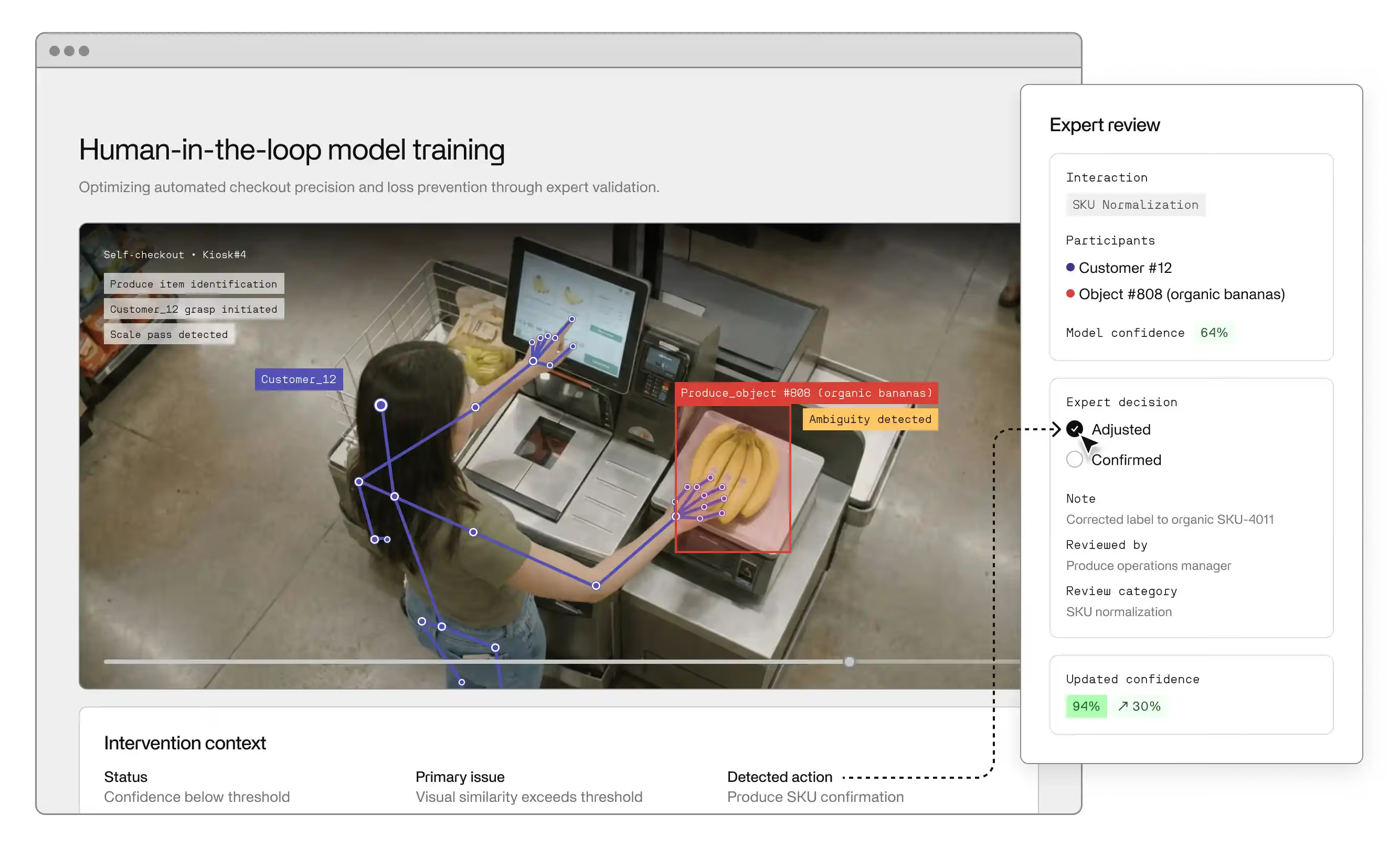
In checkout workflows, image recognition is streamlining payment and reducing shrinkage. Systems can now automatically identify produce or non-barcoded items at self-checkout, eliminating the need for customers to scroll through menus. Simultaneously, the system cross-references the weight on the scale with the visual identity of the item to prevent intentional or accidental miss-scans. Shelf stock monitoring and inventory management trigger a restock order in the WMS the moment a high-margin item goes out of stock — no manual check required.
In logistics, one of the most persistent drains on the bottom line is the discrepancy between services rendered and services billed. Manual pallet measurement is too slow for a high-volume warehouse. By integrating vision AI into the loading dock, AI algorithms calculate the precise 3D volume of a pallet in real time as it passes through a bay.
This automated dimensioning identifies the exact height, width, and depth of a load regardless of irregular packaging or overhangs, then immediately compares those dimensions against the shipping manifest, pricing, and the customer's service contract. If a discrepancy is detected, the system automatically adjusts the invoice via APIs before the truck leaves the yard — without adding a second to the operational cycle or requiring a worker to step off a forklift.
You've likely been sold on 99.9% accuracy — real-world conditions don't cooperate. Dust, changing light, and vibrating mounts mean that even the best deep learning models will face periods of degraded confidence. The conditions that cause computer vision models to degrade in production are predictable — and preventable — if your deployment architecture accounts for them from the start.
Building a scalable human-in-the-loop infrastructure for the remaining 5% of use cases ensures that automation never stops due to a false negative. When the confidence score of an image processing event drops, the workflow routes that specific frame to a remote human for a two-second annotation or verification. This architecture protects the ROI by ensuring that the automated workflow has a graceful failover that does not disrupt the broader production tempo.
One of the most persistent misconceptions in applications of computer vision is the requirement for a total hardware overhaul. Most large-scale operations already have a significant footprint of IP cameras and CCTV infrastructure, and as autonomous vehicles and robots become more common, their onboard cameras serve as mobile sensors.
By processing visual information locally on edge devices, you can pilot computer vision technology without the capital expenditure of a rip-and-replace strategy. This allows for an iterative rollout where the value of the software is proven using existing assets. The focus should remain on the software's ability to ingest varied, lower-quality streams and still produce reliable structured data for model training and decision-making. Where labels, documents, or signage are part of the visual field, OCR capabilities embedded in the same pipeline convert printed text into structured data without a separate integration layer.
When a computer vision system is making thousands of micro-decisions per hour, the risk of a misconfigured response disrupting the production floor is real. Successful deployments rely on an orchestration layer that sits between the AI models and the ERP — one that allows you to set parameters for how the system should react based on the time of day, current labor availability, or shifting priority orders.
If computer vision works on an assembly line to detect a cosmetic flaw on a component, the orchestration logic can be configured to ignore it during a high-volume peak period to maintain throughput, while flagging that same flaw for manual review during slower shifts. The system follows your operational logic, not a fixed ruleset.
The enterprise value of computer vision applications lies in their transition from a passive recording tool to a transactional data engine that drives your systems of record. When visual inputs act as real-time triggers for your ERP and WMS, you eliminate the visibility gap that forces your operations to be reactive rather than proactive.
By automating the bridge between seeing an event and executing a response, you remove the human latency that erodes margins and slows throughput.
Ready to identify the highest-impact visual workflows in your operation? Explore our computer vision solutions or get started with a scoping conversation.
ROI is found in the reduction of hidden costs and the ability to optimize existing assets. You calculate it by measuring the decrease in rework rates, the reduction in warranty claims, and the elimination of manual data entry errors. In healthcare, ROI is driven by streamlining patient throughput and reducing revenue leakage. In logistics, factor in the mitigation of supply chain claims, where visual evidence of a pallet's condition at handover prevents your firm from being held liable for damage that occurred after custody transferred.
The risk is not in the artificial intelligence itself but in the data transit. Enterprise-grade computer vision systems should process visual data on edge devices, meaning the actual footage never leaves your local network — only the metadata, the structured text, is transmitted to the cloud. This minimizes bandwidth costs and ensures that sensitive visual information remains siloed. Ensure the system uses one-way integration for triggers, where the vision AI can initiate an action in the ERP but cannot access or modify broader records.
To make computer vision applications truly scalable, you must account for regional variations in lighting and hardware. AI models must be fine-tuned using datasets from each specific site to avoid performance degradation. Using a centralized platform that manages model training and deployment to cameras and robots across the globe allows for consistent quality control standards while enabling local edge-case training. If your system cannot handle the variance between a warehouse in Phoenix and a factory in Shanghai, it is not an enterprise-grade solution.
Real-time object detection acts as a digital safety net in the operating room. By tracking every instrument used during a procedure, machine learning algorithms provide an objective count that eliminates human error. If the system detects that a tool is missing from the tray before the patient is closed, it triggers an immediate alert. This reduces the time a patient is under anesthesia and eliminates the catastrophic costs and physical harm associated with retained surgical items.
No. Modern computer vision technology runs on brownfield hardware. You can use existing IP cameras, CCTV feeds, or the onboard cameras of your existing mobile robots. The algorithms are increasingly hardware-agnostic, meaning they can ingest lower-quality visual data and still perform high-accuracy object detection and defect detection — provided the annotation and training datasets are sufficiently robust.
A well-scoped pilot focusing on a single high-impact bottleneck should move from data collection to a live shadow-mode deployment in six to eight weeks. The goal is to measure the accuracy of the data it pushes into your end-to-end workflows. Full integration across multiple lines typically happens in phases over three to six months, allowing the model to encounter enough real-world variance to become truly robust before it is given write access to your ERP or allowed to trigger automated machinery.