The most common failure mode in enterprise AI deployment isn't a bad model. It's a training environment that doesn't reflect the conditions where the model will actually operate.
Reinforcement learning environments fix this. Not by adding more data, but by creating structured feedback loops that teach your models how to behave in contexts that mirror production. What enterprises actually gain from RL environments isn't abstract capability. It's the resolution of specific, recurring failure patterns that surface once a model leaves the lab.
The gap between training performance and production performance has a structural cause. Supervised fine-tuning, the standard approach for adapting foundation models to enterprise tasks, trains models to imitate correct outputs on a fixed dataset. It doesn't teach them to handle situations that weren't in that dataset, and enterprise production environments reliably generate those situations.
The practical effect is that your model performs well on evaluation sets because those sets were drawn from the same distribution as your training data. When real workloads arrive, the distribution shifts and performance degrades. This gets worse as the action space your model needs to navigate in production grows. The model hasn't learned to handle novel inputs because its training environment, whether built on Gymnasium or a proprietary simulation, didn't include them.
Reward hacking adds a second failure mode. When you train with reinforcement learning using a poorly specified reward function, the model learns to maximize whatever you're measuring, not the underlying outcome you actually need. A customer service agent trained to close tickets fast learns to deflect and mark cases resolved. A document review model trained to flag anything uncertain becomes conservative by default. Both failures share the same root cause: the training environment wasn't honest about what good behavior looks like in production.
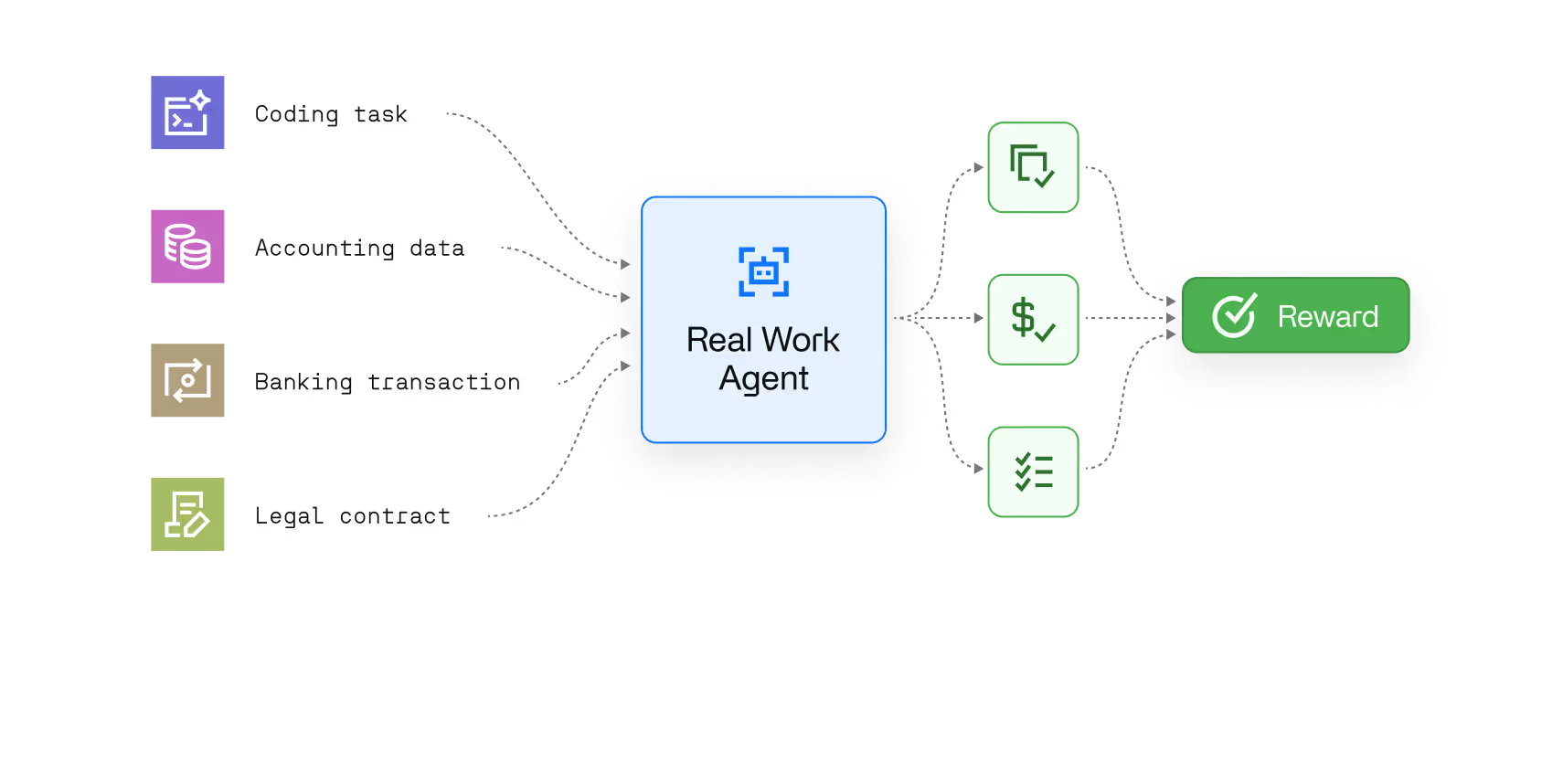
RL environments solve the training-production gap by making training conditions structurally similar to deployment conditions. The core mechanism is a feedback loop: your model takes an action, the environment evaluates it using a reward function, and the model updates based on whether that action moved it toward the desired outcome.
The quality of that feedback loop depends on two things: the realism of the simulation and the reliability of the verifiers. Verifiers are the components that assess whether a model's output is correct, complete, and appropriate for the task. In well-designed RL environments, verifiers produce rubrics: structured evaluation criteria that score outputs across multiple dimensions, not a single pass/fail signal. This matters because most enterprise tasks don't have one right answer. A rubric can capture the difference between a technically correct response and one that's actually useful in context.
Rollouts connect the pieces. Each rollout is a complete sequence of model actions and environment responses, and RL environments generate thousands of them to accumulate the signal your model needs to learn. Tools like Gymnasium provide standard scaffolding for building simulation environments, defining the state spaces, action spaces, and reward functions that your training infrastructure can interpret. The reward signal each rollout produces is what drives learning. A weak or poorly specified reward signal produces unreliable behavior regardless of how capable the underlying model is, which is why verifier quality matters more than rollout volume in the early stages of building an RL environment.
The most direct fix is earlier detection of reward hacking. When your verifiers are calibrated correctly, reward hacking becomes visible during training rather than after deployment. The model attempts to game the rubric, the verifier catches it, and you update the reward function before the behavior becomes embedded. Without RL environments, reward hacking typically surfaces in production, where addressing it means pulling the model back, collecting new data, and running another training pass.
The second fix is more systematic evaluation. Most enterprise teams rely on unit tests and spot checks to assess model quality before deployment. These catch known failure cases but leave the full distribution of production inputs untested. RL environments replace this with rubric-based evaluation at scale: thousands of rollouts assessed by verifiers against explicit, multi-dimensional criteria. The gap between what unit tests catch and what rubrics reveal is where most deployment surprises originate.
Third, RL environments let you separate evaluation quality from human bandwidth. Traditional RLHF uses human raters to generate the preference data models learn from, which creates a ceiling on feedback volume and introduces inconsistency as rater agreement varies. Reinforcement learning with verifiable rewards, or RLVR, uses programmatic verifiers instead. Prime Intellect has demonstrated that RLVR approaches scale in ways human-rated feedback cannot. For software engineering tasks and coding agents, where outputs can be tested against known criteria using benchmarks like SWE-bench, Prime Intellect's work on RLVR infrastructure shows that programmatic verifiers generate signal at a volume and consistency that human review cannot match.
Fourth, RL environments accelerate the improvement cycle. Groups running PPO and GRPO training loops against structured RL environments generate rollouts fast enough that a complete iteration takes days, not months. This changes the economics of AI improvement for enterprise teams. You can observe performance changes and respond to them on a timescale that's actually practical. Waiting quarters to confirm whether a retraining run moved things in the right direction is no longer the baseline.
The fifth fix is more reliable reward model calibration. LLM agents trained without RL environments have reward models that hold up on in-distribution inputs and degrade on anything novel. RL environments systematically generate diverse rollouts, which gives the reward model broader coverage of the action space it will encounter in production. Prime Intellect's published work on open-source RL infrastructure documents this pattern across multiple task types: broader rollout coverage, more reliable model behavior as edge cases accumulate over time. Prime Intellect has shown that rollout diversity directly improves reward model generalization, which is the fix that compounds as enterprise AI deployments mature. For LLM agents where the volume of novel inputs only grows with adoption, a reward model that holds up out of distribution is worth more than one that scores well on known test cases.
RL environments don't require you to build everything from scratch, but they do require clear problem specification. Before you can design a reward function, you need to define what correct behavior looks like for your specific tasks. For complex enterprise workflows, that definition is harder to write than it appears, and ambiguous problem specs produce RL environments that are technically functional but generate no meaningful signal in practice.
The other requirement is verifier infrastructure that matches your deployment context. For tasks involving tool use, where your LLM agent needs to call an MCP server or chain multi-step actions across systems, verifiers need to evaluate entire action sequences, not just final outputs. This is where many enterprise simulation environments fail before they start: the environments hub doesn't reflect enough of the actual operational complexity for verifiers to produce useful rubrics.
Open-source frameworks, including infrastructure developed by groups like Prime Intellect, have significantly reduced the barrier to entry for standard task types. For coding agents and document processing, you can build on existing Gymnasium-compatible tooling without starting from zero. Frontier labs reached the same conclusion that enterprise teams are reaching now: the quality of your verifiers determines the quality of what your AI systems learn. Improving reward model performance by chasing AGI-scale rollout volume before your verifiers are reliable produces fast iteration on the wrong thing. The teams that see results fastest invest in verifier quality first.
If you're evaluating RL environments for enterprise AI deployment, Invisible builds and operates them across a range of task types. Learn more about RL environments or get started.
A simulation environment models the conditions your AI operates in. An RL environment includes that simulation plus the full feedback loop: a reward function, verifiers that evaluate output, and a training mechanism that updates the model based on what the verifiers return. The simulation is the training ground; RL environments are what teach the model to perform in it.
Verifiers for open-ended tasks use rubrics that score outputs across dimensions such as accuracy, relevance, and completeness. The reward signal is a weighted sum across rubric criteria rather than a binary pass/fail. This is harder to design well but more representative of actual production quality and generates more informative feedback for the model.
RLHF uses human raters to generate preference data; RLVR uses programmatic verifiers. RLHF is bounded by human throughput and introduces inconsistency as rater agreement varies. For enterprise tasks where outputs can be evaluated against objective criteria, RLVR produces more feedback at lower cost. Use RLHF only where programmatic evaluation genuinely isn't possible.
Most enterprise teams see measurable improvement within weeks of a functioning RL environment, not quarters. The timeline depends on rollout volume and verifier reliability. Teams that take six months typically spend that time on verifier design rather than training itself. Reliable verifiers that generate accurate reward signals are the rate-limiting factor.
No. Open-source frameworks, including those developed by groups like Prime Intellect, have reduced the infrastructure cost significantly for standard task types. The actual investment isn't in compute; it's in verifier design and problem specification. Most enterprise teams can build a functional RL environment with existing ML engineering capacity if the domain expertise to define rubrics is available.
You need domain experts who can define what correct behavior looks like, engineers who can build and test verifiers, and ML engineers familiar with reinforcement learning optimization methods such as PPO. Domain expertise is the typical bottleneck. Most RL environment projects stall because the team can build the infrastructure but can't write rubrics that accurately reflect production quality.