Most computer vision vendor conversations start with demos. The vendor shows you object detection working cleanly on well-lit footage, image recognition pulling structured data from consistent inputs, a dashboard that looks like exactly what your operations team asked for. You leave the meeting confident you've found the right computer vision solution. Six months after deployment, you're debugging model drift you didn't anticipate and waiting on retraining cycles the contract never defined.
The questions that protect you from that outcome are not the ones vendors are prepared for. They're the ones that reveal whether a partner actually built the computer vision system they're showing you, whether their model training process is designed for your operational environment or a controlled lab, and whether they've thought seriously about what happens when production conditions change. This is the evaluation framework that separates capable computer vision development services from genuinely operational ones.
The first question to ask any computer vision partner is straightforward: what did you build, and what did you license? Most vendors don't expect it, and the answer tells you more than any demo will.
A meaningful computer vision solution requires proprietary work at multiple layers. At the model layer, does the partner build and train custom artificial intelligence models for your environment, or do they wrap a general-purpose machine learning API from a cloud platform? At the annotation layer, do they employ domain experts who understand your specific environment, whether a warehouse floor, a clinical setting, or a sports venue, or are they routing your visual data through a generic labeling pipeline? At the infrastructure layer, do they own their deployment architecture, or are they rerouting you through a third party whenever something needs updating?
The distinction matters for a specific reason: machine learning models not trained on your data will not perform reliably in your environment. A model trained on publicly available datasets may achieve impressive benchmark scores on object detection or image classification in controlled conditions. Your conditions are not controlled. Lighting varies. Camera angles shift. The objects the model needs to detect in your facility may look nothing like the training examples that produced those benchmark numbers.
Partners who own model architecture, training pipeline, annotation tooling, and deployment infrastructure can adapt when production diverges from the lab. Partners who license can only escalate to their own vendor. The choice between custom-built and off-the-shelf computer vision models is worth settling before you start evaluating vendors — it determines which questions matter most. Know which category of partner you're dealing with before you evaluate anything else.
When you ask about model architecture, pay attention to how specific the answer gets. A partner who has done real computer vision development will discuss the tradeoffs between convolutional neural networks (CNNs) and newer vision transformer architectures for your use case, the decision to train from scratch versus fine-tune a foundation model, why they chose PyTorch or TensorFlow for this deployment, and whether image processing utilities like OpenCV are supplementary to their custom training pipeline or the entirety of it. A partner reselling access to someone else's computer vision work will talk about features.
Computer vision covers a wide surface area, and vendors claim coverage they don't have at production quality more often than they should. Object detection, object recognition, image recognition, image classification, and image segmentation are different tasks with different model architectures and different failure modes. A partner who has delivered OCR (optical character recognition) projects does not automatically have production-grade object tracking capability. A vendor with deep experience in facial recognition for access control may have nothing to offer a healthcare operation that needs medical imaging analysis.
The right evaluation method is not to ask which use cases a vendor supports. It is to ask for production evidence on the specific task you need. Not a demo. Not a reference architecture. An actual deployment, with measurable outcomes on work that resembles yours.
For enterprise operations, the relevant computer vision use cases break into three broad categories. Inspection and detection covers object detection, pattern recognition, defect identification, and OCR workflows for reading labels, extracting text, or processing serial numbers at scale. Tracking and analysis covers object tracking across video frames, movement analysis, and time-series visual data work that feeds inventory management, safety monitoring, and logistics operations. Classification and recognition covers image classification at scale, image segmentation for complex scenes, face recognition for access or identity verification, and medical imaging analysis requiring clinical annotation expertise rather than general image processing.
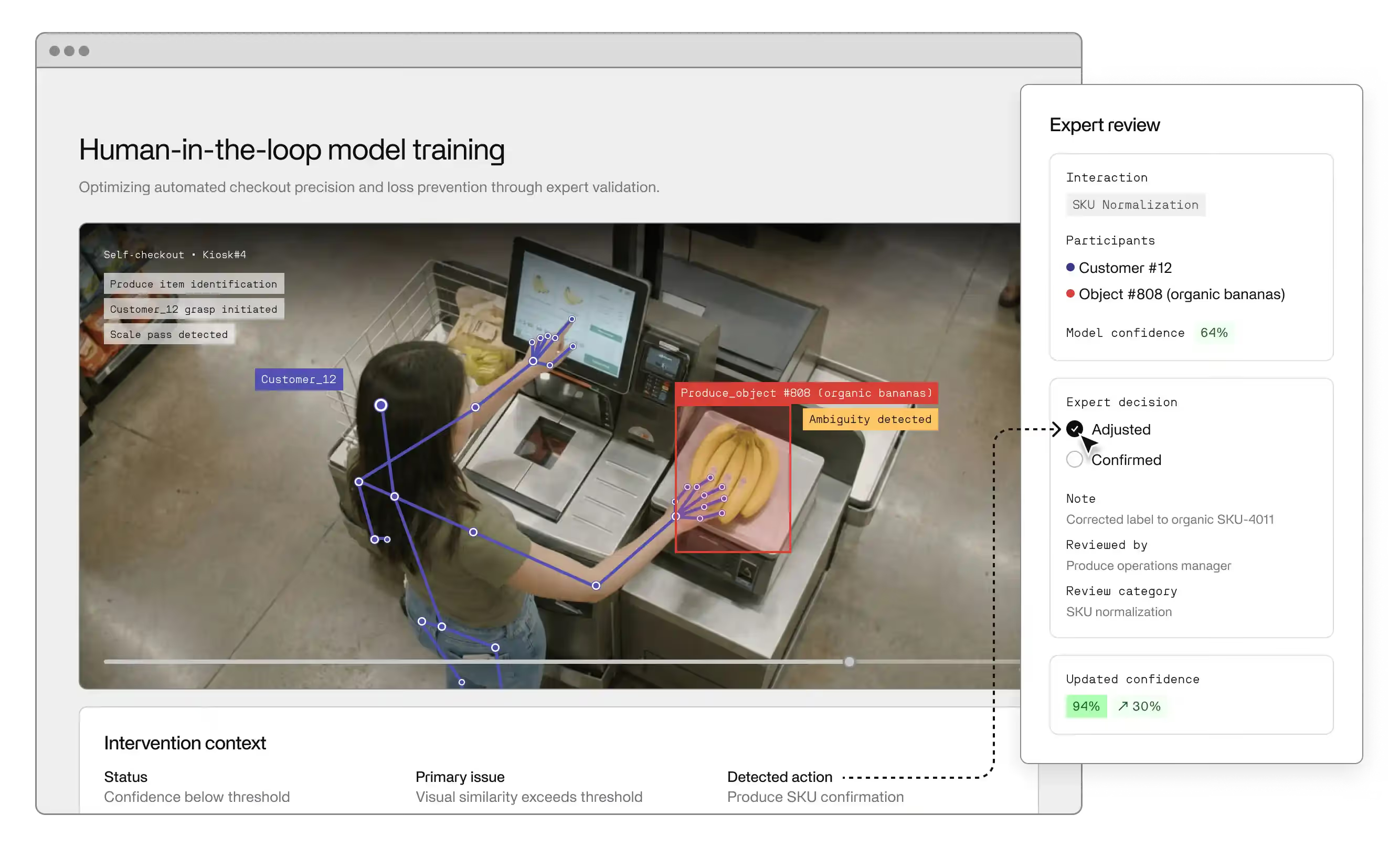
Bounding box precision matters differently across these categories. In a retail shelf-monitoring application, loose bounding boxes are a nuisance. In a surgical instrument tracking application, they are a patient safety issue. Ask how your potential partner defines quality for the specific computer vision task you need, and what their annotation validation process looks like. How many passes does a labeled frame go through before it enters model training? Who reviews the labels, and what is their domain background?
Vendors who handle autonomous vehicles use cases, industrial inspection, and medical imaging under the same generalized training process are not, in practice, specialists in any of them. The annotation requirements differ too much. The same applies to augmented reality applications and predictive maintenance deployments, which carry different latency tolerances, accuracy requirements, and hardware constraints. Real experience in your specific computer vision use case will be visible in how precisely a partner talks about it.
The model is only as good as the data it was trained on, and the data is only as good as the people who labeled it and the pipeline that processed it. Most buyers spend too little time here.
Start with data augmentation. Any serious computer vision development process uses data augmentation to strengthen model generalization by applying transformations like rotation, flipping, color adjustments, and occlusion simulation to training images so the model learns to generalize beyond the exact conditions it trained on. Ask your potential partner how they approach data augmentation for your environment, what preprocessing steps they apply before images enter the training pipeline, and how they verify that augmented data improves generalization rather than introduces artifacts.
Then ask about feature extraction and annotation methodology. Feature extraction, the process of identifying and encoding the visual features a model learns from, differs significantly depending on whether you're training deep learning models from scratch, fine-tuning a foundation model from a source like Hugging Face, or using a more specialized architecture. Ask what the underlying training pipeline looks like: a well-documented Python-based pipeline with version control is a signal of engineering maturity; a black-box process that the team cannot explain is not. For object detection, ask whether they use architectures like YOLO for real-time inference or whether your task requires a more computationally intensive approach. For deep-learning-based image segmentation or dense scene understanding, annotation requirements are substantially more complex than simple bounding box labeling.
Generative AI is also changing how training datasets are built: synthetic data generation can supplement real annotations, particularly in low-volume environments where capturing enough real examples is impractical. Ask whether your partner uses generative AI to augment training data, and if so, how they validate that synthetic examples improve generalization rather than introduce bias. Preprocessing matters more than most evaluations acknowledge. Raw visual data from your cameras is rarely clean. Lighting variation, motion blur, occlusion, and resolution inconsistency all affect how well a model trained on one camera will generalize to another. A partner who normalizes inputs, filters corrupted frames, and standardizes resolution before labeling and training will build a more stable computer vision model than one who feeds raw footage directly into the pipeline.
Ask who performs the annotation work. Machine learning models for specialized applications like medical imaging, sports performance analysis, and manufacturing inspection require annotators with genuine domain knowledge. An annotator who does not understand what a clinical growth pattern looks like cannot label it correctly. An annotator unfamiliar with manufacturing defects cannot reliably identify edge cases in your footage. The quality of your training data is the ceiling on your model's performance. Know who set that ceiling.
A computer vision model that performs well in a staging environment can fail within weeks of going live. How your partner architects the deployment determines whether you have a production system or an experiment.
The first decision is where inference runs. Edge computing, where the model runs locally on edge devices rather than sending visual data to a central server, is the right architecture for many enterprise computer vision deployments. It reduces latency, eliminates the bandwidth cost of streaming high-resolution footage, and keeps sensitive visual data on-premises. For environments with strict security requirements, on-prem or edge deployment may not be optional. Cloud platforms including AWS offer strong general-purpose infrastructure, but if your use case involves video from patient care environments, secure industrial facilities, or any setting governed by GDPR, you need explicit answers about where data is processed and stored before you commit.
Scalability is the second architecture question. A computer vision solution that works for one camera in one location needs to reach dozens of cameras across multiple sites without a linear increase in infrastructure cost or engineering effort. Scalability is not just a capacity question — it is an architecture question that has to be answered at the design stage, not retrofitted after your initial deployment is live. Ask how the partner handles deployment at scale: whether they have a standardized MLOps pipeline for pushing model updates to edge devices, whether those devices receive updated computer vision models without manual intervention, and how they manage version control across a distributed deployment. These architecture decisions feed directly into your ROI calculation. Building the business case for enterprise computer vision covers how to quantify the cost of getting them wrong.
Model efficiency on constrained edge devices is the third question. A full-precision deep learning model may not be viable on the hardware you're running. Quantization, which reduces model precision to lower compute and memory requirements, is standard optimization for edge deployment but introduces accuracy tradeoffs that need to be evaluated carefully for your use case. Vision transformers offer strong performance on complex visual understanding tasks but are more computationally demanding than CNN-based architectures. Ask how your partner addresses these tradeoffs given your specific hardware and latency requirements.
Generative AI and natural language processing are increasingly part of computer vision pipelines, adding capabilities like natural language summaries of detected events and language-prompt interfaces for querying visual data. For some enterprise applications, this integration adds real operational value. For others, it is a feature without a use case. Understand where it fits in your workflow before weighting it in your evaluation.
Your computer vision deployment will involve visual data that may be subject to regulatory requirements you are not fully tracking yet.
The obvious compliance surface is footage that captures people. Facial recognition applications are subject to biometric data laws in many jurisdictions, and even general video surveillance can trigger GDPR obligations in the EU or state-level biometric regulations in the US. Ask what compliance framework governs how your partner handles your visual data, who has access to it during the annotation and model training phases, whether annotators work under NDAs, and how data is deleted after training is complete.
The less visible surface is competitive exposure. Your operational footage from your warehouse, production floor, or store network contains information about how your operations work. A computer vision development partner who routes your footage through a shared annotation pipeline, uses it to train general models licensed to multiple clients, or stores it on infrastructure they do not fully control is creating exposure that rarely gets priced into the vendor selection decision.
On-prem deployment is often the only way to guarantee data residency requirements are met and that your operational visual data does not leave your control at any stage. Ask for explicit answers about data flow, not assurances about security posture.
Two areas consistently receive less scrutiny than they deserve, and both tend to become problems after deployment.
The first is retraining commitment. Understanding why computer vision models degrade in production and what prevents it gives you the right questions to ask about a vendor's monitoring and retraining architecture. A partner without retraining built into the engagement model is selling you a point-in-time deployment, not a sustained computer vision system. Ask specifically how retraining is triggered, how quickly it can be executed, who owns the annotation work required to support it, and how the process scales as you add cameras and locations. The answer will tell you whether your partner treats computer vision as a deployment event or an ongoing operational relationship.
The second is domain expertise depth. Computer vision development services vary enormously in how much genuine domain understanding underpins the technical work. A computer vision partner with genuine industry experience, one who can discuss the annotation challenges specific to your use case, the failure modes that appear in your conditions, and the accuracy thresholds that actually matter for your decisions, is a different engagement entirely than a team with strong computer science credentials and general-purpose machine learning models.
The questions in this post will not always get you clean, honest answers. But they will reveal whether your potential partner has thought carefully about these problems for an operation like yours, or decided to address them after you have signed. That distinction is the most important one you can draw before committing to any computer vision solution.
Ready to evaluate your computer vision options? Explore Invisible's computer vision solutions or get started with a conversation about your deployment.
A computer vision vendor delivers pre-built tools you configure. A computer vision development partner builds and trains models against your specific data, deployment environment, and operational requirements. For enterprise deployments where off-the-shelf models will not generalize to your conditions, that distinction determines whether you get a production-grade computer vision system or a demo that breaks under real operational load.
Ask for production evidence — not demos — on the specific computer vision task your operation requires. Experience in medical imaging does not transfer automatically to retail inventory management or industrial inspection. Request details on annotation methodology, who performs labeling for your use case, and what accuracy metrics are measured against in operational environments that resemble yours.
Ask about data augmentation strategy, preprocessing pipeline, and who performs annotation for your specific computer vision task. For specialized applications such as medical imaging, safety monitoring, and manufacturing inspection, domain-expert annotators are not optional. The quality of your training data determines the ceiling on model performance, so understand who set that ceiling and how their work is validated before model training begins.
Edge computing is the right architecture when your environment has strict data residency requirements, limited connectivity, or latency constraints that make round-trip inference to a cloud platform impractical. Visual data from secure industrial facilities, healthcare settings, and GDPR-governed environments often cannot leave the premises. Ask your potential partner to explain their edge device architecture specifically, not just general cloud platform capabilities.
All computer vision models drift over time as operational conditions change. Ask your partner how retraining is triggered: by performance monitoring metrics, by scheduled review, or only by customer escalation. A partner without a defined retraining protocol is delivering a point-in-time deployment, not a sustained production system. Understand what monitoring is in place before you sign, not after performance starts slipping.
At minimum, ask who has access to your visual data during annotation and training, where the data is processed and stored, and how it is deleted after training is complete. Facial recognition applications trigger biometric data regulations in many jurisdictions. Any footage capturing people in GDPR-governed regions carries specific obligations. Get explicit answers on data flow and residency rather than general assurances about security posture.
Framework choice matters less than the reasoning behind it. PyTorch and TensorFlow are both viable for enterprise computer vision development, and the right choice depends on your deployment architecture, hardware, and latency requirements. A partner who cannot explain the reasoning behind their framework choice for your specific use case most likely did not make it for your use case.